One of My Favorite Places: Sunny’s Bar

From the outside, Sunny’s Bar is the very picture of unassuming. A lonely building, identified with a yellow “BAR” sign, on a dark cobble-stone street at the very tip of Red Hook, a Brooklyn neighborhood cut off from the rest of the borough by the roar of the Brooklyn-Queens Expressway and the lack of any subway stations. Standing on the sidewalk in front of the bar, you can smell the salt in the air, hear the water of New York harbor lapping against the shore.
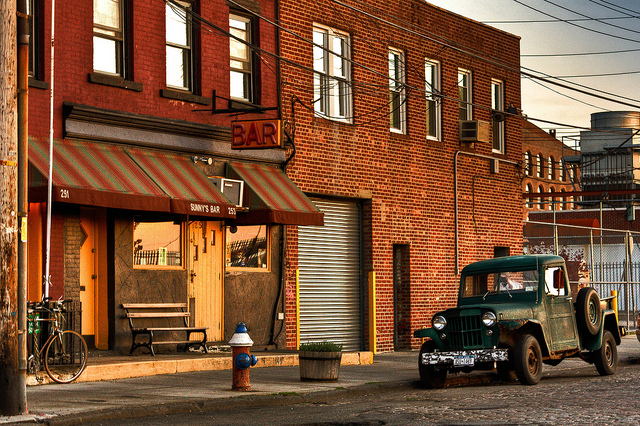
Ah, Sunny's

Ah, Sunny’s

Walk inside and you’ll feel, forgive the cliche, like you’ve stepped back in time. The wood floor is worn to the point of unfinished, the chipped walls burst with nautical kitsch–a model of a clipper ship, a neon anchor in the window–that befit a bar that was a hangout for longshoremen back when longshoremen still worked the docks in Brooklyn.

The customers are a mix of old neighborhood folks and the bearded, flannel-draped kids who have begun to encroach on Red Hook’s lofts. This isn’t your artisan cocktail bar: Drinks are simple, and wonderfully affordable: Four dollars for a bottle of Bud, three dollars for a can of Pabst Blue Ribbon, even on Saturday night, prices now unheard of in most parts of New York City.

As you move through the front room, you begin to hear the music. Step down into the back room, the walls back here hung with paintings from local artists, and on the small stage you’ll often find someone performing. Norah Jones’ guitar player, Smokey Hormel, has a regular gig on Wednesdays. But you don’t go to see Smokey. You go on Saturday night, to the jam. Starting around ten o’clock, bluegrass, country, fold, and old-time musicians file in. Guitars, banjos, mandolins, harmonicas, an upright bass, the piano against the wall, an autoharp, a pedal steel. You never know exactly what you’ll get, but you know the players will be fantastic. They’ll sing gospel tunes, the Carter Family, the Stanley Brothers, songs from O Brother Where Art Thou, twelve-bar-blues numbers, maybe a Dylan or a Neil Young cover. The audience, which packs the hallway out to the front room and the smoking patio outside and the seats along the wall, sits awestruck, applauds the songs, shouts requests, sings along, sometimes stomps their feet and dances, though they might get a curt, disapproving glance from one of the saltier musicians for loud outbursts (Saturday night is about the music, first and foremost). Outside of the price of their drinks, they don’t pay a dime for this show, where they see some of the best musicians in New York, many of them professionals–I’ve seen Steve Martin’s backup band, the Steep Canyon Rangers, show up and absolutely shred for a couple of hours.

A candid shot from the jam. Co-owner Tone Johansen is on the right; the guy with the mandolin is my uncle

A candid shot from the jam. Sunny’s co-owner Tone Johansen is on the right; the guy with the mandolin is my uncle

It would not be an exaggeration to say that Sunny’s changed my life. I first went there about four years ago, when I was in town from the Bay Area, visiting my uncle in Brooklyn. I’d been playing guitar for seven or eight years at that point, but had gone through a long plateau period in which I hadn’t improved, and had mostly quit practicing and dedicated my time to other things. My uncle took me to the jam, and I was instantly enchanted. This is what music was supposed to be: people playing together, feeding off one another, creating something greater than the sum of its parts, something that lifted your feet from the ground and your ass from the seat, something that made you feel like you could find some greater joy or meaning in life.

I wasn’t good enough to play in the jam at the time. But I was hooked. I went home and rededicated myself to practicing. A year later, I moved to New York. I still wasn’t good enough to play in the jam. But I kept practicing, and eventually I got the balls to head down to Sunny’s. I still wasn’t good enough, not really, but I sat and played and sang, and was made to feel welcome. I started spending more and more Saturdays at Sunny’s.

Life went off the rails for me for awhile, and I left New York. But I always felt the pull to return, and a year-and-a-half after leaving, I did so. When people ask me why I went back east, I usually say, “I missed New York.” What I mean when I say this is that I missed Sunny’s. I’m not the only one who loves this place. Just ask Anthony Bourdain, who visited for the final episode of No Reservations.

Now comes the sad part of this story: Sunny’s, being at the very tip of Red Hook, right next to the water, was devastated when Hurricane Sandy struck New York last fall. Tone Johansen, one of the bar’s owners, and the person most responsible for the continuing Saturday night jam, was sealing off the basement when the floodwater burst in, and narrowly escaped with her life. The basement flooded completely, and the barroom took on five feet of water, wreaking havoc on the hundred-year old establishment.

The bar was closed for months. A Kickstarter program started and quickly reached it’s $50,000 goal, which allowed the owners to replace fixtures and make a number of long-awaited updates. And they were able to reopen the rear half of the bar, so the Saturday night jam has returned, with those in the know entering through a side-door. But the front of the bar still needs massive repairs, including concrete work, and Sunny’s is embarking on a new fundraising campaign so that they can reopen the bar in full.

This fundraising drive begins on May 1, with a benefit show at the The Bell House, a cool concert venue in Brooklyn. If you live in New York and you care about things like awesome music, down-to-earth community, preserving a real slice of Brooklyn, and Justin still being able to go to pretty much the only place that makes him happy, you should come down. Tickets are available here, and at $30 are a small price to pay to help a few good people fight the good fight.

And next time you’ve got a free Saturday night, come down to Sunny’s. I’ll sing you a song, or get one of the good musicians to do it. And I’ll buy you as many three-dollar PBRs as you can drink.
Posted in Current Events, Music, Travel | Tagged , , , , , , , , , , , | 2 Comments

Movie Review: On the Road

This was adapted...

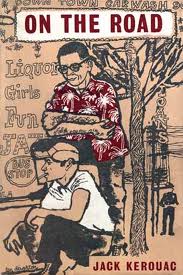
This was adapted…

... into this. Did it work?

… into this. Did it work?

I’ve always loved Jack Kerouac’s On the Road. Most of the reasons for this should be fairly obvious: I’m an aspiring writer (is there any other kind?); I’ve bounced back and forth between New York and San Francisco several times, as Kerouac does in the book; I love the youthful energy and spirit of the Beats, who attempted to cast off staid society’s expectations in search of new adventures and experiences; I’m a wandering restless soul; I’m a drunken fool.

I’m hardly the only one who the book has spoken to over the years. When it was published in 1957, it became a keystone for an entire generation. Kerouac and his Beat compatriots provided the foundation upon which the hippie counterculture of the ’60s was built. Not everyone loved it: James Baldwin accused Kerouac of being shallow and exploitative in his portrayal of African American life, and Truman Capote famously said of Kerouac’s spontaneous writing style, “That’s not writing, it’s typing.” (For what it’s worth, the whole notion of the spontaneity of the writing is somewhat exaggerated. Kerouac did tape pages together to form a scroll so he could type uninterrupted, and he did write the first draft of On the Road in three weeks. But, as the movie shows, the novel grew out of notebooks he’d been keeping for years beforehand.)

Almost from the moment it was published, fans have clamored for a film adaptation. Kerouac himself wanted to see it optioned, and asked Marlon Brando to buy the rights and star in the film. Brando passed, and the possibility of a film languished for years, even after Francis Ford Coppola obtained the rights and got Russell Banks to write a screenplay. But a couple of years ago, word came out that the film was finally entering production, and it would be directed by Walter Salles and written by Jose Rivera. The prospect of any On the Road adaptation would have gotten me fired up, but the writer/director team was particularly encouraging: These are the same guys that made Motorcycle Diaries, one of my favorite movies, which tells the story of a young Che Guevara taking a life-altering road trip through South America.

I stayed optimistic as casting updates came out. Sam Riley, who was fantastic as Ian Curtis in Control, was cast to play Kerouac (note, I’m going to use the names of the real people, as Kerouac did in the original scroll version, and not the pseudonyms that are used in the published novel and the movie version); Kristen Stewart and Kirsten Dunst were cast to play Neal Cassady’s wives; and Viggo Mortensen playing William Burroughs? I mean, could it get more awesome? I also thought the first trailer was encouraging–I got goosebumps when I heard the “mad ones” passage.

But then the news took a turn for the worse. The release date was pushed back. The reviews from the Cannes Film Festival were generally negative. The movie eventually came out around Christmas, except I couldn’t find it in a theater in San Francisco. Maybe it played for a week at the Castro or the Kabuki, but if it did I didn’t notice, and I was looking for it. For emphasis, let me repeat this: On the Road did not make it to screens in San Fran-fucking-cisco. So I missed it.

Of course, I recently moved to New York, and it happened that a few weeks ago I was walking up Second Avenue in the East Village, and I saw that On the Road was on a theater marquee. So, last week I went to a matinee showing (one of the perks of being unemployed), and I thought I’d share my thoughts on the adaptation. Here goes:

They tried. They really did. And frankly, I’m not sure, given that they didn’t really succeed, that On the Road is adaptable at all. There are a number of good things about the film. The cinematography is lovely, from the dark gray streets of New York to the open spaces of the west. I thought Dunst and Stewart were both pretty great. And they really nailed the Neal Cassady character, from the way he’s written to the performance by Garrett Hedlund. You could make an argument that the movie works if you look at it as being Cassady’s story: the very embodiment of Kerouac’s mad ones, Cassady inspires everyone around him, makes everyone, from Kerouac to Ginsberg to the women, fall in love with him, and ultimately let’s everyone down. (It’s to the film’s credit that it shows how damaging Cassady’s constant running off is to the women in his life; Kerouac glosses over this in the novel, and for this I think he’s ultimately as guilty of treating the women as disposable objects as Cassady is.) In  particular, they nailed the sad final scene of the book (it’s the penultimate scene in the film) when a shambling, disheveled Cassady surprises Kerouac on the streets of New York, only Kerouac leaves Cassady behind for a prior engagement.

But there are too many problems. First, while the mad ones speech gave me goosebumps when I saw it in the trailer, it felt shoehorned into the scene where it actually appeared in the film. They needed to include some of Kerouac’s prose in voice-over–that was not optional–but as is often the case, I didn’t think that it really worked. (I don’t have a suggestion for how it could have been done better; I thought this was a problem in The Thin Red Line as well, though I’m in the minority there.) And I admit I may be betraying some bias here, but very few scenes in the film take place in San Francisco, and I feel like that city is so crucial as a setting in the book–it almost feels like they cut an important character. Also, I’ve listened to a bunch of Kerouac audio recordings, and Sam Riley doesn’t sound like Kerouac. I know that’s even less fair than complaining about an actor not looking like the real life person he’s playing, but it was an issue for me.

The biggest problem is the movie lacks the energy, the driving force of the novel. It’s not for lack of trying. The characters are constantly getting in adventures, and saying how wild and crazy they feel, but for some reason I can’t articulate, it’s not infectious. When you read On the Road, the energy of the prose jumps off the page and grabs you by the shirt and picks you up off the couch and pushes you out the door and onto the next train out of town. That energy doesn’t make it off the screen, which is hugely problematic because the book lacks much in the way of narrative arc. You read the book for that energy, not for the plot. The film similarly lacks an arc–it starts with Kerouac meeting Cassady, and ends with him beginning to write the book, but you don’t feel like Kerouac’s character actually grew at all. Without the methamphetamine burst of Kerouac’s prose, the lack of plot and character development really stands out. This also contrasts with Salles’ and Rivera’s previous road narrative, Motorcycle Diaries, in which there is a well-defined arc–the way the road trip turns the young medical student Ernesto into the revolutionary leader Che. As readers, we know that the road changed Kerouac, and Kerouac in turn changed the world–much like Che. But the movie doesn’t make you feel that.

They tried. It didn’t work, but all the same, I’m glad they tried.

Posted in Books, Movies, Writing | Tagged , , , , , , , , , , , , , , , , | Leave a comment

Desert Island Albums #2: Heartbreaker

RyanAdamsHeartbreaker

The album cover:

A close-up shot of the 25-year old (again with the boy geniuses) Ryan Adams, who appears to be wasted (given that he was notorious for his drug and alcohol problems at the time, he’s probably not acting) and lying on a white tablecloth, lit cigarette between his lips, ashtray just beyond the smoke. The album was released on September 5, 2000, and was Adams’ first solo effort, coming on the heels of the dissolution of Whiskeytown, the band which Adams fronted and which has been referred to by some (along with Uncle Tupelo) as the Nirvana of alt-country. Said dissolution came, in large part, due to Adams’ substance abuse problems and his sometimes prickly personality.

The album title:

Adams has been quoted as saying that his manager called him on the phone and gave him fifteen seconds to come up with a title for the album. He happened to be looking at a poster of Mariah Carey wearing a t-shirt that said “Heartbreaker” and voila, he had an album title.

Really, Ryan, what were you doing when you were looking at this?

Really, Ryan, what were you doing when you were looking at this?

While I don’t doubt Adams’ story, the truth surely runs a bit deeper. The tone of the songs, as we’ll get into shortly, ranges from somber to downright suicidal. It’s a quintessential get-drunk-by-yourself breakup album, and much of it was supposedly inspired, according to this great profile piece, by Adams’ breakup with his then-girlfriend, a music industry publicist named (track four!) Amy. While Amy is the most likely source of the album title, the album also came out after Adams had failed at his first shot living in New York City. In this story he recalls driving away from the city and seeing the lights through the rear window, an experience that I can attest is quite a heartbreaker in its own right.

The first sound you hear:

A single strike on the muted strings of a guitar, followed by David Rawlings, the guitar virtuoso partner of Gillian Welch, both of whom appear on various songs throughout the album, saying, “Nah, Bona Drag.” The next thirty seconds records Adams and Rawlings arguing over, and eventually betting five bucks on, whether Morrissey’s solo debut single, Suedehead, is found on the album Viva Hate or the compilation Bona Drag. Rawlings doesn’t think it’s on Viva Hate, whereas Adams (correctly) contends it’s on both. (Although Adams is wrong in saying “It’s the sixth track on Viva Hate”; it’s number seven.)

I have two theories for why this is the album intro: a) Adams is a serious geek about all kinds of pop music (he recorded a death metal album a couple years back), and this is his way of introducing an album that’s an amalgam of folk, country, bluegrass, and rock, or b) he wanted to lord it over Rawlings that he was right. (Maybe Dave welched on the bet?)

The last sound you hear:

An echoing electric guitar grace note fading out at the end of Sweet Lil Gal (23rd/1st), that fits the song and the album so well: quiet, brooding, lovely, with a touch of menace.

Track by Track:

The intro leads into To Be Young (Is to Be Sad, Is to Be High), an up-tempo bar-room floor stomping rocker of a track featuring an electric lead guitar that rings bells like Johnny B. Goode. The song brings a youthful, life on the road exuberance to the album, almost like Adams is on his way up, just moving to the big city or just beginning a new relationship with a girl, at the same time acknowledging the sadness ahead with the refrain, “Oh one day when you’re looking back/You were young and man, you were sad.”

The next track is the lovely My Winding Wheel, featuring a slightly up tempo acoustic guitar backed with understated electric guitar and organ. The song seems to address a girlfriend, or at least a love interest, a girl he defies to “Buy a pretty dress/Wear it out tonight/For all the boys you think could outdo me.” The alternative is for her to stay with him and be his winding wheel (the part of a watch that keeps it ticking). If you didn’t get the metaphor, don’t feel bad: I had to look it up, and legend has it that the first time Adams met Bob Dylan, Dylan asked him, “What the fuck is a winding wheel?”

Winding Wheel descends into Amy, a finger-picked acoustic song with deeply depressing lyrics using burial imagery (“Oh, I love you, oh/When you laid me down into your beautiful garden/Flowers and the love in my arms/It’s God playing evil tricks on me”) before telling a lost love: “Oh, I love you, Amy/Do you still love me?”

The next track is the unparalleled Oh My Sweet Carolina. It’s the tale of a wanderer who finds himself lost in the big city, feeling homesick (Adams is from the small town of Jacksonville, North Carolina) and wondering where things went wrong. Lending gravitas, and a beautiful background vocal, to the song is country icon Emmylou Harris, who Adams met while doing a tribute for her former partner, Gram Parsons. Her presence on the album is an almost too perfect nod to Adams’ place as the modern day Parsons (both as country rock genius and self-destructive drug addict).

The next track is the threatening Bartering Lines. The song is ominous all the way through, from the dark acoustic guitar lick, to the banjo complement, to the opening verse: “Hold me up, hold me down/Leave me in the withering pines/Steal my love, steal my kisses/Take ‘em to the bartering lines,” which recalls the classic murder ballad Where Did You Sleep Last Night (which of course Nirvana covered. And the background vocal provided by Gillian Welch is haunting (won’t be the last time I use that word in this piece).

We go from a threat to a sob with the next song, Call Me on Your Way Back Home, which Adams has called a song “to slit your wrists” to. He’s not kidding. A fingerpicked acoustic backs Adams plaintively wondering, “Oh baby, why/Did I treat you like I did?” and telling another lost love, “I just wanna die without you/Honey, I ain’t nothing new.” The song fades out with a heartrending harmonica solo—for some reason, no instrument evokes pain like a harmonica.

Things perk up a bit with Damn, Sam (I Love a Woman That Rains). With lyrics like “As a man I ain’t never been much for sunny days,” it’s not exactly a happy tune, but it’s whimsical in its sadness. It’s hard to love a woman that rains, but we’ve all done it, and loved doing it, at least a little.

Next is perhaps Adams’s most well known song, Come Pick Me Up, about that bitch of a girlfriend who tears apart your life but you still can’t get enough of her. Bonus points for this song because Mary-Louise Parker, uh, loves it.

Adams takes it down a notch with the next two songs. To Be the One, a harmonica and acoustic number featuring an Icarus image (anyone who’s woken up lovelorn and hungover knows the feeling of flying too close to the sun with wings made of wax) and features one of my favorite lyrics on the album “I don’t know which is worse/To wake up and see the sun/Or to be the one/That’s gone?” The self-explanatorily titled Why Do They Leave? follows in a similar vein.

The paces ramps back up with Shakedown on 9th Street, a blustery electric number about a crew looking for a street fight, ending with Lucy (voiced in the background by Gillian Welch) catching “one in the chest.” It’s a fun, high-energy track, but it feels a little out of place surrounded by all these other mournful, quiet tunes.

The final three songs on the album descend slowly. Don’t Ask for the Water, another acoustic, almost spoken word piece that fits with To Be The One and Damn Sam, with lyrics like “Don’t ask her for the water/cause she’ll teach you to cry,” is followed by In My Time of Need, a fingerpicked acoustic number about the struggles and comforts of a rural southern marriage. The song might be a bit too self-consciously old-timey for some, but I don’t care: It’s beautiful, and the sentiment of lyrics like “I will comfort you, when my days are through/And I’ll let your smile just off and carry me” still feels genuine to me, even if it seemed corny when I typed it out just now.

The album closes with the aforementioned Sweet Lil Gal (23rd/1st), a song that I can only describe as haunting (I just used it twice!) and is mostly made up of echoing vocals, with a smattering of piano and the occasional electric guitar lick backing lyrics like “When I’m lonely, she makes me feel nice/Steals my shirt, makes me hurt.” It’s a song for the morning after you tied one on, still feeling fucked up about a girl you lost, wanting nothing more than to die but not knowing quite how to do it. A perfect closing track for the album.

The signature track:

The album is chock-full of great songs, and Come Pick Me Up is the most famous, but most hardcore Adams fans will tell you the signature is Oh My Sweet Carolina. If you listen to the recordings from Live After Deaf, Adams’ collection of live recordings from his 2011 European tour, it’s consistently the song that gets the loudest audience applause. Plus, it’s Nick Hornby’s favorite song. I mean, that guy wrote High Fidelity!

The signature lyric:

The signature lyric comes from the final verse of the signature song: “Up here in the city/Feels like things are closing in/Sunset’s just my light bulb burning out/I miss Kentucky, and I miss my family/All the sweetest winds they blow across the south.” Especially when Emmylou comes in on the “I miss Kentucky” line. Gorgeous.

The essence of the album:

This is probably the single album I’ve listened to the most in the last two or three years, a time that saw my musical taste shift somewhat, away from electric guitar driven hard rock and toward acoustic alt-country and folk. This happened at least in part because I think I’m starting to, as they say, feel my oats (I turned thirty during this period), but also because I started playing guitar in a bunch of folk- and bluegrass-oriented jams during this time. Adams is one of the few young (at least when he recorded this) contemporary artists that can fit in this tradition while also writing narrative songs that can hang with those of Bob Dylan (yeah, I said it) or Townes Van Zandt.

So, I love the spare style of the music, and the heartbroken (see what I did there?) lyrics perfectly fit the period of my life when this album went into heavy rotation, a time when I failed in my first shot at living in New York as an adult (obviously, like Adams, I came back) and also a time in which I broke up with a girl I’d been very much in love with and then saw her die from a chronic illness a few months later. Most of my favorite songs are sad ones, because when you’re sad, listening to a sad song makes you feel like you’re not alone in your pain (I think I stole this from David James Duncan, though damned if I remember where he wrote it). Heartbreaker certainly functions that way for me. It’s a truly great album, and a truly great desert island album.

Find all the Desert Island Albums here.

Posted in Desert Island Albums, Music | Tagged , , , , , , , , | 4 Comments

2013 NBA Playoff Preview

All right, taking a break from some of the heavier shit discussed earlier this week, let’s have some fun and look at this year’s NBA Playoffs.

Much as I write an annual MLB Preview to my buddy Matt, every April my buddy Josh and I write each other predictions for what’s going to happen in the NBA Playoffs. Basketball is, on the whole, a lot more predictable than baseball, so this isn’t quite the exercise in dart-throwing that an MLB preview is. In basketball (spoiler alert), the team with the best player usually wins. But this gives me a chance to talk about one of my favorite sporting events (even if you’re pretty sure of the outcome, the NBA playoffs are full of drama).

Before I get started, a note on my biases: As a kid in New York, I grew up watching the Patrick Ewing Knicks. And living in the Bay the last few years, I developed an affection for the Warriors–in particular since Steph Curry made the leap and became the best shooter in the history of the NBA this year. I root unabashedly for those two teams. Also, I hate the fucking Lakers with the fury of a thousand suns. On to the picks:

Eastern Conference

First Round:

Miami over Milwaukee 4-0. There might be one game that’s close, if Monta Ellis goes nuts. Maybe. Probably not.

New York over Boston 4-2. The Celtics will play the Knicks tough, but with all of the Celtics’ injuries, there’s a pretty big talent gap between the teams right now, and I see J.R. Smith and the Knicks giving the Celtics the pipe.

Indiana over Atlanta 4-2. No one cares about this series. Seriously, does anyone care about this series? Anyone? Bueller?

Brooklyn over Chicago 4-3. Look, I live in Brooklyn. In a basement, in case you haven’t heard. I love Brooklyn. Add to that: My buddy Matt is a huge Bulls fan, booster of all things Chicago, and hater of all things New York, and he and I love talking shit to each other. If Bulls-Knicks had happened, the comment thread on this post would have gotten ugly quick. But I can’t bring myself to care about this Nets team. The only thing that would have made this series compelling would have been Derrick Rose vs. Deron Williams. Get well soon, D-Rose; basketball fans miss you.

Second Round:

Miami over Brooklyn 4-0. Maybe the Nets win a game … but nah, probably not.

New York over Indiana 4-3. A nice, old-fashioned Eastern Conference Playoff war. Pacers are tough, but I think Game 7 at the Garden makes the difference for the Knicks.

Conference Final:

Miami over New York 4-2. The games will be competitive. I say the Knicks get one win because of the Garden crowd and one win because of a 45-point ‘Melo supernova … but Miami’s too strong.

Western Conference:

First Round:

OKC over Houston 4-0: Woohoo! The Lakers rallying to beat the Rockets on Wednesday night gave us our much hoped for OKC-Houston-James Harden-Revenge Series. Except the Rockets have looked bad the last couple of weeks, and Harden looks tired. Sadly, I think this series will fall short of expectations.

San Antonio over LA Lakers  4-1: I think the Spurs are the one team the Lakers have a legit shot at in the first round, because San Antonio can’t run them off the court the way OKC or Denver could. Well, except Tony Parker. He can run them off the court, and he will, because with no Nash and no Kobe, the Lakers have the worst backcourt in the NBA

Denver over Golden State 4-1: I really, really want to believe that the Dubs can test the Nuggets. But Denver has handled the GSWs fairly easily this year, the Dubs don’t have anyone who can check Lawson, and the Nuggets have a huge, huge homecourt advantage playing at altitude. As much as I’d like to see Steph Curry go nuclear, I think Iguodala will make life tough for him and Denver will win in five.

LA Clipper over Memphis 4-3. This is going to be a seven game war that goes down to the last posession of the final game. I really like Memphis and wouldn’t be surprised if they win, but I’ll take Chris Paul in the fourth quarter of an elimination game.

Second Round:

OKC over LA Clippers 4-1: I think the games will be closer than the five game result would indicate, but I like Durant to hit the big shots when it matters most.

San Antonio over Denver 4-2. I’d love to see Denver knock off the Spurs, but San Antonio has too much veteran smarts, and Tony Parker can neutralize Ty Lawson. A seven game series would not shock me, though.

Conference Finals:

OKC over San Antonio 4-2. The difference from last year is that the Thunder won’t have to rally from a 2-0 deficit.

NBA Finals:

Miami over OKC 4-2. Miami is better this year, and OKC, without Harden, is a little bit worse. I’m saying six games because of my respect for Durant, but LeBron James is the best player since Michael Jordan, and this is his time.

lebron-james-with-nba-title-trophyw420h316crop1

Posted in Basketball, Sports | Tagged , , , , , | 4 Comments

On the Boston Marathon bombing, Zero Dark Thirty, Social Media, and Life in the 21st Century

I’ve been fighting a horrible cold, one of those illnesses that stretches on for days without any sign of improvement. The last time I remember being this sick was the most recent time I had the flu, and that was more than two years ago. I was feeling bad enough on Monday morning that I typed into the Facebook status update bar that I felt like I was going to die at any moment. I ended up not posting the update, largely because I’m always monitoring myself to prevent over-sharing or being too melodramatic on social media.

Of course, Monday afternoon, someone set off two bombs at the finish line of the Boston Marathon, killing three people (so far), and badly wounding hundreds more. Made me feel pretty self-absorbed for bitching about my cold, even if I didn’t actually post the complaint.

There are all sorts of reactions to a tragedy like this. The first reaction is the initial shock most of us feel at the news. I definitely felt this, especially when I saw the initial videos of the explosions. The second reaction is to reach out to loved ones, an impulse I saw many people acting on immediately via social media. I don’t know anyone in Boston, so this wasn’t an issue for me, but as someone with friends and family in New York, I can look back to 9/11 and remember the feeling. The third reaction is to wonder, whodunnit? Was it a strike by some cell of Al Qaeda or some other international terrorist group? Or could it have been an instant of domestic terrorism a la the Timothy McVeigh Oklahoma City bombings?

Obviously, I hope they catch whoever did it. But in terms of what we do moving forward, I don’t think it matters that much.

It so happened that the night before the bombing, I watched Zero Dark Thirty. I thought it was an extremely well made movie, and that Jessica Chastain put on a great performance. But in some ways, I thought that the movie’s ad campaign, as being about the hunt for Osama bin Laden, was not 100 percent accurate. I mean, yes, that is what the movie is about. But really, more than anything else, it’s about one character’s obsessive drive to succeed at a task (in this case, the hunt for bin Laden) at all costs. Think about the last shot in the movie: It’s Chastain sitting by herself in the back of a C130, crying. She’s accomplished her mission, a mission she spent more than a decade working on with complete and utter singlemindedness. The shot, and the implication, echoes the famous school bus scene at the end of The Graduate, leaving the viewer asking the question: What does she do now?

And that’s the question we now ask of ourselves. Of course, Zero Dark Thirty became controversial because of the depictions of detainees being tortured, and the assertion that these “enhanced interrogations” contributed to the ultimate finding and killing of bin Laden. Now, studies have been done that indicate that interrogations involving torture do not lead to useful intelligence. I believe that. On the other hand, I think we’re kidding ourselves if we try to pretend that, in all those years, interrogators never got any information out of any of those “enhanced” sessions that helped in the hunt. Maybe it was info they would have gotten without torture, but either way, I think the odds are likely that, at some point, they got something they could use.

Does this mean I condone the use of torture? No. And let me clarify that, while I may be a bleeding heart liberal, I actually don’t give a fuck about due process for someone who tries to hijack a plane or blow up a bus. There are reasons that terrorism happens (and no, it’s not because “terrorists hate freedom”; it’s usually as a reaction to the United States’ and Western Europe’s imperialistic economic and military policies), but I don’t believe that there are justifications for terrorism. But ever since 9/11, we’ve been negotiating as a people with who we want to be, how we want to define ourselves, how far we’re willing to go to prevent terrorist attacks from happening. Is it worth it to (hypothetically) get the information that leads to the killing of bin Laden from a torture session if it also means you may have detained and abused a (hypothetically) innocent man at Gitmo for eleven years.

Terrorism is a fact of life in the twenty-first century. It was a fact of life in the twentieth and nineteenth centuries as well, but 9/11 removed the illusion of safety so many Americans lived with. So what do we do with that? Do we cancel the Boston Marathon next year? As I said earlier, I don’t have any close friends in Boston. I’ve only been there once as an adult, when I went to the AWP conference last month. But from what I’ve read, the Boston Marathon is a huge tradition there, one of the city’s defining festivals. On the other hand, I lived for years in San Francisco, which is home to Bay to Breakers, a race across the city that doubles as a rolling drunken costume party. I imagine a Bostonian’s feelings about the Marathon are similar to my feelings about B2B. I know that San Franciscans won’t think twice about donning their costumes (or going naked) on May 19 this year, and I know the people of Boston will line up to run next year as well.

This all may seem like a self-centered response to tragedy. And I think it’s important to address that notion, in particular with regard to social media. Social media can both broaden and narrow our perspectives. Twitter provided an outlet for people to share pictures, videos, and on the ground reporting from the site of Monday’s bombing. It also provided Justin Bieber an opportunity to be a self-absorbed twit when he visited the Anne Frank House (I’m shocked! Shocked!). I nearly posted a self-pitying status about my cold on Facebook on Monday. Facebook is also where most of my readers will find this essay, and it’s where many other readers will find many other essays that provide more thoughtful, intelligent, and comprehensive reactions to the tragedy than I am capable of.

The Boston Marathon bombing isn’t about me. I did not lose an eight-year old son. I did not lose a limb. The event that’s forever been altered isn’t particularly precious to me.

But the Boston Marathon bombing is about me, and about you. It’s about what we do next. To say that if we don’t do something, “the terrorists win” is comically cliche at this point, but you know what? If we don’t run Bay to Breakers, if we don’t run the Boston Marathon, if I don’t get on the subway today or you don’t cross the Golden Gate Bridge because you don’t think it’s safe, well, that means the terrorists, whoever they are, win.

Don’t let them win.

Posted in Current Events | Tagged , , , , , , , , , | 4 Comments

Desert Island Albums #1: Highway 61 Revisited

A brief introduction: I’m one of those people who likes lists. Greatest guitarists, best books, tastiest burritos, doesn’t matter what: If you can make a top 10 or 20 or 50 or 100 ranking of something, I will read your list. Also, one of my favorite debates to have with friends is the classic, “If you were stranded on a desert island and could only take ten albums (no Greatest Hits or Live albums) with you, what would they be?” I thought it’d be fun to post my Desert Island Albums on the blog, with a writeup summarizing the story of, and what I love about, each one. Today I’m kicking off the series with Bob Dylan’s Highway 61 Revisited.

Bob_Dylan_-_Highway_61_Revisited

The album cover:

A 24-year old (and seriously, it kills me to type that—24!?!) Dylan sits slightly off-center, wearing an indescribably awful patterned shirt over a Triumph Motorcycles t-shirt (an interesting choice, given that less than a year later Dylan famously–possibly apocryphally?–crashed his Triumph motorcycle in upstate New York, which resulted in his ceasing touring for many years). Over his shoulder we see a man from the waist down, standing and holding a camera, most likely an allusion to the intense media scrutiny Dylan experienced at that time (this was not too long after after Dylan caught fire from the folk community for switching to electric instruments, and it was also a period during which, as you can see in Martin Scorsese’s documentary No Direction Home, he got so sick of journalists that he began making up absurd answers to reporters’ question). On the album, Dylan’s weariness with the media comes through in particular on Ballad of a Thin Man.

The album title:

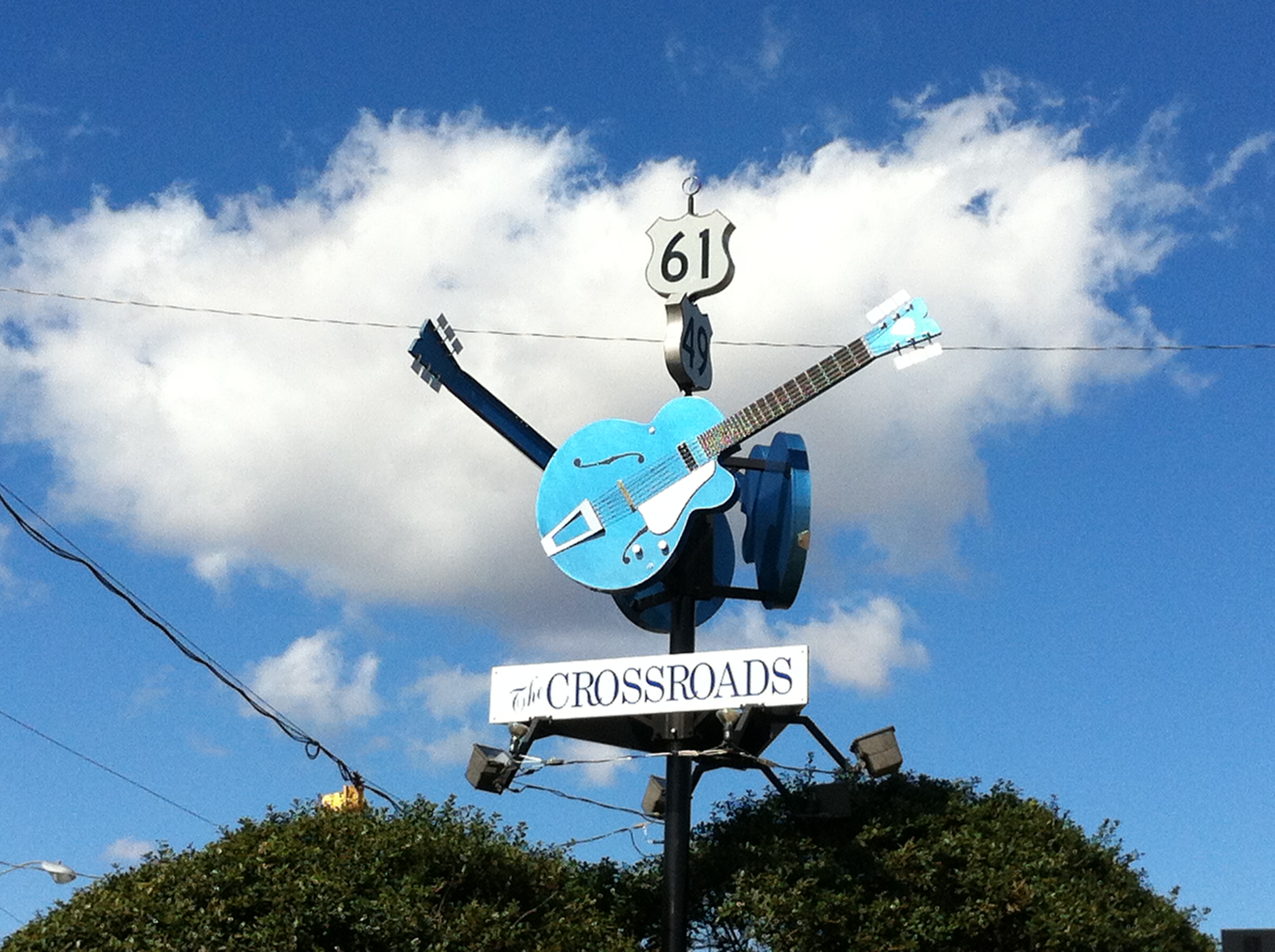
The title refers to U.S. Route 61, which travels along the Mississippi River from New Orleans to Dylan’s home state of Minnesota. The road was used by many Mississippi Delta residents who moved north to St. Louis and the Twin Cities, bringing with them blues music, and Highway 61 became known as the “Blues Highway.” The crossroads where blues pioneer Robert Johnson claimed to have sold his soul to the devil in exchange for his guitar playing skills is on Highway 61, and legendary singer Bessie Smith died in a car accident on the same stretch of road.

Satan never showed

I went there. Just saying.

Dylan “revisits” the blues highway by collecting a band that sounds very much like a bar-room electric blues band. Many of the tracks, including Tombstone Blues, It Takes a Lot to Laugh, It Takes a Train to Cry, From a Buick 6, and Just Like Tom Thumb’s Blues are structured as blues numbers (although Dylan doesn’t resort to the 12-Bar call-and-response style with his lyrics), featuring electric guitar, piano, and of course, harmonica. Dylan uses the blues band as a canvas on which to paint his complexly poetic and sometimes psychedelic lyrics.

The first sound you hear:

A single strike of the snare drum a beat before the rest of the band fires into Like a Rolling Stone.

The last sound you hear:

Dylan’s harmonica solo at the end of Desolation Row fading out at the same moment the final acoustic guitar note is struck.

Track by Track:

The album of course leads with the iconic Like a Rolling Stone. It follows this six-minute epic of social upheaval with Tombstone Blues, a rollicking up-tempo blues full of semi-apocalyptic biblical imagery which closes with Dylan telling the listener (presumably the college kids who adopted him as the voice of their generation) that he doesn’t have the answers: “Now I wish I could write you a melody so plain/That could hold you dear lady from going insane/That could ease you and cool you and cease the pain/Of your useless and pointless knowledge.”

The album continues with a couple of blues numbers, one slow and dreamy (It Takes a lot to Laugh, It Takes a Train to Cry), one fast and nightmarish (From a Buick 6). Side One, in record speak, ends with Ballad of a Thin Man, Dylan’s sneering takedown of the music journalists who spent years flinging stupid and repetitive questions at him. This is the track that sends the album veering into “Angry Dylan” territory. (Further evidence: In Seize the Time, Bobby Seale recounts how Huey Newton, the founder of the Black Panther Party, was a fan of Ballad of a Thin Man.)

Side Two begins with a change of tone, the lovely Queen Jane Approximately, with its layering of organ and electric guitar, a song that lyrically seems to be extending an olive branch of solace for the abandoned, resented, sick of repetition Queen Jane. (I’m not sure who Queen Jane represents. Maybe Edie Sedgwick? Maybe some other girl? Maybe it’s Dylan speaking reflexively to himself in the voice of his fans and followers?)

He follows Queen Jane with the title track, a psychedelic tune with a rolling rhythm and unmistakable slide guitar lick punctuating every line and lyrics that recall the Bible (“God said to Abraham, kill me a son”) to Shakespeare (“Now the fifth daughter on the twelfth night”).

The next track, my personal favorite on the album, Just Like Tom Thumb’s Blues, is another semi-psychedelic tune, set mostly in a whorehouse in Juarez, Mexico. The lyrics describe Dylan’s growing disillusion with the whores, drugs, and cops that have taken control of his narrative (and perhaps his real life).

The album closes with a classic epic, Desolation Row, an 11-minute 21-second acoustic song so packed with literary allusion too daunting to unpack in the short format I’m working with here. This is a key “Angry Dylan” number, summed up in the final lyric of the album: “Right now, I don’t feel so good/Don’t send me no more letters, no/ Not unless you mail them from/Desolation Row.”

The signature track:

Considering how entrenched the words “Rolling Stone” are in rock music, it’d be hard to argue that the signature track is anything other than Like a Rolling Stone.

The signature lyric:

Every line on this album would be a signature lyric for the average songwriter. For most listeners, the line that stands out is the refrain of Like a Rolling Stone: “How does it feel/To be on your own/With no direction home/A complete unknown/Like a Rolling Stone. (A college history professor of mine once sang those lyrics during a lecture in front of a 500-seat auditorium).

But my favorite line? The final verse of Just Like Tom Thumb’s Blue’s: “I started out on burgundy but soon hit the harder stuff/Everybody said they’d stand behind me when the game got rough/But the joke was on me, there was nobody even there to bluff/I’m going back to New York City, I do believe I’ve had enough.” As a New Yorker who’s spent much of his life living elsewhere, those lyrics have taken on a self-defining quality for me.

The essence of the album:

This is “Angry Dylan” (as opposed to the “Sad Dylan” of Blood on the Tracks or the “On a Shitload of Drugs” Dylan of Blonde on Blonde) at his absolute songwriting peak. The lyrics are elusive and allusive, painting a picture of the world as seen through the eyes of a 24-year old genius who had already spent years being bombarded with public criticism. And those lyrics are backed with some of the best electric blues instrumental work you’ll hear anywhere.

In this project, I’m counting down my “Desert Island Albums,” the few records that I’d be allowed to take with me to a grim, eternal exile. This album was released on August 30, 1965, more than 15 years before I was born, and in spite of that fact, it is THE Desert Island Album. If I could only listen to one more record for the rest of my life, Highway 61 Revisited would be it.

Posted in Desert Island Albums, Music | Tagged , , , , | 17 Comments

The Greatest Moment of My Baseball Career

As I said in my 2013 MLB Preview, I have a deep and abiding love for the game of baseball, but the sad reality is that I was never much of an athlete, nor much good at the game. I taught myself to pitch through hours of obsessively throwing a ball against the side of my parents’ house, and to this day I can still get pretty good movement on a sinker or a cutter, but I could never blow up a radar gun like Rick “Wild Thing” Vaughn. I was a pudgy kid, and in the early days I got stuck at catcher when I wasn’t pitching. I did learn the nuances of the position, but the day my coach found another kid to catch was one of the happier days of little league for me. (Don’t judge me until you take a foul-tip off the collarbone.) I ended up playing a fair amount at second and third base, and while I became passable at the positions, I was never anything special. And I could never hit much.

Which is all to say that even though I loved the game, my baseball career petered out sometime in middle school. I wasn’t that sad about it. I found other games to play, and I still attended dozens of Oakland A’s and San Francisco Giants games every year. In college—I was much skinnier by now, though sadly not all that much taller than I’d been in middle school (We’re talking five-foot-nine and a buck-forty, soaking wet)—I played intramural softball, and I eventually became a baseball beat writer for my school’s daily paper. It was a pretty sweet gig. The games were always during the day, and I went to school at UC Santa Barbara, where the weather is basically always perfect, and I’d sit in the stands (or occasionally chill back behind the outfield fence where I could drink beer), watch a ballgame, and afterwards conduct a couple of short interviews, dash off a quick game recap, and go to the beach.

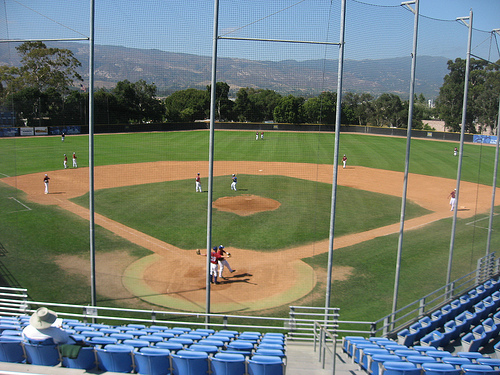
The site of my moment of glory: Caesar Uyesaka Stadium

The site of my moment of glory: Caesar Uyesaka Stadium

During every home game, the UCSB athletic department ran a number of giveaways, contests, and raffles. One of these was a challenge to see if one lucky contestant, picked at random based on the number of his or her ticket, could hit a home run off of a tee placed in the outfield grass just beyond the infield dirt, roughly in line with where the shortstop would take his position. This doesn’t sound hard, but I’d say less than a third of the people I saw attempt it actually succeeded (if you went yard, you won a gift certificate to Outback Steakhouse). Some of the failed swings were as amusing for the crowd as I’m sure they were traumatic for the batters.

Anyway, during one game during my final semester working for the paper, I was sitting near an older couple, I’d say in their fifties, and the woman was holding the ticket number that the stadium announcer called. Oh no, she cried, and looked frantically around her. I was the nearest young guy, and she handed me the ticket. Here. You do it.

I looked up at the announcer’s booth, held up the ticket questioningly. He laughed and introduced me: Today’s contestant, The Daily Nexus. I walked down to the field, where a pretty girl who was some kind of athletic department assistant had set up the tee. She handed me the bat, wished me luck. I took a practice swing, then stepped up to the tee, measuring the proper distance to get the barrel of the bat to the ball.

You might think I was nervous from all the people watching me take the swing—I think that’s why a lot of people whiff so badly—but I was actually calm, perhaps if only because I felt a bit out-of-body. I took a breath, got in my crouched batting stance, measured the stroke one more time, and swung.

Like I said, I was never much of a hitter, even back in little league. But anyone who ever played baseball knows the feeling of good contact, when the bat makes the right sound, when you feel hardly any vibration in your hands, when every bit of force is channeled through the sweet spot of the bat and into the ball.

The ball soared off the tee and over the left-centerfield fence, a perfect arcing bomb of a home run that crashed high into the trees outside Caesar Uyesaka Stadium. I doubt it would have cleared the fence if the tee had been set up at home plate (remember, I weighed 140 pounds), but the girl who set up the tee told me it was the farthest she’d ever seen a contestant hit a ball. The crowd applauded, I got my gift certificate, and as I walked past the home dugout, several of the players called out, nice swing. I told the team, Look out boys, I’m walking on next year.

I returned to my seat in the stands, all smiles, and I offered the woman with the winning ticket the gift certificate. I mean, I’d gotten the hit, but it had been her ticket. She shook her head and said, Oh no, you take it. You look like you could use a good meal.

Sigh. Even in the greatest moment of my baseball career, I still got punked.

Posted in Baseball, Humor, Sports | Tagged , , , , , , , , | Leave a comment

Anatomy of a Song: Shadowlands by Ryan Adams

MUDD31

Love is Hell

Seeing as how this blog is pretty new, I’m still working through which of my interests I’m going to write about (though I’m leaning towards: “All of them”), and how I’m going to approach each one. As those who read my Epic Road Trip Recap know, I am a complete and utter fool for music. I chose my road trip route based on being able to visit cities that are important to America’s music history. Hell, the biggest reason I moved back to New York is because it has a better music scene–specifically the Saturday night jam at Sunny’s, where you can find me playing guitar almost every week. So, there are going to be a lot of posts about music on this blog.

One idea I had is that I can take a look at particular songs that I really like and break them down, give a sort of anatomy of a song. Lately I’ve been listening fairly obsessively to the Ryan Adams album Love is Hell (yeah, I’ve had a bit of a rough month). There are a number of songs on this album worth dissecting, including the cover of Oasis’ Wonderwall, which Noel Gallagher said he prefers to his own arrangement, and the heartbreaking English Girls Approximately (my favorite track on the album, and I pretty much guarantee you’re getting an essay about it at some point), but the song that I’m most fascinated with at the moment is the seventh track on the album, Shadowlands.

Before you read any further, give the song a listen.

Did you like it? Okay. We can still be friends.

You thought it sucked? Well, there’s still hope for you. Let me break down exactly why I think this song is great. Listen again, and this time I’ll walk you through it.

For the first 2:44, the song is entirely piano and vocals, which Adams has done on tracks on other albums, like Heartbreaker’s Sweet Lil’ Gal, or Gold’s Sylvia Plath. This one is even more simple than those–really, it’s about as simple as a song can get, at least at first. Adams strikes the same three chords, over and over, slowly, staying for one beat on the I chord, one beat on the V Chord, four beats on the IV chord (don’t worry, I won’t get anymore technical than that). He doesn’t play any arpeggios or melody lines, just those three chords, bum, bum, bummmm, and there are no other instruments other than a couple of atmospheric, barely audible guitar notes at 1:30.

While he plays those three chords, Adams sings one of his typically bleak songs, with lyrics about prayers for rain, fathers on amphetamines, wedding rings tossed in sewers. I’m not going to break down the lyrics, because in my opinion they’re more impressionistic, about creating a mood (the color of this song is definitely blue) than they are about creating a narrative. The interesting thing is the song resolves lyrically at the end, as you don’t encounter the title until the final verse:

Most people never find a love
Sometimes you just can be a man
When you’re living in the darkness
Of the Shadowlands
The Shadowlands

He repeats the final line, and at the 2:44 mark the lyrics are over. But the song is just beginning. Because this is when Adams starts adding layers. As soon as the last word is out of the singer’s mouth, an arrangement of strings takes over, playing a melodic line. For two measures it’s the piano and the strings, and then at 2:56 an acoustic guitar comes in, playing rhythm along with the piano, at first strumming each chord once, but gradually diversifying the strum, filling in the blank spaces left by the piano’s individual chord strikes. At the same time, you hear the same atmospheric electric guitar as played at 1:30, but louder now, the fills more noticeable. All of these elements play together for four measures, until, at 3:21, the drums come in. I don’t know enough about drumming to give you a technical breakdown of the drum track–though it seems pretty simple–but I can  say the drums bring an element of power to the whole thing; the tempo of the song is still slow, but those drums are driving the other instruments forward now.

It’s already a lovely, complex arrangement at this point, but much as the lyrics waited until the end to resolve, the music is still building up to this point, when just barely shy of the end of three full measures from the entry of the drums, the lead electric guitar comes sliding in. The solo isn’t hyper complicated–a scream from outer space like a Hendrix solo, or a religious blues experience like an SRV solo–but it’s perfect for this song, slow yet soaring, with bent notes and the perfect amount of vibrato at the end of each phrase leaving you yearning for more. Just ask B.B. King: the bends and the vibrato are the soul of guitar playing.

The guitar solo goes on for more than 1:40 (the other instruments rising and falling in the mix, but always present), all the way through the fadeout at the end of the song, and every time I listen to it, I find myself rewinding to 3:36 so I can listen to that guitar again.

And that’s Shadowlands, the song I’ve been listening to on a loop for weeks now. It’s a depressing, miserable song that’s so beautiful it makes being depressed and miserable worth it. Well, almost.

Thoughts? Have I changed your opinion on this song at all? Was this a fun post to read?

Posted in Anatomy of a Song, Music | Tagged , , | 10 Comments

My Writing Sample for The Onion

Last week, a friend e-mailed me a link to the news that The Onion A.V. Club was looking to hire contributing writers. All they asked was for interested candidates to write a sample story and send it in. I figured, What the hell? Why not? Then I procrastinated for a week before throwing something together an hour before samples were due. I’m sure I won’t get a call-back, but I had fun writing this, so rather than just let it die in The Onion‘s slush pile, I figured I’d post it here for y’all’s reading pleasure. As you’ll see, I went kind of meta with the whole thing. Enjoy!

Onion Search for Contributors Leads to Much Hand-Wringing, Few Actual Applicants

By Justin Goldman

Underemployed humor writers across America were sent into extended paroxysms of hope last week, when The Onion’s A.V. Club announced it would be looking for contributors.

The consequences of the announcement were devastating. Internet connections slowed to a glacial pace in Brooklyn, San Francisco, Portland, and parts of Chicago and Los Angeles, as underemployed writers and comedians logged on to their neighbors’ un-password protected networks to send in their faux news stories.

“Goddammit,” said James Hertzfeldt of Silverlake, Los Angeles. “I wish the guy in 4B would get a better router already. Cheap bastard.”

Baristas across America found themselves overwhelmed, as self-described writers went back to the counter for second rounds of double and triple espressos, “fuel” for writing the sample stories that would get them their long pined-for, high-prestige, low-wage positions.

“I mean, sure, it hardly pays anything, and I still won’t be able to make my rent next month,” said Jerry Caldwell of Bushwick, Brooklyn. “But how awesome would it be to tell people at parties that I write for The Onion?”

The announcement was devastating for bars and pubs in the “hip” neighborhoods of America’s major cities, as the usual Saturday morning and early afternoon patrons streamed back to their closet-sized apartments to dash off witty takes on current events.

“This is it,” cried Carlos Alvarado as he stumbled, already three Bloody Marys deep, from the patio of Zeitgeist, a popular bar in San Francisco’s Mission District. “I hope I can find my laptop.”

The frenzy of typing and e-mailing continued unabated until Sunday evening, when hopeful writers took a collective break to go to the houses of their employed, cable subscriber friends to watch the season premiere of Game of Thrones. Though the submission deadline was set for Tuesday, as of Monday evening, the wave of productivity appeared to have slackened, and editors at The Onion expressed surprise at the paucity of applications they had received.

“I really don’t get it,” said Managing Editor Sarah Sanderson. “This is a great opportunity. And we gave people plenty of time to get their applications in.”

“What?” said Steve Grisman of Wicker Park, Chicago, when asked if he’d finished his application. “Eh, fuck it. Nobody’s gonna get that shit anyway.” He passed a joint to a friend of his who introduced himself as “Fraggle.”

“Did you see Thrones last night?” Fraggle said. “Dragons are sick, yo.”

Posted in Humor, Writing | Tagged , | 1 Comment

Gone to Look for America: An Epic Road Trip (Part 8)

Previous Posts: Part 1 Part 2 Part 3 Part 4 Part 5 Part 6 Part 7

Day 15: Whiskeylandia

I got up early on Tuesday, needing to get to Frankfort, Kentucky by 2 p.m., a three-and-a-half hour drive that also included an hour I’d lose crossing time zones. Why did I need to get to Frankfort by two p.m.? To visit the Buffalo Trace Distillery, the oldest continuously operating maker of bourbon in the United States. I’ll allow Lionel Hutz to explain my feelings on the subject of bourbon.

I drove real fast and reached the distillery just after one and stepped out of my car to the overpowering smell of fermenting malted grain. If you’ve ever done a brewery tour, you know how strangely heavenly that smell is. I’d narrowly missed the standard tour, but I got to take a behind-the scenes tour that took me back to stare into the 93,000 gallon fermenting tanks and walked me through the distillation process.

93,000 gallons. It was pretty hard to resist the urge to jump in.

93,000 gallons. It was pretty hard to resist the urge to jump in.

I then got to do a small whiskey-tasting, trying Buffalo Trace’s eponymous whiskey and it’s higher grade brand, Eagle Rare 10-year. This is the time that I explain that Buffalo Trace is where they bottle Pappy Van Winkle, the greatest alcohol I’ve ever had in my life. Pappy is incredibly expensive (I paid $35 for a shot of the 15-year old, only the third longest-aged vintage, at a bar in Santa Monica a couple of months ago) and impossible to find (I’ve never seen it in a liquor store, although my dad found a couple of bottles in Europe last year, and my tour guide said he hadn’t seen a bottle of it in a year-and-a-half. Wright Thompson explains more about Pappy here.) I had been hoping to buy as much Pappy as I was legally allowed, but with this plan thwarted, I bought a bottle of the Eagle Rare, which, in case you’re curious, is widely available and at $30-35 is affordable and really, really good. I also carried a new hope with me: My tour guide told me that 12-year old W.L. Weller is made with the same recipe as Pappy, and he said he thinks it tastes better. Clearly I needed to find a bottle.

From the distillery I drove to my motel in Lexington. People make fun of Los Angeles for being a giant sprawling strip mall, and while there is some truth to this, at least L.A. has some interesting neighborhoods and some attractions. Lexington actually is just a big, sprawling strip mall, with parking lots that for some reason are all very difficult to get out of (I should note that the countryside in Kentucky is really quite lovely, and I’m sure this is even more true when it’s not, you know, winter). It was getting to be dinner time, and I had a debate with myself: I had for the most part avoided fast food and chain restaurants on the trip, wanting to eat locally and regionally distinctive food as much as possible. But there’s a certain dishonesty to that, because if you really want to have the true American experience, especially in a town that’s basically a repeating strip mall, shouldn’t you eat some chain food too? I mean, I’d driven through the south without stopping at a Waffle House. I was having this debate because I was tired, I’d gone to a Liquor Barn (Kentucky’s version of BevMo) that didn’t have the 12-year old Weller, and right next door to the Liquor Barn there was a Chick-Fil-A. Now, I’ve heard Chick-Fil-A is tasty, but I’ve never had it, and part of me was tempted to just dome a chicken sandwich and go back to my motel and pass out. But I decided I wanted to eat something particular to Lexington (also bearing in mind the whole “Chick-Fil-A hates gay people” thing), so I went to Gumbo Ya-Ya, a Cajun place near the UK campus. The food was cheap, but kinda meh. Afterwards I went to the Horse and Barrel, the best whiskey bar in Lexington.

That's all whiskey.

That’s all whiskey.

My bartender there was a friendly and just horribly cute senior from UK, who I chatted with for a couple of hours while I had a couple of bourbons. They had the 12-year old Weller, about which the bartender gave me the same spiel that the Buffalo Trace tour guide had. Let me tell you, it is not even in the same GALAXY as Pappy. My bartender did make good by recommending I try the Double Oaked Woodford Reserve, which was sublime.

Day 16: A Friend! That I Actually Know and Stuff!

I thought about hitting another distillery the following morning before blowing town, but my stomach was pretty cranky (it was clearly too close to Mardi Gras for me to be adding bourbon to the mix again), and I felt like I needed to keep the train moving east. So I hit the road, driving through the mountains of Kentucky and West Virginia, in the mid-afternoon seeing the pale near-full moon against the clear blue sky so close I thought I could reach and touch it, to Harrisonburg, Virginia, where a friend of mine from Grad School, Indigo, lives. We went to dinner, where despite my stated goal to not eat fried food, she talked me into having fried catfish (it was very good), and I talked her into drinking a bottle of wine. We then went out to a bar where we had a beer and she talked me into eating a fried Oreo cookie. (She didn’t really have to twist my arm on that one—I was pretty curious anyway. If you’re wondering, it’s a big ball of sweet fried dough with powdered sugar sprinkled on top and an Oreo lost somewhere inside. Not bad. Afterwards I reiterated my vow, which I’ve since broken repeatedly, to never eat fried food again.)

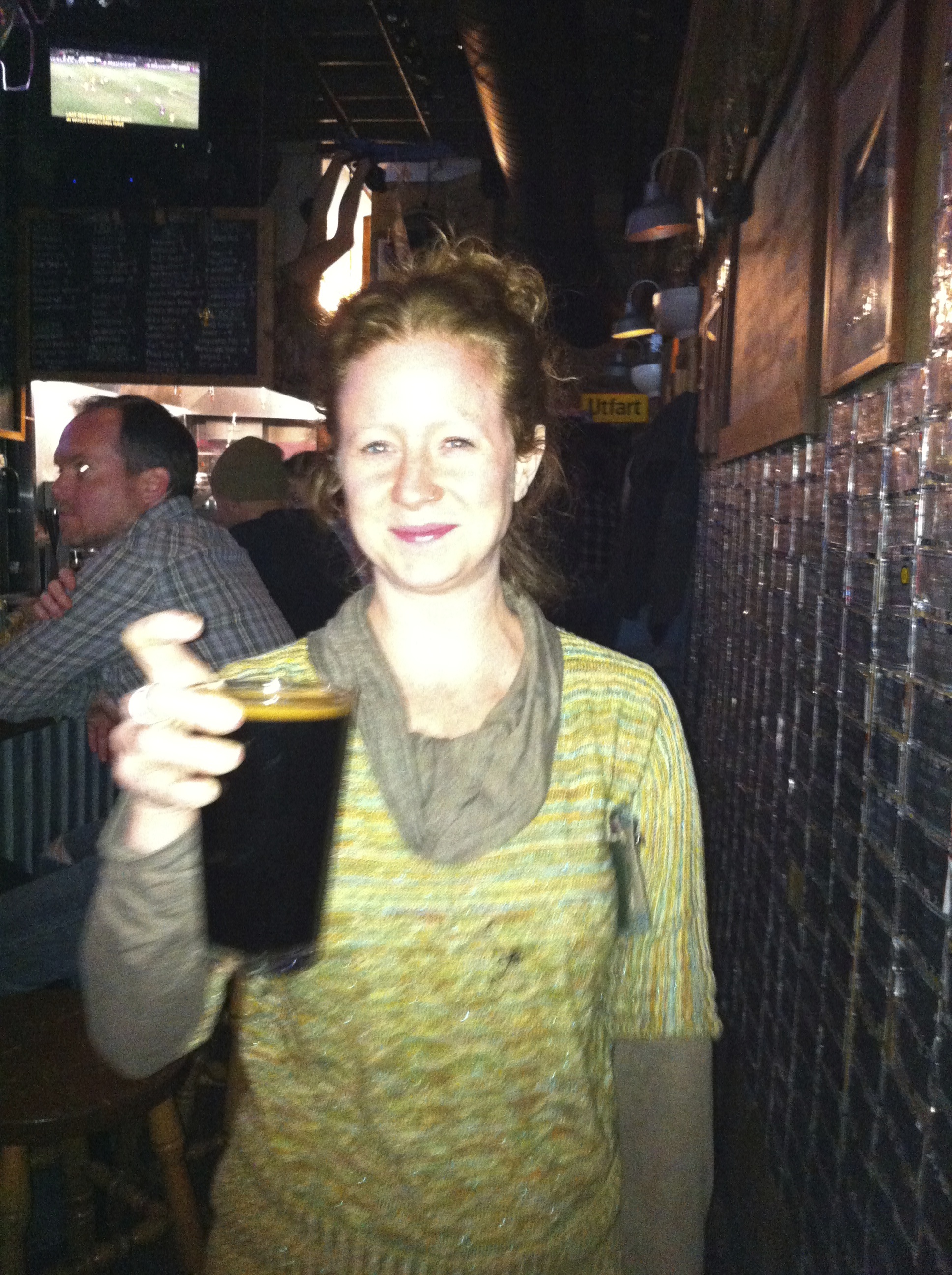
Indigo, with beer.

Indigo, with beer.

After the bar we went back to Indigo’s place and cracked into a couple of jars of flavored moonshine she had. For those who don’t know, moonshine is corn liquor, basically just bourbon taken from the still and bottled without being put in an oak barrel for aging. The barrel gives a bourbon its color, a good deal of its flavor, and removes some of its potency. Hence, the reason moonshine is clear, potent, and known as “White Lightning.” We had a couple of glasses each, which were very tasty and got me pretty seriously drunk. We had a nice catch up conversation and then I face-planted in the guest bedroom.

Day 17: Homeward Bound

I had breakfast with Indigo the next morning at a cute, hippie-ish café, and then took to the road for my last day of driving. Six hours and $35 in tolls later (seriously, don’t take I-95 if you don’t have to), I coasted up in front of my Aunt and Uncle’s house in Brooklyn, the Epic Road Trip having come to a close. They greeted me with yet another locally distinct food: a New York pizza pie.

Final Road Trip Tally:

Days: 17
Miles: 4,660
Fried food and Whiskey Consumed: Enough to kill a medium-sized pachyderm
Pounds Gained: I’ll never step on a scale again
Money Spent: I’ll never look at a bank statement again, either. I’m just gonna assume everything’s fine. <Looks around, whistles casually>
Car Break-ins: 0
Car Breakdowns: 0 (Why is “break-in” hyphenated but “breakdown” isn’t?)
Speeding Tickets: 0 (Don’t ask me how)
Words Written in My Blog Recap: 10,406

I hope y’all enjoyed reading this. It was a long, strange trip.

Posted in Drinks, Road Trip, Travel, Whiskey | 2 Comments