First of all, a mea culpa: I wrote a first trimester review for the Giants, but not for the A’s. I intended to, but didn’t for a simple reason: I’ve had hardly any time to watch baseball this season, and at that point in the year, while the two teams had similar records, I had managed to watch at least a couple of Giants games, but hardly any A’s games. I didn’t feel knowledgeable enough about the team to do a review. Of course, in the last two months the Giants have hit the skids, but the A’s have accelerated their pace, playing outstanding baseball and establishing themselves as a World Series contender. With the trade deadline and the two-thirds poll of the season both passing yesterday, now’s the perfect time to take a look at the A’s.
The Good:
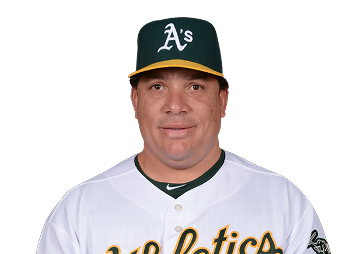
A lot has gone right for the A’s this season. First and foremost, their pitching has been outstanding. Despite his low strikeout rate, his extreme reliance on his fastball (as in, throws basically nothing else), his advanced age, and his resemblance to Shrek, Bartolo Colon has been one of the most valuable starting pitchers in baseball, going 14-3 with a 2.54 ERA (I know, pitcher wins don’t mean anything, but I’ll take 14-3).
This is the leader of the pitching staff?
After Colon, the team has seen generally solid, though not necessarily spectacular performances from its rotation, with A.J. Griffin, Jarrod Parker (who struggled mightily for the first month of the season before righting the ship), Tommy Milone, and Dan Straily all putting up ERAs right around 4. The bullpen, meanwhile, has picked up right where it left off last year, with Sean Doolittle, Ryan Cook, and Grant Balfour absolutely dominating. Balfour is my favorite of the trio, not so much because he broke Dennis Eckersley’s streak of consecutive saves or because he made the All Star team, but because after every pitch he throws he lands on the infield grass and begins striding toward the plate like he’s going to fight the batter if he even dares to think about swinging the bat. Maybe it’s because he’s Australian.
Aussie Aussie Aussie Oi Oi Oi
At any rate, the combined efforts of the rotation and the bullpen have resulted in the A’s giving up the second-fewest runs in the American League, while mostly being without Brett Anderson, their presumptive ace, who got hurt because that’s what Brett Anderson does. Playing in the cavernous Oakland Coliseum certainly helps the pitching staff, but there’s no doubt that, as a team, they’ve thrown the ball very well this year.
There have been bright spots in the lineup, as well. Josh Donaldson has emerged as a down-ballot MVP candidate who wasn’t an All Star only because third base is the most stacked position in the AL; Jed Lowrie, who Billy Beane shrewdly picked up in the offseason, has cooled from his scorching start but is still putting up a very solid .292/.357/.422 line while splitting time at second base and shortstop. John Jaso’s putting up a .387 OBP as a catcher. Yoenis Cespedes won the home run derby, which for some reason means he gets a WWE-style championship belt.
Adios, pelota! Dame el cinturon!
The Bad:
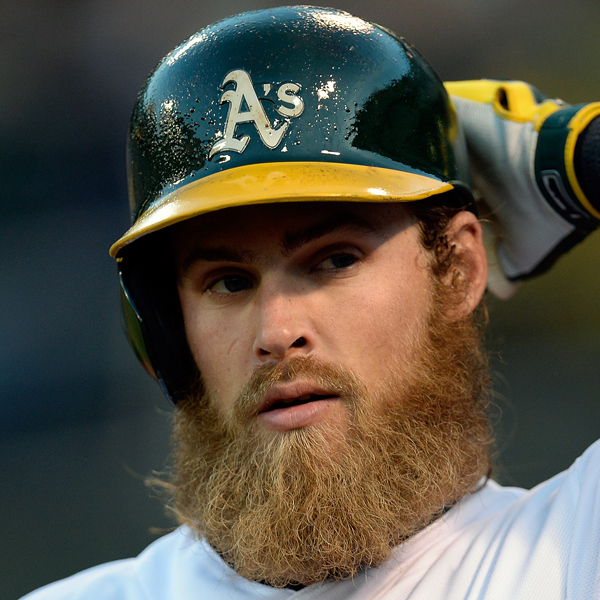
The Coliseum is undoubtedly a pitcher’s park, but that doesn’t totally excuse the numbers being put up by much of the lineup. Cespedes (.232/.300/.435) and Josh Reddick (.214/.293/.344) have both battled injuries and then struggled even after getting into the lineup. That’s especially worrisome for Reddick, who slumped badly in the second half last year, meaning he hasn’t hit well in a full calendar year–even if he still has the best beard in baseball (pending Brian Wilson’s possible return from injury).
It’s magnificent. Not just full and bushy, but well-groomed
Chris Young’s numbers are so bad I won’t even type them here. Coco Crisp really cooled off after a hot start. Brandon Moss and Seth Smith haven’t produced at the levels they did last year, and the non-Lowrie middle infielders have struggled so much that GM Billy Beane dealt Grant Green, a legit (if slightly overrated) prospect for the underwhelming Alberto Callaspo. Despite all this, the A’s have scored 481 runs, which is middle of the pack for the AL but is actually the most by any team in the AL West.
Overall:
The combination of outstanding pitching and middling offense has worked for the A’s: They’ve posted a 63-45 record, third best in the AL and good for a 4-game lead on second place Texas in the AL West. Their run differential of +64 is fourth best in the league. They’re on pace for 94 wins (the same total that won them the division last year), and given the way Texas has struggled of late, it’s not a stretch to say the A’s are prohibitive favorites to repeat. The question is, can they improve on their playoff run from last year, when they were slayed by Justin Verlander in Game 5 of the ALDS?
Right now I’m a bit skeptical. On the plus side, shutdown bullpens are always good to have in the playoffs, and the A’s definitely have one of those. Cespedes is the kind of hitter who could get hot and carry the team in October. The team really catches the ball. But right now, the offense feels a bit thin, and the starting rotation doesn’t have the front-line power arms that Tampa Bay and Detroit do. Beane picked up Callaspo at the deadline, but didn’t add a big bat or an ace that would be a playoff difference maker (not that I blame him–there was nobody out there worth giving up major prospects for, except maybe Cliff Lee, who has a ginormous contract–but the fact remains, he didn’t get anybody of consequence).
I’m probably being too negative here; the A’s are a wonderful, well-balanced team that’s probably going to win the division, and I wouldn’t be surprised to see them go on a tear in the playoffs. But as far as I’m concerned, the playoff nightmare scenario is to end up with a 2- or 3-seed and have to play the Tigers–with Verlander and the 15-1 Max Scherzer–again. I don’t see how that would go better for the A’s this year than it did in 2012. And if the playoffs started today, that is exactly the matchup they’d be facing.
Disclaimer: All characters appearing in this work are fictitious. Any resemblance to real persons, living or dead, is purely coincidental.
Cast:
Justin: A no-longer-young writer and musician who has been working days as a receptionist to pay his exorbitant Brooklyn rent.
The Boss: A tall but otherwise generic-looking upper-middle class white guy, friendly-demeanored in a typical salesman sort of way.
Scene: It’s Tuesday, 5 p.m. Justin is at his desk, packing his bag, preparing to leave his office for the day. Two weeks earlier, the Boss had called him into his office to tell him that he had been performing unsatisfactorily at the job–a job which consisted of answering phone calls from surly contractors and greeting insufferable rich people in a showroom, and which made Justin increasingly miserable with each passing day in a way that helped him understand, like nothing before, the concept of compound interest. The Boss informed Justin that he had two weeks to improve his performance, or he would be dismissed before the rapidly approaching end of his ninety-day probationary period. The follow-up performance review had been scheduled for Tuesday. As Justin finishes packing his bag and stands to leave, the Boss walks up.
Boss: Hey, Justin, sorry I lost track of the day. Let’s do your review tomorrow.
Justin: Yeah, I was gonna tell you, you forgot to fire me today.
Boss: [Pauses] … Well, let’s have a meeting tomorrow.
Justin: Really? What’s the point? We both know how that meeting’s gonna go.
Boss: [Looking bemused, trying to figure out what to say] Well … Do you want to come in tomorrow?
Justin: Honestly? … I mean, if you want to pay me for an extra day just so I come in and fill out some official paperwork for you or whatever, I’m fine with that.
Boss: Okay, well, come in tomorrow, we’ll meet in the morning, and we’ll do it right.
Justin: [Barely able to keep from bursting into hysterical laughter] Okay. Fine.
As I noted in my first trimester review of the Giants, in Moneyball, Oakland A’s GM Billy Beane explained to writer Michael Lewis that he breaks a season into thirds when he’s constructing his team. The first third is for figuring out what you have; the second third, leading up the the trade deadline, is for improving what you have; and the final third is letting what you have gel and hopefully making a playoff run.
When I wrote that first trimester review, the Giants were at 29-25 and in second place in the NL West, despite a slight negative run differential. Their play had been uneven, but I was cautiously optimistic that they were still a contender, in part because of the poor competition in their division. Then … well … things fell apart. The Giants have gone 17-33 in their second trimester, leaving them with a record of 46-58 and a run differential of -62 that’s third-worst in the National League. For perspective, that second trimester pace is the level the Houston Astros have played at this year, and is equivalent to a 55-win pace for a full season. It’s no surprise, then, that the team is in last place in the NL West. So the question coming up to the trade deadline isn’t how the Giants improve for a playoff run, but whether or not they should trade impending free agents Tim Lincecum and Hunter Pence. So, how did we get here?
The Good:
Pretty much just this:
#busterhugs
For my extended thoughts on Timmy’s no-hitter, click here.
The Bad:
Pretty much everything else. The lineup carried the team through the first part of the season, but Sandoval got hurt and has sucked since he came back and looks fatter than ever, Brandon Crawford and Hunter Pence came back to earth, Brandon Belt has stagnated, and the Angel Pagan injury has led to the team frequently starting both Gregor Blanco and Andres Torres, who often look like they’re swinging matchsticks. Buster Posey is still an MVP-caliber player, and Marco Scutaro has been Marco Scutaro, but it’s not exactly a shock the team stopped scoring runs.
The pitching hasn’t been much better. Madison Bumgarner has continued to be stellar, but Matt Cain, Lincecum, and Barry Zito all have ERAs dangerously close to 5, and Ryan Vogelsong is still on the disabled list. To make matters worse, the bullpen fell apart, hitting its nadir last weekend when Sergio Romo (still my favorite player in all of baseball), lost two straight games in the ninth inning, the second loss coming on a home run by Giants castoff Nate Schierholtz (hitting a robust .274/.334/.523 this year, by the way), all as part of a three-game sweep to the Cubs. In San Francisco. Oy.
The really bitter pill, though, is that it’s not just the Diamondbacks that the Giants lost track of; instead, the hated Dodgers made a run, thanks to Zack Greinke’s return from injury, a hype-inducing performance from Cuban-defector Yasiel Puig, and a borderline MVP-caliber performance from Hanley Ramirez, taking them from worst-to-first, and they look like they’re clearly the team to beat in the West now. Damn it all.
Overall:
Obviously, the Giants aren’t a playoff team this year. The question is, what kind of team are we looking at moving forward? There are a lot of good building blocks here: The infield of Posey-Belt-Scutaro-Crawford-Sandoval is a solid one that doesn’t need tinkering, although the Panda really needs to put the arepas down (not that I blame him–those things are delicious) and get back into a training regimen. The outfield needs to be rebuilt: Pagan, who has three more years on his contract, will obviously be back, but Pence is a free agent, and whether or not he comes back is going to depend largely on his price tag. Even if they do re-sign him, they’re really going to need to find another corner outfielder who can hit.
And then there’s the pitching staff. Cain and Bumgarner ain’t going nowhere. Lincecum is a free agent, and it’s an open question on whether the team will bring him back (for the record, I love Timmy and want him to be a Giant forever, but given the way he’s pitched most of the last two years, I would not give him a long term, big money contract). Zito’s contract is finally, mercifully over as well, though it wouldn’t totally shock me if the team worked out something to bring him back at a much smaller figure. The club has an option on Vogelsong, which, assuming he comes back and pitches well in August/September, I’d expect them to exercise. But the rotation, on which so much of the team’s success of the last few years has been built, is in flux. I won’t go into the bullpen, as bullpen performances tend to vary wildly from year to year, and are usually pretty easy to resolve. The biggest problem is that the team doesn’t really have any Major League-ready prospects in the minors ready to step in and fill those outfield and pitching holes. So they’re going to need to look outside the organization. And that’s expensive.
Look, this year fell apart, but Giants fans don’t have any right to complain. Since 2010, we’ve seen two World Series titles, Cain’s perfect game, Timmy’s no-hitter, Rookie-of-the-Year and MVP awards for Posey, and a host of lovable, entertaining characters: Lincecum, Sandoval, Huff, Pagan, Uribde, Romo, the Beard, and on and on. Even this season, ten years from now, won’t be remembered for the collapse as much as it will be for TIMMMAAYYY!!! Things aren’t perfect at Phone Booth Ballpark right now, but every single fan base in baseball would trade their last five years for ours. Keep that in mind.
Later this week, I’ll be back with a look at the Bay Area team that could be a championship contender this year: The Oakland A’s.
If there’s one thing my compadre Juan Alvarado likes to do, it’s challenge me to write lists. Fortunately, if there’s one thing I like to do, it’s write lists. Following our competing Top 10 SimpsonsEpisodes lists, he immediately challenged me to write competing Top 10 Led Zeppelin Songs lists. Well met, sir!
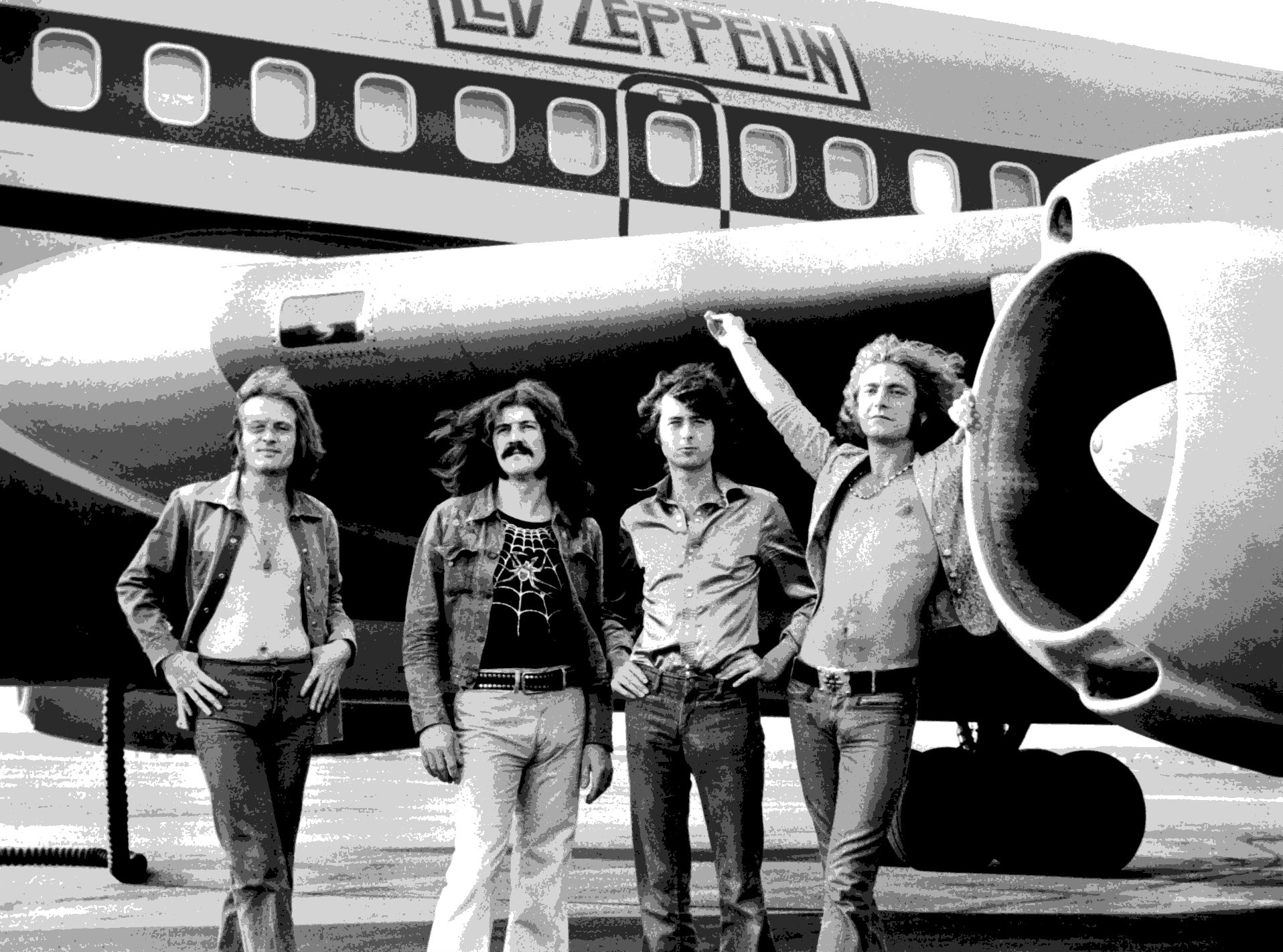
I’ll start with a brief explanation of my selection process. I’ve listened to the entire Led Zeppelin catalog so many times that Jimmy Page, Robert Plant, John Paul Jones, and John Bonham have made my ears bleed. This means that I’ve played out some of the band’s more signature songs. As such, you won’t be seeing Stairway to Heaven, Whole Lotta Love, or Kashmir on my list. Those are great, great songs, but how many more times in my life do I need to hear Stairway? There are so many great songs in the Zeppelin catalog that I can highlight, I don’t really feel the need to rehash the Stairway stories that everyone already knows.
One more note: unlike on my Desert Island Albums series, Juan and I agreed to allow live tracks–mostly because there are a couple of tracks from BBC Sessions that I had to have. Other than that, there were no rules. Without further ado, let’s get to the list.
Honorable Mentions: This list wasn’t quite as hard to winnow down as my Simpsons list was, but there were still a few painful cuts. The four hardest songs to excise: When the Levee Breaks, with its thunderous drum track courtesy of the front hall at Headley Grange; Gallows Pole, with its clever lyrics about wheedling a hangman with promises of silver, gold, or a sister’s love in exchange for freedom (if you listen to the lyrics, the hangman takes the sister and still executes the singer), and its great banjo track; The Rain Song, with its beautiful string arrangement; and Fool in the Rain, with its killer drum track, great guitar riff, and funny ending about waiting for your dream girl on the wrong block. I still can’t believe I cut any of these songs.
10. Thank You (BBC Sessions version)
This song, the first on which Robert Plant wrote the lyrics entirely on his own, is best known for being the lovely acoustic number that closes side one of Led Zeppelin II. As great as that original recording is, the truly epic version is on BBC Sessions. The closing song of a concert the band performed at the Paris Theatre in London on April 1, 1971 (Thank You was an encore staple in the early days, for obvious reasons), it is structured much like the original, with a Hammond organ harmonizing with the guitar, though in the live version it’s a fuzzy electric guitar, rather than an acoustic. It’s actually a fairly pedestrian performance–until the 2:28 mark, at which point Jimmy Page launches into a guitar solo that is unfuckingbelievable. He flies all over the fretboard with bent strings and hammered and pulled notes, a one-minute, thirty-second display of sheer virtuosity that is, in my opinion (and I know this is a bold statement) the greatest guitar solo on any Led Zeppelin recording. When I’m listening to this song, I close the door, turn the lights off, and air guitar along with it like a rejected extra from Wayne’s World.
9. Traveling Riverside Blues
While Led Zeppelin is generally considered to be the original hard rock band, they owe most of their sound to the blues (as an example, they took the lyrics for Whole Lotta Love from a Willie Dixon/Muddy Waters song). Traveling Riverside Blues is a cover, the original recorded by the great Robert Johnson, the King of the Delta Blues. Zeppelin recorded their version for the BBC on June 24, 1969, and as is true of all great covers, the band makes it indisputably their own. The song opens with an instantly recognizable ringing, open-tuned slide guitar riff. Every Led Zeppelin fan I know gets a little weak in the knees when that riff comes in. Plant contributes a pastiche of classic blues lyrics over a shuffling rhythm, including, of course, the famous “squeeze my lemon til the juice runs down my leg.” If you want to understand the roots of where Led Zeppelin’s music came from, this song is a good place to start.
8. Hey Hey What Can I Do
It shows how awesome this band is that one of their greatest songs didn’t even make it on to an album. Hey Hey What Can I Do was released as the B-side on the Immigrant Song single, the only non-album studio track the band ever released, and it still became a staple of classic rock radio. Musically, it’s an acoustic track that prominently features the tasty mandolin playing of John Paul Jones. It’s a fun song to listen to when you’re pissed at your girlfriend, because it’s all about a guy searching town for his cheating “street corner girl” who “wanna ball all day.” What really makes it great is Plant’s inspired vocal, in particular during the song’s coda, when he cries out “Hey hey, what can I do/I got a woman and she won’t be true.”
7. Ten Years Gone
The 1975 double LP Physical Graffiti is notable for its epic, longform songs, the most famous of which is, of course Kashmir. My favorite, though, has always been Ten Years Gone. It’s a song that showcases Led Zeppelin’s studio production (which is to say, Jimmy Page’s studio production), as it layers several guitar parts (14 of them, to be exact), each one more beautiful than the next, on top of each other. It was originally meant to be an instrumental piece, but Plant set lyrics to it, writing about looking back at a girlfriend he’d broken up with ten years before because she made him choose between her and his music (I’m gonna go out on a limb and say he made the right choice). What’s interesting is the lyrics aren’t bitter at all; rather, they’re reflective and mournful, in particular the use of the “eagles of one nest” metaphor, as eagles mate for life.
6. In My Time of Dying
On second thought, this is my favorite epic longform track from Physical Graffiti. It’s a cover of a traditional gospel song that goes back to the 1920s, one that’s been covered by any number of blues artists, as well as Bob Dylan on his 1962 self-titled debut album–but nobody does it quite like Zeppelin. It opens with a snarling open-tuned slide guitar riff, and then Page melodically echoes Plant as he sings, “In my time of dying/Want nobody to mourn.” The song progresses through several different sections, including a sick extended guitar solo. At the 8:15 mark the band stops dead, and pauses, before Plant chants, a capella, “Oh my Jesus, oh my Jesus, oh my Jesus.” He continues to sing these lines as the band crashes back in, building to a crescendo at which Plant is almost screaming the lyrics and John Bonham thrashes his drum kit so hard he seems to be trying to break it. I get uncontrollably fired up when I listen to it. The studio version ends with a humorous moment, when Plant sings “Gonna make it my dying dying dying …” at which point someone starts coughing, and Plant says, almost laughing “cough.” (I went with a live version from 1975 for the link below because, well, it’s awesome.)
5. Heartbreaker
Jimi Hendrix is unquestionably the greatest guitar player who ever lived, but Jimmy Page is, I think, the greatest architect of riffs in rock ‘n’ roll history (Keith Richards being the only other guy with a claim to that title). Heartbreaker, the first track on side two of Led Zeppelin II, features what is probably my favorite of his riffs, opening with that extended, slightly bent, heavily vibrato’ed G-bass note. The guitar on this song just sounds so fucking heavy. Plant sings angry lyrics about a cheating girl (a common theme for Zeppelin–that’s the blues influence again), most famously, “One thing I do have on my mind/If you could clarify, please do/The way you call me another guy’s name/When I try to make love to you.” After that line the band abruptly stops, giving way to one of Page’s most famous moments, the 45-second true solo; my favorite part of the song, though, is actually the second half of the solo, when the backing guitar track and drums and bass all come back in for a driving, high octane break that is truly Led Zeppelin at its finest.
4. Over the Hills and Far Away
In many ways, this is the perfect Led Zeppelin song. It starts with an intricate and instantly recognizable acoustic guitar riff–one of those riffs that you always hear someone playing when you’re walking through a guitar shop. The opening lyric, “Hey lady, you got the love I need,” is one of the band’s most well-known, and after the first verse the song transitions, in classic Zeppelin fashion, from the jangly acoustic work to a heavy electric guitar riff. The guitar solo is another fretboard shredding masterpiece, and the outro lyrics, “You really oughtta know … I know I should, I know I should” repeated through a fadeout, and then an extended, slowly plucked guitar outro, give the song a lovely, textured ending
3. Tangerine
Let me tell you a story: During the summer between my sophomore and junior years of college, I went on a trip with a few friends down to Tijuana. We got about as drunk as you’d expect a bunch of 20-year old college kids in TJ to do, but the most conspicuously drunk were my roommate and I; both of us were going through tough times (as tough as anybody can when he’s living on a beach in Santa Barbara, anyway), and for some reason when we were walking back toward the border we linked arms and started singing Tangerine. I don’t know why exactly we chose Tangerine, but even though I was blacked out at the time, that’s become one of my favorite memories. (The best part of the story is that we insisted on going through the border checkpoint like that, and one of our other friends had to physically separate us.) Musically, the song has one of the simplest guitar tracks in the Zeppelin catalog, but that 12-string acoustic guitar intro is iconic for its simplicity. And it gives way to a thick-toned electric guitar solo that’s a perfect counterpoint to the light acoustic work. A telling endorsement of this song is that Cameron Crowe, who covered Zeppelin for Rolling Stone as a teenager in the ’70s, chose Tangerine as the music for the final scene in his semi-autobiographical opus Almost Famous.
2. Ramble On
All the elements that define Led Zeppelin come together on this one. You have a classic acoustic guitar riff, giving way to another classic electric guitar riff. You have an intricate bass line, creative percussion (it’s a mystery what Bonham is actually playing during the verses, but those are definitely drums during the chorus, and they’re impeccable). And, of course, it has those Tolkien-inspired lyrics: “‘Twas in the darkest depths of Mordor/I met a girl so fair/But Gollum, and the evil one crept up/And slipped away with her.” This is a perfect Led Zeppelin song, and when they showed Page playing the guitar part in this scene in It Might Get Loud, my heart almost stopped.
1. Your Time Is Gonna Come
Ramble On may be the perfect Zep tune, but it’s not my favorite. That would be Your Time Is Gonna Come, the first track on side two of the band’s self-titled debut album. It opens with a one-minute, five-second solo organ intro played by John Paul Jones that gives way to a lightly plucked guitar and heavy drums, over which Robert Plant sings lyrics about a cheating girlfriend: “Lying, cheating, hurting, that’s all you seem to do/Messing around with every guy in town/Putting me down for thinking of someone new.” As we’ve been over, Zeppelin has a lot of songs about the woman who done you wrong, but this one has personal resonance for me: During college I fell pretty hard for a girl who strung me along for a good while, and when I finally figured out it wasn’t going to work out and I needed to quit her, the lyrics, “Made up my mind to break you this time/Won’t be so kind, it’s my turn to cry,” and “Don’t care what you say cause I’m going away to stay/Gonna make you pay for that great big whole in my heart” carried a LOT of weight.
There you have it, my Led Zeppelin Top 10. It goes to show how deep and diverse this band’s catalog is that even though I chose Led Zeppelin IV for my Desert Island Albums list, none of the songs from that album made it onto my Top 10. Fuck me, Led Zeppelin is awesome. Now go read Juan’s list.
The NBA closed out its 2012-2013 season with what was probably the best Finals in recent memory, and then launched right into an offseason with an unpredictable, trade-filled Draft night that featured the Boston Celtics tearing down the last remnants of their dynasty by sending their two aging cornerstones, Kevin Garnett and Paul Pierce, to Brooklyn. (Hey! That’s where I live! In a basement, even!)
Hey guys, want to come hang out in the basement? The ceilings are kinda low … What’s that? … Screw you, then. You’re old and I don’t care about your team anyway
The free agent period then saw a flurry of activity that made the Western Conference even more brutally competitive than it had been previously. Now that the dust has mostly settled, I thought I’d take a look at the aftermath. This won’t be as comprehensive as the piece done earlier this week by Grantland’s Zach Lowe, the best basketball analyst in the business, who summed up what all 30 teams accomplished (be it for good or ill) this offseason. Rather, I’ll just look at a couple of questions that interested me.
Are the Houston Rockets now better than my beloved Golden State Warriors? And where do both stand in the Western Conference?
The consensus answer to the first question seems to be “yes,” as the Rockets added Dwight Howard, the league’s top free agent (given that the Clippers, once they got Doc Rivers, were a lock to keep Chris Paul). Many analysts have asserted that the Howard signing makes the Rockets one of the top two or three teams in the West, and a title contender. However, I’m not so sure–and I’m not even sure they’re better than the Dubs. Last year the Dubs finished 47-35, sixth in the conference, while the Rockets were 45-37, tied for seventh. Any astute analyst would point out that the Rockets scored 3.5 points per game more than their opponents, while the Dubs had a positive differential of just 0.9–numbers indicating that the Dubs overachieved and the Rockets were the better team.
However, the Rockets were bounced quickly out of the playoffs by OKC, while the Dubs upset Denver before falling to San Antonio in a tight second round battle. I recognize that playoff performances are subject to small sample size wonkery, and of course the quality of those first round matchups was wildly different, but I think it’s important to consider those playoff results, because they do tell us something about the teams, in particular the Dubs. Specifically, the Dubs put up that 47-35 record largely without Andrew Bogut, who missed much of the year with injury and was hobbled when he did play. Bogut’s return to prominence was a huge factor in the team’s playoff run. Obviously it’s treacherous to be dependent on two players (Bogut and Steph Curry) with chronic ankle issues, but if the Dubs can get 70 games out of Curry and even 60 out of Bogut, I think they can improve on last year’s regular season record. And I haven’t even mentioned that David Lee was hurt for most of that playoff run, which allowed the Dubs to discover that Harrison Barnes can be a serious weapon as a small-ball power forward.
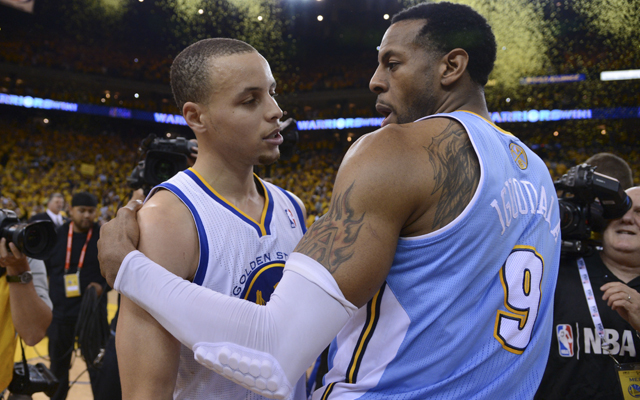
And there’s another reason that the Dubs should improve: They signed Andre Iguodala, the second best free agent on the market.
These guys are teaming up next year
Iguodala fits the team perfectly–he’s one of the best perimeter defenders in the league, he thrives in the open court, and he’s a good distributor who can play on the ball a few minutes every game, allowing Curry to run around off screens, which should mitigate the loss of backup point guard Jarrett Jack. I was in shock when I found out the Dubs had cleared the cap space to sign Iguodala (they got the tanking Utah Jazz to take the execrable contracts of Richard Jefferson and Andris Biedrins in exchange for a couple of draft picks that will probably be low in the first round anyway). Then, even better, the Dubs convinced Denver to sign-and-trade Iguodala, a move which got the Dubs a salary cap exemption they were able to use to fill out their bench with Jermaine O’Neal, Marreese Speights, and Toney Douglas. None of those guys are world-beaters, but the depth will be important for a frontcourt that, in addition to worrying about Bogut, also lost Festus Ezeli to knee surgery.
Meanwhile, the Rockets added Dwight Howard, who is still widely considered the best center in the game, but who also has gone through at least two years of weirdness, injury, and diminished play. He’s still one of the best players in the league, but you could easily argue that he’s already past his peak. The Warriors were involved in the Howard sweepstakes, but I, for one, was relieved they’re not the team that gave him $88,000,000. He’ll obviously help the Rockets’ defense and rebounding, but he’s going to a team that runs an offense similar to the one he was so unhappy in with the Lakers. James Harden is great, but should we really be THAT excited about the Rockets? Their backup center, Omer Asik, is pissed that he’s now a backup and wants to be traded. Chandler Parsons is good, but people are a little too excited about a guy who was just a slightly above player according to the stats from 82games.com. (Warning: If you’re a basketball geek, you shouldn’t click that link unless you have a lot of time to kill.) Their point guards are Jeremy Lin (who I love, but it’s pretty clear he’s a third guard more than he the superstar of the Linsanity days) and Patrick Beverley (best known for being the asshole who tore Russell Westbrook’s meniscus).
Asshole
I think the Rockets improved themselves, and they’re certainly a 50-win team now. But are they a 60-win team now? I don’t see it. Meanwhile, after their second round loss to the Spurs, I said that I thought the Dubs could win 50-55 games and contend for the Western Conference Finals next year. That assessment may have been a bit rosy, but in light of the improvements they made, I see no reason to downgrade it.
So, look at the Western Conference landscape now. You have the Spurs, who will win 55-60 games because they’re the Spurs. You have OKC, still the home of Durant and Westbrook. You have the Clippers, who won 56 games last year, and now got themselves a real coach, kept CP3, and added a couple of solid players in J.J. Redick and Jared Dudley (I like what the Clips did, and man, I cannot wait for those Clips-Dubs matchups next year). Memphis canned their coach, but kept the core of their team together. The one top 5 team that’s likely to fall off is Denver, who lost Iguodala and coach George Karl. Basically, we’re probably looking at a fight for seeding from 3-6 between the Clips, Grizzlies, Dubs and Rockets. A very, very good team will be the 6-seed in the Western Conference playoffs next year. And the playoffs … Man, is that gonna be fun. My favorite football team, the Niners, are a Super Bowl contender this year, and yet I’m somehow more excited for basketball this coming season than I am for football.
Also, the Lakers are gonna suuuuuuuuuuuuuuck (cue Nelson Muntz). Man, is that gonna be fun.
Bonus Question: Who won the Celtics-Nets trade?
The answer, so for as I can see, is both teams. At the same time, I think both teams also lost the trade. Allow me to explain.
For the Celtics, it was time to tear it down. The glory days were over, and Pierce and KG can’t carry a team for a whole season anymore, especially not when Rajon Rondo is going to miss a chunk of next year recovering from knee surgery. It made sense to tank for this year’s draft lottery, which is getting hyped as the best since the LeBron-Darko-Carmelo-Bosh-Wade (one of these things is not like the others) draft of 2003. It also made sense to get all those distant future draft choices from the Nets, because Brooklyn is already an old team that’s probably going to be a complete shitshow in a couple of years, meaning that the Celtics may be looking at extra high lottery picks in their future.
The downside is, they traded the two most iconic players the team has had since Larry Bird, one of whom was a guy who really should have retired having played every game of his career as a Celtic. I think if I was a Celtics fan I’d understand this trade, but I’d still kinda feel like Danny Ainge took a shit on me.
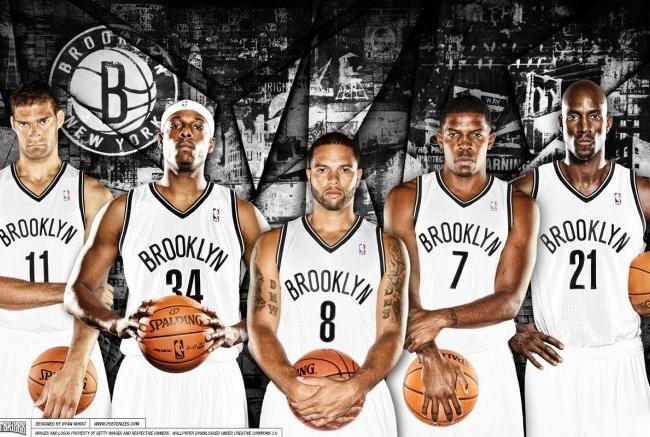
For the Nets, it made sense because they were already all-in with their current roster, the gutless squad that got crushed in an elimination game, at home, by a Bulls team with no Derrick Rose and a hobbled Joakim Noah. Their billionaire Russian owner, Mikhail Prokhorov, doesn’t care about the salary cap or luxury tax; he just wants to win now, especially with the new arena and the fledgling Brooklyn fan base. And this trade will make them better in the short term: A crunch time lineup of Lopez-KG-Pierce-Johnson-Williams is pretty sick. And signing Andrei Kirilenko to an under market deal for depth was a great move (even if I do think the contract negotiations between Kirilenko and Prokhorov probably played out like the knife fight scene in Eastern Promises (that link’s probably NSFW)).
The downside is, as nice as that crunch time five looks, I don’t think the team’s ceiling is as high as they’d like to believe. They’re not better than Miami. They’re not better than Chicago if the Bulls have D-Rose back at 100%. They’re probably not better than Indiana. Yes, they probably leapfrogged the Knicks for the City Title (we could be set up for a pretty entertaining first round Nets-Knicks series next year), but they still look at best like a 4-seed who’s a second round out for one of the real title contenders. And the cost of that ceiling is the future: A couple of years from now, the Barclay’s Center is gonna be the basketball equivalent of a meteor crater, with the carcasses of all those dinosaurs All-Stars scattered around it.
Over at Grantland yesterday, Bill Barnwell concluded his annual NFL Trade Value column. I recommend reading it, as Barnwell’s a thoughtful analyst who clearly put a lot of time into his rankings. I’m not going to go through his whole list of evaluations slot-by-slot, but I wanted to talk about his ranking of Colin Kaepernick, who he pegged as the eighth-most valuable player in the NFL.
Kaepernick Kaepernicking
Now, there’s an obvious caveat to what I’m about to discuss, which is that I am a Niners fan. Even beyond that, I have a particular affection for Kaepernick: This is in part because, as someone who has tattoos, I love the “Kaepernicking,” but it’s much more because, when the Niners had their overblown-by-the-media quarterback controversy last year following Alex Smith’s injury and Kaepernick’s emergence, I was staunch in my belief that going with Kaepernick permanently was the right call. I think it’s safe to say that the Niners’ two playoff victories and near-comeback in the Super Bowl vindicated my opinion.
With that caveat issued, I think Barnwell had Kaepernick too low on the list, and I want to quickly go through and explain why. Of the seven players on the list above Kaepernick, six are also quarterbacks. The seventh is Houston defensive tackle J.J. Watt. The choice of Watt–who Barnwell calls “the most destructive lineman in a generation”–at number four is a matter of taste that I won’t quibble with. It’s Kaepernick’s ranking relative to the other QBs that I’m interested in. He ranked those QBs in the following order:
1. Aaron Rodgers
2. Russell Wilson
3. Andrew Luck
5. Robert Griffin III
6. Matt Ryan
7. Tom Brady
Now, if you want to argue for Rodgers, who’s at his career peak and has been pretty universally regarded as the best QB in the NFL the last couple of years, I won’t argue (Hell, I’m still bitter the Niners passed on him in the 2005 draft). Nor will I argue against Luck, who was the most anticipated QB prospect since Peyton Manning and who led the Colts to a 9-win single season turnaround (although I will point out that Luck was so highly regarded in part because of the coaching he received at Stanford from Jim Harbaugh, who is of course now Kaepernick’s coach with the Niners).
But I don’t buy any of those other names being ahead of Kaepernick. All due respect to Tom Brady, who has been one of the three best QBs in the league for more than ten years, but he is 36 years old. You might be able to convince me I’d want Brady for one game, or even one season, over Kaepernick, but for the remainder of their careers? The ultimate guiding principle behind the Trade Value Column is that the team with the player in the seventh slot wouldn’t trade him for anyone lower on the list. This doesn’t hold up here, because the Niners absolutely would not trade Kaepernick for a QB who is eleven years older (and conversely, I guarantee Bill Belichick would make that trade).
Next up: Matt Ryan. I have to be honest, I don’t get the Matt Ryan love. He’s a good player, and the Falcons have had good records with him as their QB. His numbers were excellent last year, but across the length of his career, they’re really not that great–at least, not that much better than Kaepernick’s, and that’s without considering that Kaepernick adds massive value as a runner that Ryan does not. Also, Ryan is a year from free agency, whereas Kaepernick still has two years left on his rookie deal.
Then there’s RG3. I love this guy as much as anyone else, and if you could depend on him being healthy, I’ll concede he’d deserve to be above Kaepernick. But he was injured several times in his rookie year, including a gruesome knee injury he suffered in a playoff game just seven months ago. Both Kaep and RG3 run the read option and run the ball a lot (though it’s a bit overstated in Kaep’s case because of the epic performance against Green Bay), but if you had to bet on one of the two to actually stay on the field for a full 16 games, which one would you take?
Finally, there’s Russell Wilson, and can we all please just calm the fuck down about Russell Wilson? Yes, he had a great rookie year, particularly when the Seahawks went on their second half run, but as Barnwell himself showed in his “Gang of Four” column last week, if you normalize the stats for a full season, Wilson and Kaepernick’s numbers are almost identical. If you want to give Wilson a bump because he’s only one year into his contract, while Kaepernick is two years in, that’s fine. But that’s a tie-breaker kind of difference, not a six-slot difference. Personally, all other things equal, I’d go with the guy that’s bigger and stronger and more likely to be able to take the punishment.
One more point: In the Trade Value piece, Barnwell downgrades Kaepernick a bit because while he’s started just 10 NFL games, at 25 years old he’s a bit older than you’d think (aside: Aaron Rodgers was 25 when he became the Packers starting QB). He also downgrades Kaepernick because of the injury of his best receiver, Michael Crabtree, which makes a little bit of sense for this year–but how is that relevant for the rest of his career? He’s still a physical specimen whose teammates rave about his intelligence and work ethic, a guy who set the the all-time single-game NFL record for rushing yards by a QB in his first playoff start, who led two huge playoff comebacks, one on the road and one (that barely came up short) in the Super Bowl, and who has the NFL’s top quarterback guru as his coach.
The way I see it, Kaepernick should be no lower than fifth on that list, behind Rodgers, Luck, maybe Watt (if you think any lineman should be that high), and maybe Wilson (if you give Wilson the contract tie-breaker). And I really think he’d make the most sense at number three.
I realize I have spent entirely too many words on this hypothetical, totally made up idea by another internet writer. Football season needs to start yesterday.
I’ve thought that tattoos were cool for a long time–probably since I was a teenager, when I first started noticing them on people. There are lots of reasons to get a tattoo: as a memorial for a lost loved one, a reminder to live your life by a certain principle, or just to have a cool piece of art that you take everywhere with you.
Part of me always wanted to get one, but I held back for a couple of reasons. The first is the standard reason: I didn’t want to get something I wasn’t totally sure about. A tattoo, obviously, is on your body for the rest of your life (that commitment, by the way, is the whole point: If tattoos weren’t permanent or painful, everyone would get them, right? It’d be like changing shirts), and nobody wants to see himself turn up in a Google search for “awful tattoos.” (One funny thing about the internet: Because I typed that phrase, this post will now show up in exactly the Google search I’d prefer to avoid. Oh well.)
The second reason I put off getting one for a long time is more complex and personal. My grandparents, as I’ve written about from time to time, were Auschwitz survivors, a fact that has always haunted me. My grandfather had his numbers tattooed on his left inner forearm; my grandmother didn’t have any numbers–and I prefer not to think about how she avoided them. When I thought about getting a tattoo, I wanted it to be something personally meaningful, and the thing I always returned to was a tribute piece for them. But would it be appropriate for me to pay tribute to them by marking myself using the same method that the Nazis used to dehumanize Jews? The number of remaining Holocaust survivors is dwindling, and in the last few years a trend has arisen of young Jews getting their survivor grandparents’ numbers tattooed on their arms. I almost certainly would have done this, but my grandfather died when I was seven, and neither my father nor my uncle know what his number was.
So I went back and forth on what I would want to get, and on whether or not it was even right for me to do it. As a result, despite my sister and several of my friends getting ink through the years, I made it all the way through my twenties without getting one. It’s a good thing, too, because 18-year old Justin absolutely would have done something stupid like get a “Thug Life” tattoo. (A cool piece if you happen to be Tupac–not so much if you happen to be me.)
I knew I wanted to do something for Lara, one of the three or four most influential people in my life, and I knew exactly what. Sunflowers were her favorite kind of flower, and when we lived together in Portland I had bought a print of a painting of a couple of sunflowers from an artist, Christopher Bibby, at a street fair.
Lara’s print
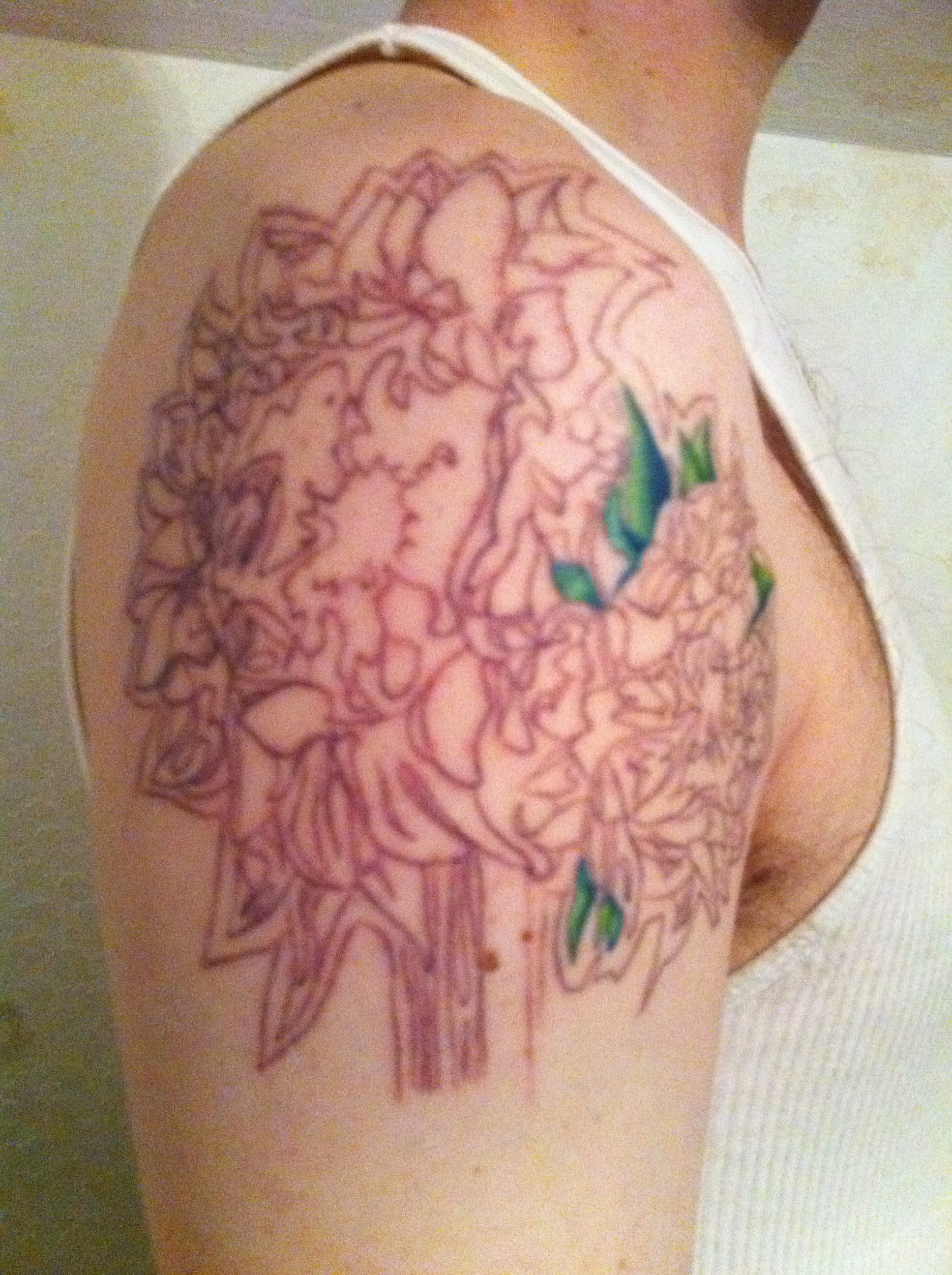
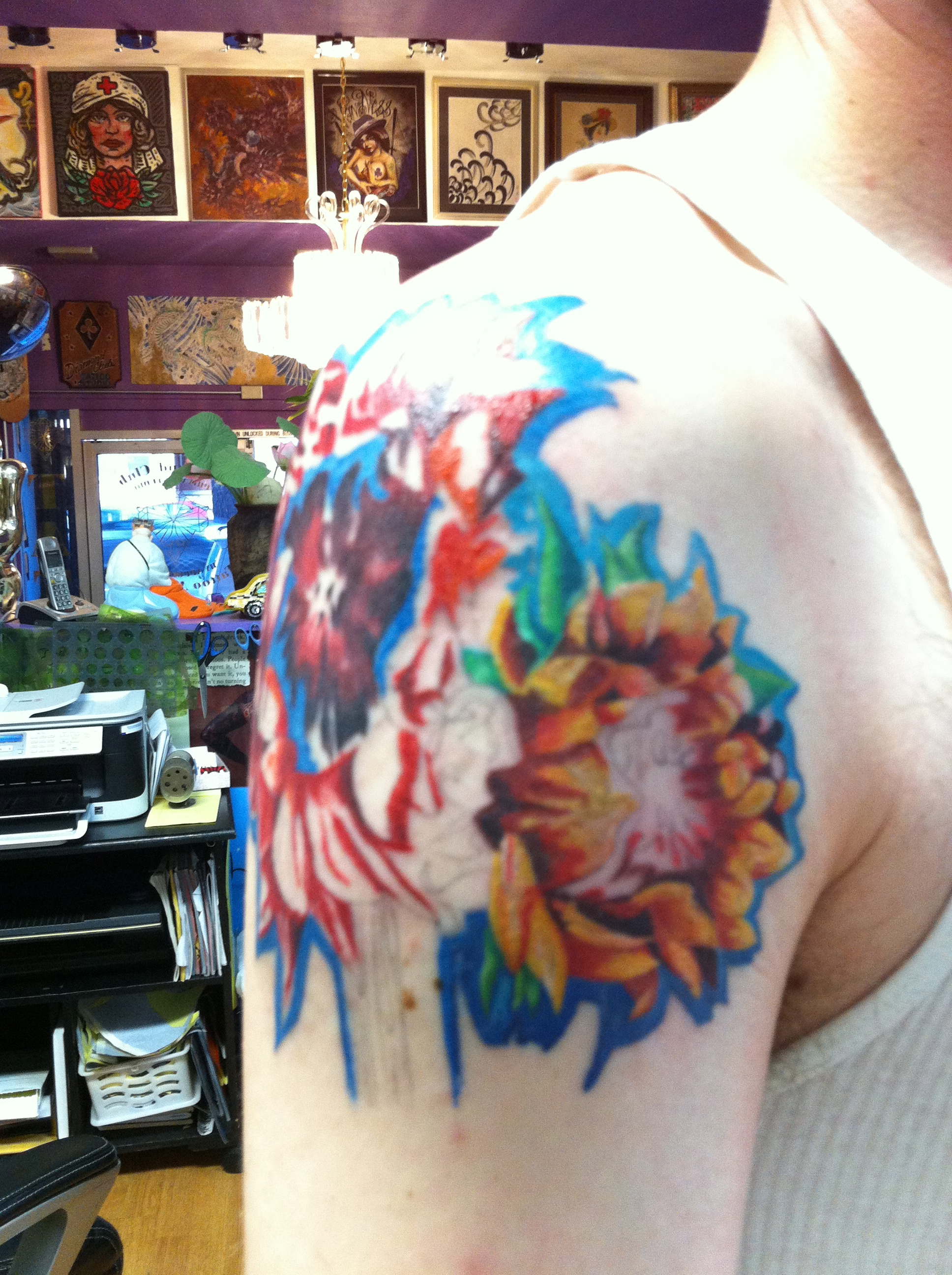
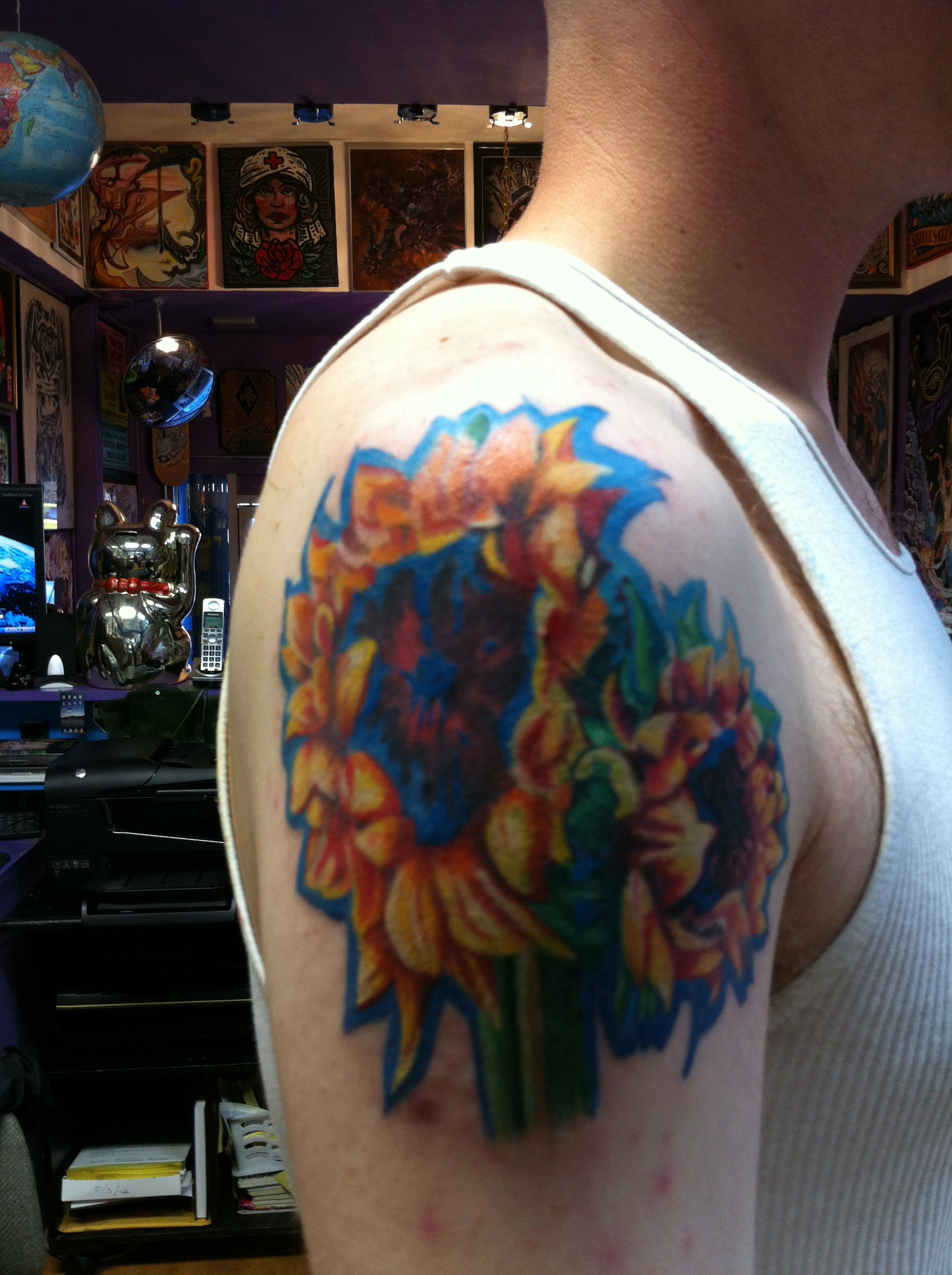
After she died, her sister returned the painting to me, and I took it to an artist, Kevin Pulido, at Diamond Club in San Francisco. He had done a nice lotus flower tattoo for my sister, and he agreed to do a re-creation of the painting on my upper arm. It’s not huge, but because it was complex and had lots of color in it, over the course of the next three months it took five sessions, each around two or three hours, to complete the tattoo.
Session 1: The outline took around three hours
Session 2: The blue took another two-plus hours. Think of it as a really intense paint by numbers activity
Session 3: A lot more color gets added
Session 4: The flowers are totally filled in at this point
Session 5: Added the background to complete the tattoo
I thought it was a nice tribute for a lost loved one, and it was suddenly a piece of my body that I was really proud of. Also, I had removed the taboo–since I’d broken the seal, I figured why not just go ahead and do the tribute for my grandparents. I still felt a little ambivalent about the choice of a tattoo as a tribute, but I thought about it like this: Why should I allow the Nazis to decide what’s an appropriate tribute? Why should they get to own tattoos? Why couldn’t I take that back from them?
And so I got something to say I’d never forget my grandparents and what they’d been through: a bouquet of forget-me-nots with a coil of barbed-wire running through it. Kevin knocked this piece out in a single session that took a little more than four hours.
My memorial piece for my grandparents
An aside: If you look closely at the bottom of the photo, you’ll see a small blue dot. That is not a part of this tattoo. It’s actually a separate piece, done by my friend Katrina Chamberlin as part of a large performance art project (she learned to do tattoos and has given similar dots to 162 other people–a living art project you can read about here).
So I got two fairly large tattoos within a year. You may have heard the expression that tattoos are addictive, and it happens that I would get another one fairly soon after, but I thought I’d briefly address the topic. It’s not that the process of getting a tattoo is addictive. I mean, maybe some people like it–people are into all sorts of weird shit–but I personally don’t find it all that pleasant. It hurts–not a terrible pain, but a steady, burning sensation, and even if you have a tattoo artist who’s interesting to talk to, as Kevin is, it gets boring sitting there for hours on end. What’s actually “addictive,” for lack of a better word, is that once you have a tattoo, you start to look at your un-inked skin as a blank canvas, or as a gallery wall on which you can add more pieces of art.
Still, I would never get anything without thinking long and hard about it (my sister’s rule is she has to think about a tattoo for at least a year before she gets it), and I wouldn’t get anything that didn’t have a personal significance. My next major piece was my sister’s idea: Since we each already had flowers on our left forearms, she suggested we each get flowers on our right forearms. Specifically, she suggested that we get matching rose tattoos, as roses are our mother’s favorite flower. I liked the idea, especially that she and I would have matching ones, and the last time I was in San Francisco, I got mine.
The boy with the rose tattoo (I’ll update with another photo after my sister gets hers)
That’s all the ink I have now. I’m sure I’ll get another one sometime in the future, but I have nothing planned for the moment, and I’m in no rush–after all, I’ve got the rest of my life. Tattoos aren’t for everyone, but I’ve enjoyed making some art that I think is beautiful, and meaningful, a part of my body.
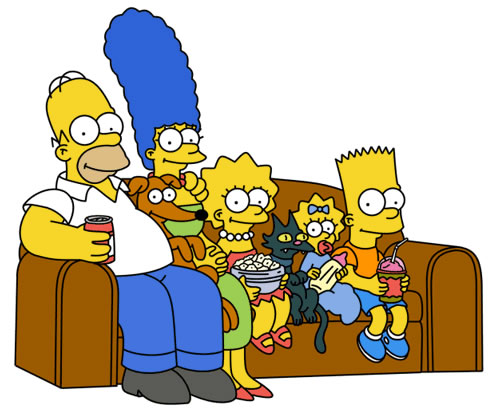
The Simpsons is my generation’s defining cultural touchstone. It’s been on the air for 24 years now, making it the longest running network sitcom in television history. Its unparalleled mix of slapstick and sharp satirical wit have made the show untouchable. It’s almost impossible to have a conversation with a guy between the ages of 25 and 40 without a Simpsons reference popping up. The most moving sign of the show’s influence is that, when the editors of the New York Times took on the task of writing obituaries for every person who died on 9/11, they found that most of the men in that age group they profiled “were described as admirers of the show,” so much so that they stopped mentioning this fact in the obits.
So, when my friend and fellow blogsmith Juan Alvarado Valdivia and I challenged each other to write our Top 10 Episodes of The Simpsons, I knew it would be tough. I didn’t know that it would turn into the single most difficult post in the history of the blog. There are so many classic episodes with lines of dialogue that have become part of our national consciousness. And I say this as someone who thinks the show fell off precipitously and hasn’t really watched it in years (my list has no episodes later than Season 8).
So, while I fully expect to be pilloried for my choices here, just know that this is a task that is objectively impossible and a task on which it is impossible to be objective. So this is the countdown of my favorites. If you hate it and think I’m an idiot, then write your own goddamn list. Deep breath. Here goes nothing.
Honorable Mention: Treehouse of Horror IV
I disqualified the Treehouse of Horror episodes from consideration for the broader list. I think that they are, in fact, some of the funniest episodes in the history of the show, but because they’re typically divided into smaller skits, and the substance is so different from the regular episodes, I consider them separately. Still, I want to take the time to mention my favorite Halloween episode, Treehouse of Horror IV, which features perhaps the funniest 10-minutes in Simpsons history, “The Devil and Homer Simpson,” in which Homer sells his soul to the devil for a doughnut. The Devil, Ned Flanders (of course), furnishes him with the doughnut, and when Homer finishes it (of course) he ends up in hell (the Ironic Punishment Division joke–“Have all the doughnuts in the world!”–is fantastic), only to be released when Marge shows the “Jury of the Damned” that she already has the deed to Homer’s soul. This sequence narrowly beats out Treehouse of Horror V, which features a sublime parody of The Shining.
10. Bart vs. Australia
Mention this Season 6 episode to any Australian and he’ll admit, with a wry smile and a shake of the head, that “Yeah, they really got us.” It’s an episode full of totally loony jokes, with the best perhaps coming in the pub scene: “I see you’ve played knifey/spooney before,” and “Cof-fee? Be-er.” There’s also Bart mooning the entire country of Australia with “Don’t Tread on Me” written on his ass, and of course there’s the ending with the invasive species: Bart’s frogs, and the vengeful koala perched to the landing gear of the Simpsons’ escaping helicopter. This one is definitely an all-timer.
9. I Love Lisa
It’s a testament to The Simpsons that Season 4’s I Love Lisa checks in this low. It starts on Valentine’s Day, when Lisa, out of pity, gives friendless Ralph Wiggum an “I Choo-choo-choose you” valentine card. Ralph develops a crush on Lisa, and takes her to the live Krusty the Clown 29th Anniversary Special, on which Lisa tells Ralph (and the television audience) that she never liked him. The scene where Bart pinpoints the exact moment of Ralph’s heart tearing in half is one of my all-time favorites. Ralph, of course, goes on to give a moving performance as George Washington across from Lisa’s Martha in the school play, winning an apology and an offer of friendship from her. I’ve often said that if I could choose one Simpsons character to give a spinoff show to, it would be Ralph Wiggum. He’s the best.
8. A Streetcar Named Marge
I’m a book and film nerd, of course, and I’ve always loved Tennessee Williams’s A Streetcar Named Desire. The Simpsons version, in which Marge plays Blanche DuBois, drawing her inspiration from Homer’s boorishness, opposite a surprisingly ripped Flanders’s Stanley, is fantastic, especially the New Orleans song (sadly, audio only). As much as I love the Streetcar element of this Season 4 episode, I think the best part of it is the subplot in which Maggie is housed at (and starts a rebellion against) the brilliantly conceived Ayn Rand School for Tots.
7. Kamp Krusty
“We want Krusty! We want Krusty! We want Krusty!” Bart and Lisa being sent to the gulag-like Kamp Krusty, and the resulting improvement in Marge and Homer’s lives (Homer loses weight and grows his hair back), is funny. Lisa’s letters home are hilarious. Bart’s eventual revolt and Homer’s reaction “Don’t be the boy, don’t be the boy … D’oh!” are side-splitting. And Krusty’s arrival brings a couple of my all-time favorite Simpsons lines: “I’m sorry! They drove a dump truck full of money up to my house!” and “I’m going to take you kids to the happiest place in the world: Tijuana!” And the Tijuana sequence, told in polaroid photos, is fantastic. This Season 4 episode (that’s three in a row–goddamn Season 4 is great) just builds and builds and never stops getting funnier the whole time.
6. Lisa the Vegetarian
I don’t even know where to start: “You don’t make friends with salad, you don’t make friends with salad”? “Sure, Lisa, a wonderful, magical animal” that produces bacon, ham, and pork chops? Lisa stealing the pig from Homer’s BBQ and almost inadvertently causing Mr. Burns to give a million dollars to an orphanage? The best Troy McClure educational video ever, “Meat and You: Partners in Freedom”? The Paul and Linda McCartney (!) cameo? This Season 7 episode has it all.
5. Marge vs. the Monorail
Many of my friends cite this Season 4 masterpiece as their favorite, and it’s hard to argue. Written by Conan O’Brien, it features the classic monorail sales pitch, in song, of Lyle Lanley (voiced by the inimitable Phil Hartman), and of course Homer’s ascension to the position of conductor of the poorly constructed train. One of my favorite random lines in the show’s history is when Marge finds the family of possums nesting in the monorail control booth, and Homer responds: “I call the big one ‘Bitey.’ ” And the Leonard Nimoy cameo is priceless. It’s got a great argument for best episode, but there are a few that are just a bit closer to my heart.
4. The War of the Simpsons
Coming from Season 2, this is the oldest episode on my list, and it’s home to a number of instantly recognizable scenes: There’s the famous dinner party scene, in which Homer imagines that he was a witty and urbane host, but was actually a drunken fool who offends Dr. Hibbert and gets caught drooling at Maud Flanders’s cleavage. Marge signs them up for a marriage counseling retreat, which takes place next to a lake that’s home to the legendary giant catfish General Sherman. Marge makes Homer promise he won’t go fishing, a promise he of course breaks. He catches General Sherman, reeling in his foe after an epic Old Man and the Sea-esque battle, only to return to the dock to find a furious Marge waiting for him. To prove his love, Homer throws General Sherman back. The whole episode is classic, but my favorite part is the last scene, in which the bait shop cashier describes the man who came closest to catching General Sherman: “Went by the name of Homer. Seven feet tall he was, with arms like tree trunks. His eyes were like steel: cold, hard. Had a shock of hair, red, like the fires of Hell.” Honestly, this episode should be probably be higher on the list.
3. Homer at the Bat
I’ve been a huge baseball fan since I was around eight years old, and this Season 3 episode, which came out when I was ten, was square in my wheelhouse. The parody of The Natural, in which Homer makes his own bat, “Wonderbat,” from a tree struck by lightning, is hysterical. And the ringers that Mr. Burns brings in, Major Leaguers Roger Clemens, Mike Scioscia, Don Mattingly, Steve Sax, Ozzie Smith, Wade Boggs, Jose Canseco, Ken Griffey, Jr., and Darryl Strawberry, are all voiced by the actual players. This was an incredible feat for an animated series in its third season. The players all end up befalling hilarious accidents that prevent them from playing in the big game (my favorites are Scioscia getting acute radiation poisoning from working in the Nuclear Plant, and Burns throwing Mattingly off the team for his sideburns–amazingly, this came before Mattingly had his famous row with George Steinbrenner over the length of his hair), except for Strawberry, who plays Homer’s position. Strawberry hits nine homeruns, but Burns pinch hits Homer for him with the bases loaded in the bottom of the ninth to get the platoon advantage (“It’s called playing the percentages”), and Homer becomes the hero when he is hit in the head by a pitch, knocking him unconscious and driving in the winning run. This episode is perfect.
2. Homer’s Barbershop Quartet
Probably the only thing I’m a bigger geek for than baseball is music, as one look at this blog’s archive will tell you. To be more specific, I’m a geek about rock music, and most particularly the Beatles. I’ve read the Beatles Anthology book cover to cover, and watched the Anthology TV special. So this Season 5 episode, a parody of Beatlemania, hits me right where it hurts. It’s rife with inside jokes, from Homer’s “Thank you, and I hope we passed the audition” line, to the Meet the Be Sharps album cover (by the way, the name of their band is a great pun–the note B# is almost nonexistent, appearing only in the key of C# Major), to Chief Wiggum getting Pete Best-ed, to Barney’s “Number 8,” to the final scene, when the Be Sharps perform on the rooftop of Moe’s Tavern. The episode also features the show’s first Beatle cameo, George Harrison, who says dismissively of the rooftop performance: “It’s been done.”
1. El Viaje Misterioso de Nuestro Jomer
I’m sure this will be a controversial choice for the top slot, but this Season 8 episode has been my favorite from the moment I first saw it. So many classic goofy lines: Lenny, on Homer’s chili spoon: “They say he carved it himself, from a bigger spoon”; Flanders and his son, when his chili is revealed to be less than 5-alarm: “Are you going to jail? … We’ll see, son, we’ll see.” And of course, Chief Wiggum’s monologue about the “Merciless peppers of Quetzalacatenango, grown deep in the jungle primeval by the inmates of a Guatemalan insane asylum.” I love Homer’s psychedelic vision quest, with his spirit guide a coyote voiced by Johnny Cash. And the end, with the people of Springfield flocking to the beach to revel in the hot pants lost in the wreck of a cargo ship, is a perfectly Simpsonian non sequitir ending.
So there, you have it: My Top 10 episodes of The Simpsons. Feel free to commence with the insults and abuse. And go check out Juan’s list.
The album cover of Eat a Peach is one of the most famous in rock ‘n’ roll history, though it’s often misinterpreted. Legend has it that the Allman Brothers Band chose the name and artwork because guitarist Duane Allman, who was killed in a motorcycle crash in 1971, while the album was being recorded, was hit by a truck carrying a load of peaches. In reality, Duane was hit by a flatbed lumber truck, and the title comes from an interview in which he said of the counterculture revolution that he would “eat a peach for peace.”
The band had recorded just three songs for the album in the studio at the time of Duane’s death (all of which appeared on side 3); as a result, Eat a Peach, released as a double album in 1972, turned into a pastiche of studio songs by Duane, his brother Gregg, guitarist Dickey Betts, and bassist Berry Oakley, as well as live tracks that had been cut from the band’s famed At Fillmore East record. And the most famous artwork is actually the psychedelic landscape on the fold-out inside the album:
I gotta get me some of them peaches
For years, my favorite room decoration was a copy of the original album sleeve unfolded and tacked to my wall.
The first sound you hear:
A rolling piano riff to start Ain’t Wastin’ Time No More, accentuated by classic Allman Brothers slide guitar licks.
The last sound you hear:
The harmonics at the end of Little Martha, a Duane Allman composition. I think of these lovely harmonics, the final notes on the last album of his life, as his musical angel wings. Maybe that’s corny, but, well … yeah it’s corny. I don’t have a defense.
Track by Track:
The album opens with Ain’t Wastin’ Time No More, a Gregg Allman composition recorded in the studio after Duane’s death. Those slide guitar licks, always the definitive sound of the band, are played by Betts on this song, as Duane–the more famous guitarist in general, but especially for his slide playing–was already gone.
The nine-minute Dickey Betts guitar instrumental Les Brers in A Minor follows. Betts may be the less well-known of the Allman Brothers’ guitarists, but some of the band’s best known instrumental compositions are actually his, including In Memory of Elizabeth Reed and Jessica.
The last song on the first side of the record is the radio staple Melissa. It’s a beautiful song of wandering the road and longing for home that’s similar, to me at least, to the Rolling Stones’ Wild Horses. Gregg Allman wrote Melissa several years before, but this version was recorded in 1972 and included on the album because Duane, now gone, had said it was one of his favorite songs. I agree: I like this song so much that I made it an important element in the novel I wrote for my MFA thesis. Just the other day I was on a crowded subway platform waiting for the 8 a.m. train to take me to work, and I heard a busker singing it from somewhere at the other end of the station. For the briefest moment, I ceased to be depressed about my morning commute, and I found myself singing along: “Again the morning comes/Again she’s on the run…” Did I get weird looks from people? Probably. Did I care? No.
Mountain Jam is one of the previously recorded live tracks included on the album, and it’s a doozy, a 33-minute, 41-second jam based on a Donovan song that would put even the more induglent Grateful Dead jams to shame, with solos for multiple guitarists, keyboards, and drums. It’s so long that on the original double-LP it was split in two and it still took up sides 2 and 4 of the album. How you feel about this song probably depends on how you feel about jam bands, and Eat a Peach being one of my Desert Island Albums should pretty much tell you how I feel about jam bands. The Allmans could have kept going for another album side and I wouldn’t complain
Side 3 of the original LP opens with another live track, a cover of blues legends Elmore James and Sonny Boy Williamson that became one of the band’s best known songs: One Way Out. It starts with Betts playing a boogie riff, which Duane Allman comes over the top of with a vicious slide riff. The lyrics are self-explanatory: “Ain’t but one way out babe/Lord I just can’t go out the door/Cause there’s a man down there, might be your man I don’t know.” If there’s one thing the blues knows about, it’s infidelity. Of course, the defining quality of this track is the guitar solos: Betts goes first, and it is not an exaggeration to say his guitar roars; then Betts and Duane trade licks over a clapping audience, before Duane launches into his own solo. This song rocks so hard that, as I sort of said in my first Epic Road Trip recap, it might be the best driving song in the universe.
Next is Trouble No More, another live outtake from At Fillmore East. It’s a cover of a Muddy Waters blues song, and also one the Allmans recorded in the studio for their debut album.
Stand Back is a studio recording written by bassist Berry Oakley. It features the typical Allman mix of keyboard riffs and mean slide guitar licks, but it’s probably the least notable track on the album
Next is the Dickey Betts song Blue Sky. Betts wrote the song about his then-girlfriend, Sandy “Bluesky” Wabegijig (she was Native American), and it is the first time he performed as the band’s lead vocalist. It’s my favorite song on this album, my favorite song by this band, and one of my five favorite songs of all time. It opens with a clean, pretty guitar riff, and then simple lyrics about walking along a river with the love of your life. The title appears in the chorus: “You’re my blue sky/You’re my sunny day/Lord, you know it makes me high/When you turn your love my way.” The next three minutes are made up of an extended guitar instrumental: Duane comes first, with rapid fire notes that seem to climb toward the clouds; Betts joins as the two play a quick melodic line together, and then he takes his own long solo, ending in an unmistakably “Allman Brothers” repeating riff before he sings the second verse and chorus. This song makes me so happy, you could play it 10o times on repeat, and I’d still be smiling and dancing on number 101. I literally cannot get tired of it.
The album closes with the gorgeous Little Martha, Duane’s acoustic instrumental. Duane wrote the song himself and performed it as a duet with Betts. As with In Memory of Elizabeth Reed, the name for the song was taken from a tombstone in the Macon, Georgia cemetery where the Allmans used to hang out. It’s an interesting guitar composition, played fingerstyle, with both guitars tuned to open-E. There’s so much great guitar work in the Allman Brothers catalog, but ever since I looked up the tab for this song, I’ve always found this piece to be the most impressive. Famed guitar instrumentalist Leo Kottke called it “the most perfect guitar song ever written.” Seeing as how it was recorded just a few weeks before Duane’s death, I like to think he left a bit of his soul behind in it. But then, isn’t that what any great musician wants to do in all of his work?
The signature track:
The most famous track is definitely One Way Out, and Mountain Jam is emblematic of the epic live performances the Allmans were known for. But the biggest reason this album has to be on my Desert Island list is Blue Sky.
The signature lyric:
The Allmans are much more known for their musicianship than their lyrics. In fact, three of the songs on this album are guitar-driven instrumentals (and two of the ones with lyrics are covers). As far as the original lyrics go (I’m taking the covers, hence One Way Out, out of the discussion), I’m obviously a big fan of the chorus of Blue Sky. But I’d say the lyrics on the album that stand out the most are from Melissa: “Crossroads seem to come and go/The gypsy flies from coast to coast/Knowing many, loving none/Bearing sorrow having fun/But back home he’ll always run/To sweet Melissa.”
The essence of the album:
One of my rules for the Desert Island game is that you can’t use live albums, since they often function as de facto greatest hits collections. Eat a Peach kinda sorta breaks that rule, with One Way Out and Mountain Jam, but because of the way the album came together, following Duane’s death, I give it an exemption. Because of the circumstances surrounding its recording, it’s a mixed-up, somewhat incongruous album, but the songs on it are so awesome that it just doesn’t matter. I often say that, as a guitar player, if I could pick one band to go back and time and be a part of, it would be the Allman Brothers. The mix of country, blues, and pop that they helped forge into what became known as Southern rock is home to some of my favorite tones in the rock ‘n’ roll soundscape. I would have loved to be on stage playing a one of those long guitar solos on Mountain Jam or One Way Out or Blue Sky, and if I’m going to be stranded in a lonely, eternal exile, I’ll need those epic jams to help me pass the time.
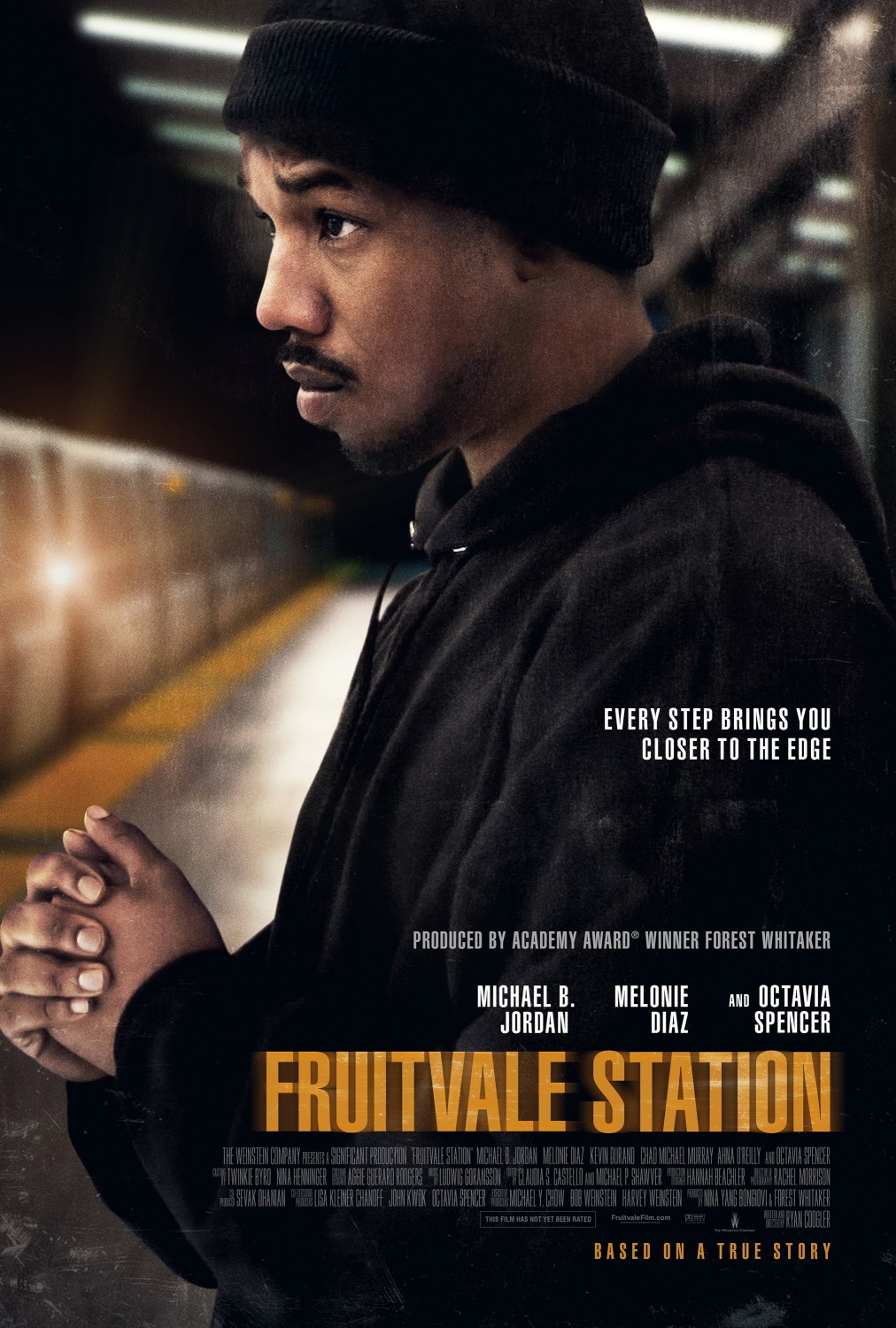
Last Saturday night, a Florida jury acquitted George Zimmerman of murdering 17-year old Trayvon Martin. By an almost perverse coincidence, the verdict came through the night after the release of Fruitvale Station, a film that dramatizes the final day in the life of Oscar Grant, the 22-year old Hayward, California man who was shot in the back and killed by a BART cop, while pinned face down, on the Fruitvale Station platform in the early hours of New Years Day, 2009.
I’d been looking forward to Fruitvale Station since I’d heard, probably a year ago that it was being made. I lived in Oakland when the Oscar Grant shooting happened, just one BART stop away from Fruitvale. I occasionally shopped at the Farmer Joe’s Market where Oscar worked, which appears in the film. I had a couple of friends riding on the Fremont BART line that night who were delayed hours getting home, though they weren’t on the same train and they didn’t know why they’d been delayed until the next day. And I remember sitting in my office watching the verdict come in against Johannes Mehserle, the BART cop who killed Grant, manslaughter instead of murder, and knowing that there was going to be a riot in downtown Oakland that night. Plus, on a minor note, I was optimistic about the casting of the film, in particular that the role of Oscar Grant went to Michael B. Jordan, who played Wallace so memorably on the greatest television show of all time, The Wire.
I saw Fruitvale Station last night, and it didn’t disappoint. It’s not a perfect film: The movie makes concessions to show that Oscar isn’t perfect (he threatens the grocery store manager who fired him, and there is a flashback scene showing him in San Quentin, which is not a place you end up by accident), but he still comes off just a bit too saintly, I think (there’s a scene involving a dog being hit by a car that works as a metaphor–think of the dog as Oscar–but feels like a bit of an overkill if taken as a literal event). The film’s also heavy handed with the foreshadowing at times, especially since the first scene you see is a cell phone camera recording of the shooting, leaving no doubt how it’s going to end. But considering that it’s 27-year old director Ryan Coogler’s debut, I don’t think you could ask for much more, because it is so viscerally, emotionally impacting.
Fruitvale Station is the rare film in which the actual experience of watching the movie feels important. (The other movie I remember feeling this way about was Brokeback Mountain; when I saw Brokeback at the Dome Theater in Concord, California on the night it opened there in 2005, there were news vans parked in front of the theater. It’s interesting how mainstream attitudes toward gay people have changed in the last eight years, huh?) When the real life cell phone footage is shown at the beginning of Fruitvale Station, a number of people in the audience gasped at the gunshot. Then, toward the end, when the scene is reenacted, people gasped again, even though they knew it was coming. This is not the cartoon violence we see in action movies–it’s a portrait of what violence is really like, what it does to real people, in this case a flawed but fundamentally good person we’d spent the previous hour getting to know pretty intimately.
The actual shooting isn’t even as emotionally challenging as the aftermath. After being shot (the bullet, if you read the reports, went in his back, hit the cement platform and then ricocheted back into his chest), Oscar was taken to Highland Hospital, the trauma center where all gunshot victims in Oakland go. He was shot around 2:15 a.m. and died around 9:15 a.m., and the two most devastating moments in the movie involve two mothers: First, Oscar’s mother (played by Octavia Spencer, who is great), who takes a long walk down the hospital hallway to look at her dead son laid out on a slab; and then by Oscar’s girlfriend, the mother of his four year-old daughter, who is left staring blankly, with no idea what to say, when her child asks, “Where’s Daddy?” (I watched the audience file out of the theater after the film, and very few had dry eyes. Some were openly weeping.)
It is the vision of these mothers that stay with me as I walked into the night, as I type this now. In the film, Oscar’s mother tells him to take BART to the City for New Years, reasoning it’ll be safer than driving. And I think of Trayvon Martin’s mother, who surely didn’t think there was any danger in him walking out to the store for a pack of Skittles. Unfortunately for these mothers, and their sons, it wasn’t safe.
It wasn’t, and isn’t safe, mainly because of what the great David Simon called, in his response to the Zimmerman acquittal, “the lewd, pornographic embrace of two great American pathologies: Race and guns.”
If Trayvon Martin and Oscar Grant were not black, they would probably both still be alive today. What’s more, if America didn’t allow poorly trained transit cops (and totally untrained nutjob “neighborhood watchmen”) to carry firearms, Trayvon Martin and Oscar Grant would still be alive.
For me, the element of race was driven home almost immediately. After leaving the theater, my friend Luke and I walked to the nearest subway station, and at the bottom of the stairs we encountered a pair of NYPD officers manning an unannounced checkpoint, with a sign that said: “All backpacks and large bags are subject to search.” Luke had a messenger bag, I had a backpack. We are both skinny, non-threatening white guys, so of course they didn’t search us. I knew they wouldn’t, and I actually wanted them to, even though I’m generally against this sort of personal invasions, just to prove me wrong. But of course I was right, and I have little doubt that if we were black, or, in this case, Middle Eastern, we would have been searched.
The thing is, our government puts in place these sorts of searches, which drip with the potential for racial profiling, at the same time that it prevents any effective regulation of guns, even after the spate of mass shootings we’ve seen in the last couple of years, including the murder of more than twenty school children in Newtown, Connecticut (and really, if that didn’t force a change, nothing ever will). Republicans in congress are so beholden to the NRA that they refuse to curtail gun purchasing rights even for people on the FBI’s terrorist watch list.
To take it even further, the NRA lobby’s (and make no mistake, the NRA defends the Second Amendment not out of Constitutional principle so much as to defend the gun manufacturing industry’s profits) hold on Federal and state government is so strong that it has been able to push through numerous legislatures the exact Stand Your Ground law that helped to acquit Zimmerman.
So we’re left to live in a country with laws that are so screwed up that juries can acquit George Zimmerman, who accosted an innocent kid and then shot the kid after he reacted the way I know I would have if I were in his shoes, or can convict Mehserle of a lesser crime than murder, with a sentence so light that he’s already out of prison, and these juries will have actually made the correct ruling. Unbelievable.
What’s more, we live in a country that values the lives of young black men so little that millions of people, as Luke said to me after the movie, can hear about the death of an Oscar Grant or a Trayvon Martin, and say something along the lines of, “Well, he was probably up to no good.” Maybe racism isn’t the same as when a Mississippi jury took an hour to acquit the killers of Emmett Till, but it still exists in our institutions, is in fact something that our institutions have been built upon. I’m not a black man, but if I were, you’d better believe I’d remember that every time I left the house. And if I were a black parent, I’d think about Trayvon and Oscar before I let my kid out of the house at night. Much of our society is built on an illusory notion of safety, but if you’re a young black male, you can’t even kid yourself: You’re not safe.
There’s one more image that sticks with me from Fruitvale Station: When Oscar is in surgery at Highland Hospital, we see the trauma surgeon remove the bullet from his chest. It’s such a small thing, that bullet, such a small thing to take another young black man’s life. It’s something that has to stop.















 From a Brooklyn Basement
You must be logged in to post a comment.