Why I’m Not Going to AWP This Year

awp-logo

Last February, just a few days after I moved from San Francisco back to New York, I went up to Boston for the annual Associated Writing Programs conference. AWP, as it’s commonly known, is basically the industry convention for the literary world. There are panels throughout the week, ranging from talks given by well-known, award-winning authors to how-to-get-published seminars to silly academic discussion groups that exist so a few friends from an MFA program can say they hosted an AWP panel.

The highlight of the conference is the Book Fair, which consists of a couple of very large halls lined with booths manned by any literary journal, writing program, or independent press you can think of. The spectacle is a bit overwhelming at first, but it’s great fun once you get a handle on it, as you get tons of books for cheap or free and, in general, you’re surrounded by people who are really enthusiastic about literature.

The AWP Book Fair. Like I said, a little overwhelming

The AWP Book Fair. Like I said, a little overwhelming

I’ll admit that there were occasional moments that I felt like I was standing on the outside, looking in at a group of cool kids—I basically feel that way everywhere I go—but I found my trip to AWP to be really inspiring. At the end of the conference I went back to New York feeling like I was part of a community, and with a ton of motivation to step it up with my writing.

Instead, I’ve written barely a word of fiction in the last year, and when a friend tried to get me to go to Seattle for AWP this week, I said, absolutely not.

I don’t intend to write a screed against AWP. It’s just that I’ve been thinking a fair amount lately about how I’m using my time and creative energy and, beyond that, how I look at and define myself. So, what’s changed? And what happened between AWP 2013 and 2014?

I’ll answer the second question first. When I left Boston last year, I used my festival materials to draw up a list of journals to submit to, and over the next month or so, I sent out several short stories and novel excerpts, along with a couple of full novel manuscripts, to journals and publishers. I sent off around 50 submissions in total.

Now, for those who don’t know how the literary world works, basically there are a million small literary journals out there, some print, many now online, that publish short stories and novel excerpts. These journals are where you find the best contemporary literature being written today, and publishing your work in them is one of the two main ways to build your profile/career in the literary world—in other words, to give yourself a shot at getting a novel published someday. (The other way is to go to a hotshot MFA program like Columbia or Iowa, which of course also helps you get published in literary journals. That tail is looking tasty, isn’t it, Ouroboros?)

A graphic depiction of my fiction-writing career

A graphic depiction of my fiction-writing career

By 2013, I already had plenty of experience submitting to these journals. Hell, I remember the days you had to actually print out your stories and mail them to the editors’ offices in New York or Alabama or Nebraska or wherever. These journals get far more submissions than their meager staffs can handle, because writers submit to far more journals than they actually read (I’m as guilty of this as anyone), and as a result, it often takes six months to get a rejection. And the rejections they will come. You learn not to take it too personally.

I’ve actually had a couple of pieces published in small journals—actual print ones, even—so I know that it is possible to get work accepted, even though it often feels hopeless. And I think I was pretty smart about how I did my post-AWP submission round. I cast a wide net: I read a bunch of journals, submitted to a mix of both print and online pubs, didn’t bother with any of the big names (I gave up on Ploughshares and Tin House long ago), and submitted a range of things, from 100-word flash pieces to 10,000-word sections of my novel.

And I waited. And the rejections rolled in. They came in waves—I’d go a month without anything, and then get five in one day. A couple of months ago I looked across my spreadsheet, and realized every single one of my submissions had been turned down.

Again, this wasn’t my first rodeo. I can’t even tell you how many short stories I’ve had rejected. My novel, Stumptown, USA, which my MFA thesis advisor told me she was sure would get picked up by an agent and then published, got turned down by more than 100 agents and publishers. I know my book is good, and I know that it’s never going to see the light of day (unless I self-publish it), and I’ll never understand why. And when I looked at the bloodbath that was my publishing record in 2013, I said, Fuck this. It’s not worth it.

To tell the truth, I think I’d been building toward that conclusion for a while. As I said, I’ve barely written any fiction in the last year, for several reasons. First was this blog. Part of why I never started a blog before last year (by the way, From a Brooklyn Basement’s one-year anniversary is next week!), even though numerous friends had exhorted me to do so, is because I knew I’d have a hard time maintaining an active blog and writing fiction at the same time. I have only so much writing time, and I don’t multitask well. And, as I knew would happen, when I did start writing blogposts, and I found it to be fun (and about a million times easier than writing fiction), I ended up spending my writing time doing those.

The second thing that happened was I found a creative outlet outside writing: I’ve been playing guitar in the Brooklyn jam scene for a while, and a couple of the guys I was playing with invited me to form a band.

Over the last few months we’ve been very active writing and rehearsing songs, and we recently started gigging at Brooklyn bars. It’s going pretty well, but that shift in creative focus has been tough for me. I know I’m a much better writer than I am a musician. Hell, I don’t even use the word musician to describe myself—I tell people I play guitar in a band. That may not seem like much of a distinction, but I think there’s a big difference between saying you do something and defining yourself as that thing (more on this in a minute).

Sometimes I feel bad for pursuing a creative project that I know isn’t my real strength. I wonder if it’s a waste of time—at least relatively. But, on the flip side, playing music is fun. I get to hang out with cool people, drink a few beers, make some noise, maybe even talk to girls. Whereas writing is an almost entirely solitary action, one that involves, to paraphrase the old saying, sitting down, opening your veins, and bleeding. What would you rather spend your time doing?

Finally, as if there wasn’t enough competition for my creative attention, I got a new job, working as the managing editor for a couple of airline magazines. The job was a tremendous score—it’s a huge professional boost, it allowed me to stay in New York, and it’s pretty much the best job I’ve ever had—but it requires me to work a lot of hours, and I often come home late and exhausted, and the last thing I want to do is sit down and write more words.

Allow a short digression: A couple of weeks ago I was watching an episode of Girls in which Lena Dunham’s character, Hannah, gets a job writing advertorials for GQ magazine. Feeling defensive about the implications of the job (sell out!), she tells her coworkers she won’t be there for long because she’s not a corporate stooge—she’s a real writer (paraphrasing again here). They all respond by listing publication records far more impressive than hers. Of course, at the same time, they admit that none of them work on their own writing anymore.

Hannah Horvath, getting ready to say something stupid. God, I hate her character—so obnoxious and self-centered

Hannah Horvath, getting ready to say something stupid. God, I hate her character—so obnoxious and self-centered

This scene killed me, because Hannah’s initial speech was exactly the sort of thing I would have said when I was 25—and now I’m one of those other characters. I used to think I was going to be Hemingway; now I edit airline magazines.

This sounds like a complaint, but it’s not—at least not much of one. I don’t know why I didn’t have more luck as a “real” writer. Maybe the publishing industry is too screwed up. Maybe I’m just not good enough. But I don’t take my job for granted: I’ve worked enough shit jobs to know I have a good thing now, and I’m pretty sure 90% of the people who went to my (not exactly Iowa or Columbia) MFA program would trade places with me in a second. But I also know that when I used to meet people, I would tell them I was a writer. Now I tell them I’m a magazine editor.

So I hit a dead end with my fiction career, but between the job and the band and what has been, on the whole, a massive turnaround in the quality of my life in the last six months, I’ve never felt better about myself. But going to AWP would make me feel like shit, because it would just cause me to pick at the scab of a huge disappointment. And I’m done feeling like shit about myself.

So, you won’t see me at AWP this year. And really, I’m not all that sorry about it.

Also: Fuck you, Seattle. GO NINERS!

49ers-Logo-Red

Posted in Writing | Tagged , , , , | Leave a comment

An Album I Love: Southeastern

At my office, it’s a tradition for everyone to share their top 10 songs of the year. When, just before Christmas, a coworker asked for my list, I responded, “I haven’t listened to a song released in 2013. I am the least hip hipster ever.” I thought about it for a while afterward, and while the sentiment was basically true, it wasn’t factually correct. There was one album that came out this year that I not only purchased, but really loved: Jason Isbell’s Southeastern.

JasonIsbellReview300

Southeastern is the fourth solo album for Isbell, who first came to prominence as a member of Southern rock band the Drive-By Truckers. I casually enjoy the Truckers’ music, but I couldn’t really name you any of their albums or any of the other band members. Isbell ended up getting kicked out of the band for being a destructive alcoholic—and seriously, you know you’re a real alcoholic when you get kicked out of the Drive-By Truckers for being too drunk—and he launched a solo career. His work found his way into my alt-country Pandora playlists, but it didn’t really reach out and grab me and force me to pay attention to him.

My first real exposure to Isbell came when I saw Ryan Adams play at the Crest Theatre in Sacramento in October 2011, during the Ashes and Fire tour. Adams was playing solo acoustic, and Isbell was his opener, also solo acoustic. I got there a bit late and only caught the last couple of songs of Isbell’s set. He ended up coming back out and playing with Adams on Ryan’s encore, which led to the highlight of the concert: It was the last show that Isbell was playing on the tour, and Adams apologized to Isbell for forcing him to listen to “satanic death metal” on the tour bus, and then played a faux death metal tribute to their friendship that is, to this day, one of the funniest things I’ve ever seen.

I didn’t know anything about Isbell’s alcohol problem, but he was obviously bloated and out of shape at that show, and apparently right after that tour he checked into rehab, thanks to the urging of his wife and Adams–once a famously destructive alcoholic and drug abuser himself.

It’s my general policy to be against sobriety, but if Isbell getting off the sauce led to Southeastern, then more power to him. The songs on the album are beautiful, heartfelt, sometimes wrenching pieces, many of them about journeying back from the depths of alcoholism. It opens with Cover Me Up, a song that Isbell wrote for his wife, which is mostly just him and an acoustic guitar. He sings with a great physical power—he really projects his voice on the chorus—about “days when we raged” and then sobering up and refusing to leave the room he shares with his lover.

The second song, probably my favorite on the album, is called Stockholm, an apparent reference to the famous Stockholm syndrome, in which a captive comes to feel bonded to his captor. It’s a smart way to allude to addiction, and has a bridge with lyrics that I just love: “Tie me up tight in these shackles I wear/Tied up the keys in the folds of your hair/And the difference with me is I used to not care/Stockholm, let me go home.” On the second bridge, he slightly alters the lyrics, in part to ascribe credit for his recovery to his wife, saying “The difference with me is I’ve fallen in love.” It’s a kickass song.

Not every song on the album is about Isbell’s addiction and recovery. Elephant tells the story of a man watching a young female friend die of cancer. It’s a gut-wrenching song that contains lyrics like “Surrounded by her family, I saw that she was dying alone,” and “There’s one thing that’s real clear to me/No one dies with dignity.” It closes repeating the line “We just try to ignore the elephant somehow,” referring to the white elephant that is our own mortality. As someone who watched my closest friend die when she was just thirty-one years old, I find it devastating, to the point where I have a very hard time listening to it. Of course, that’s a sign of the song’s emotional truth.

I could write a mini-essay about nearly every song on this album. We haven’t even touched on the fantastic breakup tune Songs that She Sang in the Shower, or Live Oak, an outlaw country song that artfully uses a man’s story of a life of crime as a metaphor for Isbell’s drinking days. The point is, most of the songs on Southeastern are great. Just go buy the damn album already.

Posted in Music | Tagged , , , , | Leave a comment

2014 Super Bowl Pick

Denver 49, Seattle 0.

Fuck you, Seabitches.

Posted in football, Sports | Tagged | Leave a comment

Ein Name Macht Frei

It is raining. I’m riding on what the woman at the bus station in Krakow called, in surprising English, a minibus. Maybe five rows of seats. I am sitting next to an Asian woman. She must be going where I’m going—why else would she be here, on a small bus in the miserably rainy Polish countryside? I am sure we’re going to the same place, but we don’t talk. The bus is full, but no one talks. I wonder who else is going to the end of the line. Are these tourists, or Polish people getting off somewhere along the way?

In the row behind me an old Polish woman sneezes and blows her nose. Every few minutes, she repeats. It is the summer of swine flu, and I lean forward, hoping to be out of range of whatever she is sneezing toward me, and look out the window. The scenery is pleasant, though unremarkable. Green trees and fields. A two-lane country highway passing small, solitary houses with vaguely attractive rounded iron fences.

My guidebook says that the bus ride takes an hour and a half. We left the station just before 10 in the morning. I keep checking my watch. My stomach gets upset when I’m nervous, and as it gets closer to 11 and then 11:30 I feel the rumbling grow. I’m glad I only had a piece of toast for breakfast. I’m sure I could not have kept anything else down. As the feeling gets stronger, my guts clamping down on themselves, I think, why are you doing to this to yourself? Why do you feel like you have to see this?

The bus stops next to a chain-link fence. A few people have gotten off or on over the course of the ride, but everyone still on the bus gets off here. Once off the bus, the other tourists group together and walk through a gate in the fence. I walk behind, a little slower, fiddling with a cheap umbrella I’d bought in Paris the week before. I have been in Europe for three weeks, traveling with a friend from school, but I broke away from my travel partner to do this leg by myself. I told him I needed to be alone for this.

I walk up the drive, past a parking lot full of tour buses, to the visitors’ center. Admission is free. Signs in the lobby urge you to book a tour guide, or to latch on to one of the many tour groups gathering there. I do neither.

Before heading out, I stop to use the restroom, which charges 1 zloty (about 30 cents American) to enter. In Eastern Europe it is common for public restrooms to charge a small fee. I have a small bladder, and in this part of the world it is costing me. Literally. I drop the coin on the table at the restroom entrance and mutter, I hate this fucking country, as I take a piss.

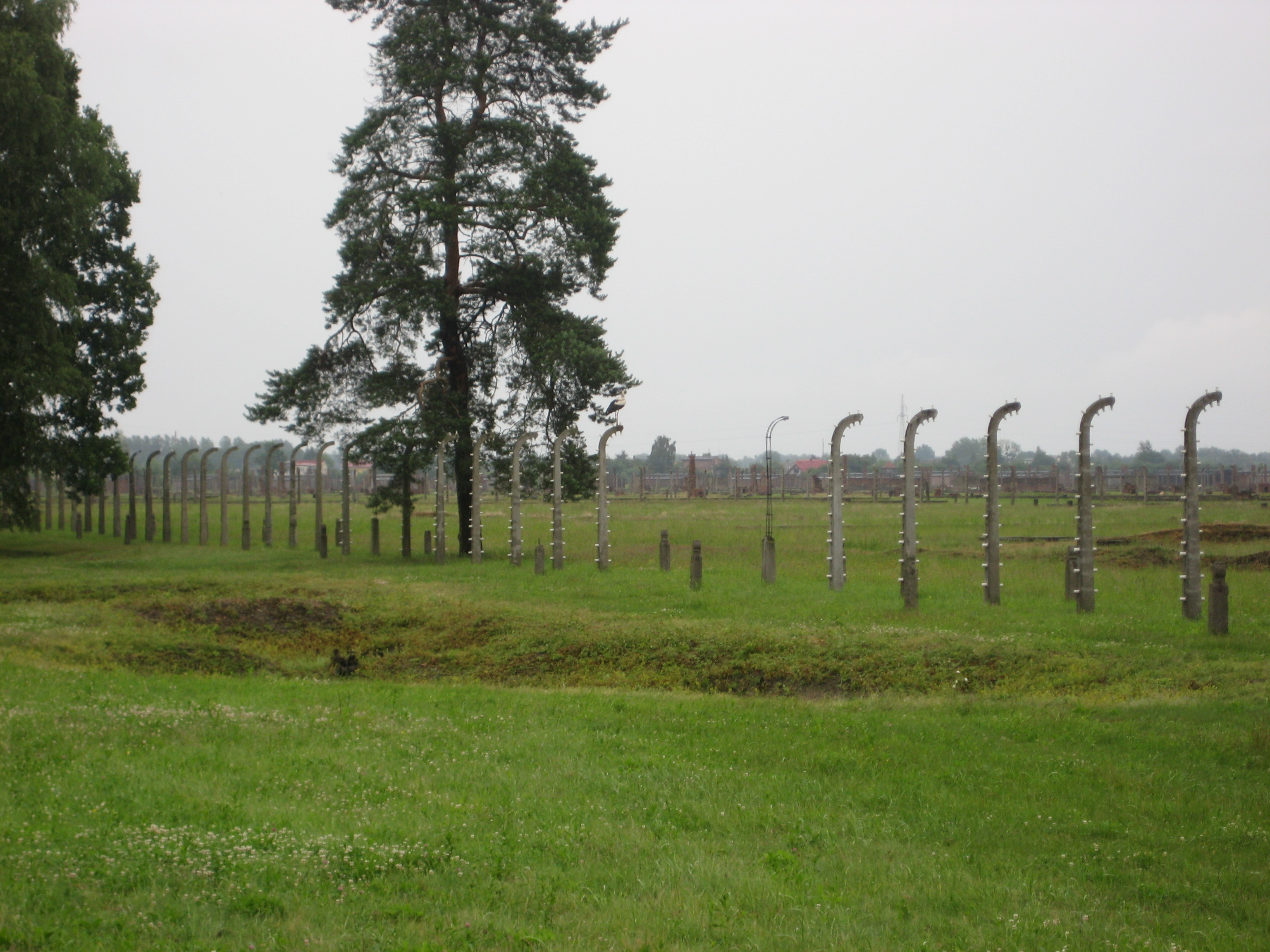
Finished in the restroom, I exit the visitors’ center via the side door. The gate is the first thing that I see. It is maybe 30 yards away, and a gravel path runs through it. I follow the path and stop a few feet short of the gate, the iron curled into those infamous words, Arbeit Macht Frei. Work makes you free. Barbed wire runs from the gate around all sides of the camp, two rows of fencing with a space about six feet wide between. The nodes through which electricity was pumped into the wires still protrude from the fenceposts.

I did not know how I would feel when I saw the gate. I’d been afraid that I’d throw up on the spot. But at this moment I don’t feel nauseated. I feel perhaps a small sense of wonder, but mostly I feel the feeling of feeling nothing. I take a photo. It doesn’t turn out well—there is a leafy green tree behind the gate that obscures the word Frei.

That old lie: Arbeit Macht Frei

That old lie: Arbeit Macht Frei

I stand before the gate, holding my camera. I debate whether or not I want to get a photo of myself in the gateway. I can’t decide if it’s disrespectful to the dead. I begin to walk through the gate. I stop and turn, looking around . I am indecisive by nature, and I often pace when I can’t decide what I want to do. I turn and walk back out the gate. I can delete the photo later if I decide it was a mistake. I ask a big, thick man who looks either Polish or Iowan to take a photo. He doesn’t speak English, but I hold out the camera and he gets it. When I look at the photo, I see myself standing below the gate, my mouth a tight, unmerry line in my patchy three-week-old beard. I am holding my umbrella open, pointing it to the ground, in a pose that makes me think somehow, absurdly, of Mary Poppins. I do not delete it.
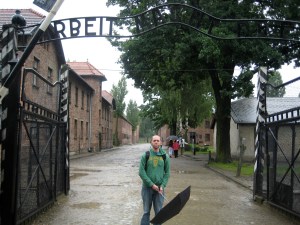
Is this a photo I should have taken? You tell me.

Is this a photo I should have taken? You tell me.

I walk around the edge of the camp, circling the rows of brick barracks. The rain patters against my umbrella, the gravel and gritty mud of the pathways crunches under my shoes. I try to steer clear of other people. After I’ve gone around the grounds once, I walk up a row between the barracks. Many of the buildings have been converted into exhibition halls. Because I walked around the perimeter first, I end up taking the exhibits out of order. The first one I enter is dedicated to crimes against the gypsies. The building is nearly empty; I see only one other person, a man with a graying beard and a purple rain jacket. I walk through the exhibit slowly, taking time to read most, if not all of the plaques chronicling the persecution of the gypsies. I think that these people suffered and were wiped out the same as my own. I have at times been guilty of privileging the suffering of the Jews, playing the whose-had-it-worse game (Don’t play the race card with me, my people got gassed and burned), but I’ve come to feel that that is unproductive. I’d like to treat this visit as an observance of everyone who died here—not just the members of my own family.
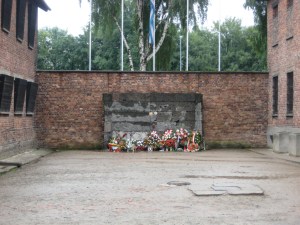
A wall against which people were shot, before the gas chambers were built

A wall against which people were shot, before the gas chambers were built

A building in which Nazi doctors performed sterilization experiments on women

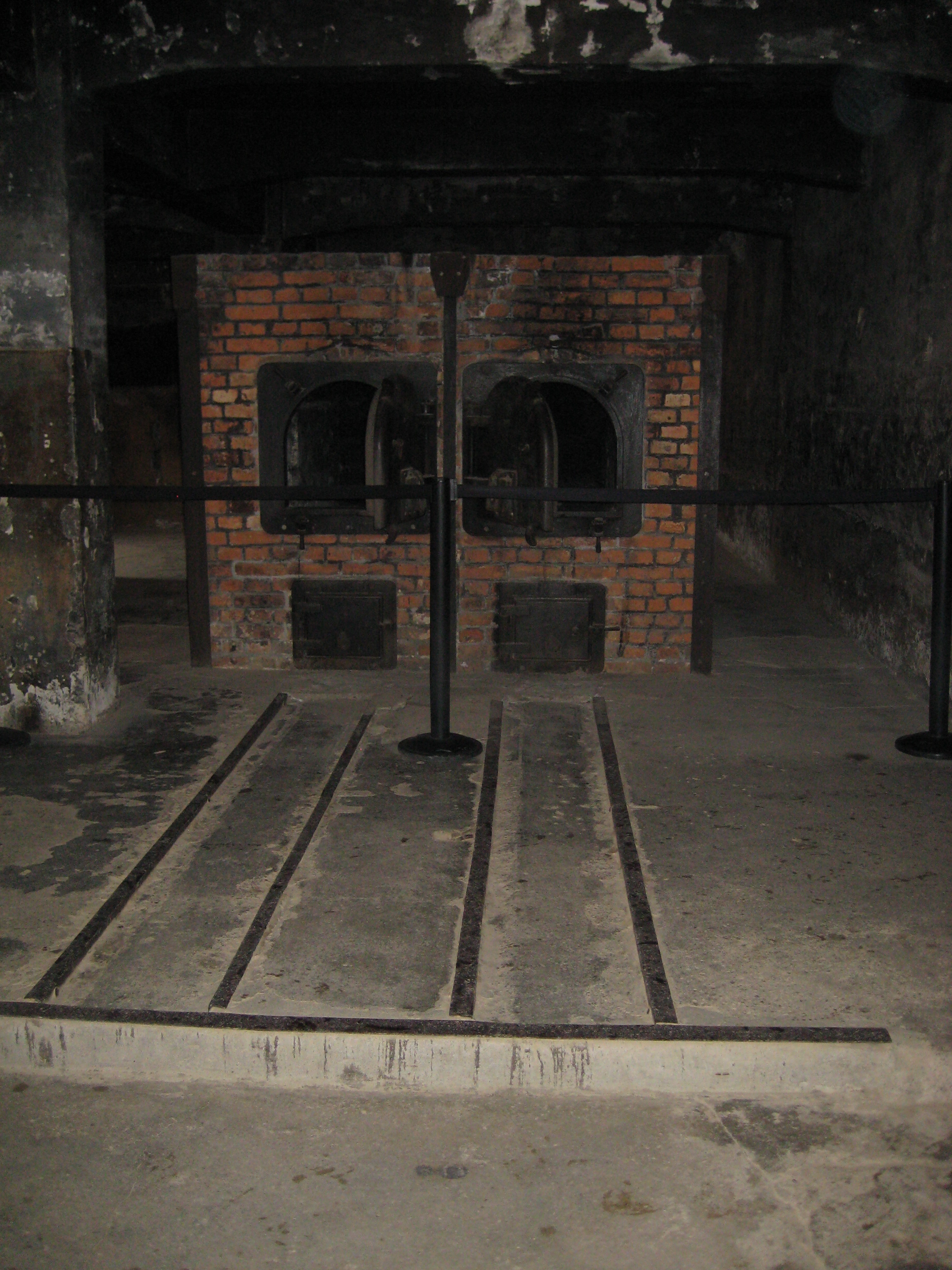
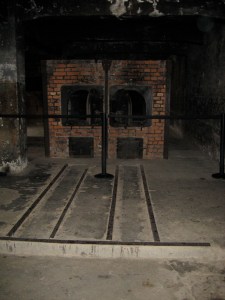
Crematorium Ovens

Crematorium Ovens

I walk. I see more barracks, more exhibits. I see piles of Zyklon B canisters. Piles of suitcases, shoes, hairbrushes, toothbrushes, items that people were stripped of, forever, the moment they stepped from the boxcars. In one room I find a glass case full of children’s shoes. This hits me hard. The shoes are so small.

Another room houses an enormous glass case full of human hair. A plaque explains that the Nazis collected the hair shorn from prisoners and used the fibers to knit nets and curtains and such. I stare at the case. It holds thousands of pounds of hair. The sign at the entrance of the room bears the words Exploitation of Corpses, and I can’t help but feel that the Nazis aren’t the only ones who know how to cash in on the dead. The piles of suitcases and shoes and the children’s dolls and other things are possessions, objects, but the hair, the hair is a part of the victims. The distinction is important. It isn’t right to display this.

In many of the barracks, the hallways between galleries are lined with photos of camp inmates. The Nazis took headshots of everyone admitted to the camp, until the number of admissions became too great. Each photo on the wall includes the inmate’s name and number—the number that was tattooed on his or her arm. I scan every photo, looking for a Goldman or a Borenstein. I find none. Some of the faces are blurry, presumably because the inmate moved as the shot was taken. The people in the photos mostly have shaved or closely shorn heads, though some of the women look out from hair tossed wildly around their faces. The expressions on the faces of these women seem more shocked than on their counterparts. It is the hair, but there is something in the eyes as well. I wonder what these women have seen that the others have not.

The thing that strikes me about these hundreds, maybe thousands of photos is that the faces are unremarkable. These are just people. Even shaved and tattooed and garbed in identical striped camp uniforms, after every attempt to strip away their humanity, their individuality, each of these photos is of a person. A person sent to this place to die.

I have been in the camp for several hours by now. There are barracks dedicated to victims from various countries—Primo Levi’s Italy, Elie Wiesel’s Hungary, Anne Frank’s Netherlands. I walk quickly through a few of these and skip a few more. I am wearing old, worn out shoes, and though I have no wish to privilege my family’s experience over any other, my feet insist that I hurry up and get to the point.

I reach the barrack dedicated to Poland. The exhibit is large and disappointing. Room after room, there is no mention of the Polish Jews. More than three million Jews lived in Poland before the war, a population that was annihilated. More than 300,000 Polish Jews died in Auschwitz alone. But all I see throughout this building, indeed, anywhere in the camp where the gentile Polish are mentioned, are exhibits celebrating the Poles who helped Jews hide and escape, the Poles who fought in uprisings against the Nazis. No mention of hundreds of years of anti-semitism. No mention of pogroms. No mention of the swaths of the Polish population who were perfectly content to let the Nazis deal with their Jewish problem, with the added bonus that they got to pick up whatever property the Jews happened to leave behind.

I am angry at this museum and at this country. I had already wondered if traveling here was a good idea. My father told me he wouldn’t do it. He believes the Polish are profiting on the ashes of a destroyed civilization, a civilization in whose destruction they were complicit. The compromise I decided on was that I would go to Jewish Museums, paying the admissions fees when there were any (figuring that admissions costs go to museum upkeep, and it was good to have the museums to encourage the remembrance of the extinguished culture), but that I would not buy any souvenirs—nothing that would go in the pocket of a Polish Catholic selling a Star of David pendant to make a quick buck. But is this compromise enough? The lack of acknowledgement of Polish complicity here confirms my father’s worst suspicions.

I am done with this exhibit. I come down a flight of stairs, into the last room in the Polish hall, ready to breeze through and take leave of this place. But at the bottom of the stairs, against the wall, I see a sideboard bearing two white binders full of laminated pages. I pause and take a look at the pages. Lists of names and numbers. A list of Polish citizens who were imprisoned in the camp, taken from the official camp registry.

I flip through the book until I reach the letter G. I do not know what I will find. I don’t know my grandparents’ Polish names—they were probably changed when they came through Ellis Island (my father’s given name is Stanislaw, but his American papers say Stanley). Plus, later in the war, when mass transits began to come through the camp, many prisoners weren’t registered. Certainly not the ones that went straight to the gas chamber.

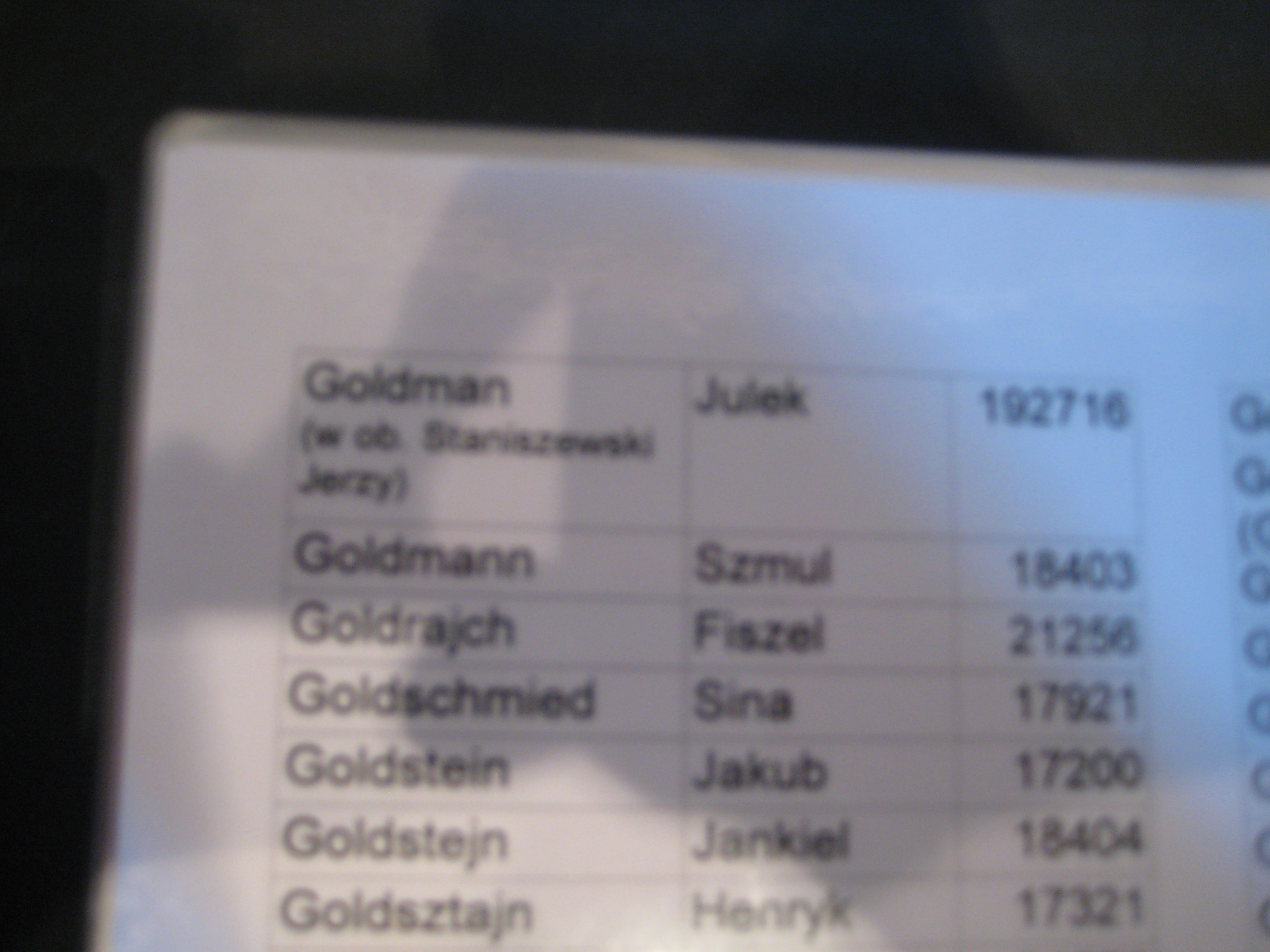
I find three Goldmans. A Samuel, a Szmul, and a Julek. No Josef. It makes sense that my grandfather wouldn’t be in the log. He fought in the Polish army, and when the Nazis captured him, he hid his identity. He was sent to work in a mine in a POW camp, and was only sent to Auschwitz late in the war when someone discovered he was circumcised. My grandfather survived the war, thanks in large part to those years in the mine, the mistaken identity. The wife and children that he had before the war, his first family, were not so lucky. I do not know if they came to the gas chambers at Auschwitz, or succumbed to heat and thirst on a boxcar, or submitted to the disease and starvation of the Lodz ghetto. I do not know the names of these people, my aunts and uncles.

Really, I don’t know much about my grandfather. He died in 1988, when I was seven years old. He was a baker and spoke little English, though he lived in New York for more than 30 years. My memory of him is only an image—a round old man in a long gray coat and a hat that might have been plaid, coming through the door and into the narrow blue walkway of a small apartment, a loaf of bread under his arm. I do not remember ever seeing the number on his arm, and while my father is sure of its presence, he cannot recall the exact number, so I have no point of comparison for the names in this book. I take a photo of the page, just in case.
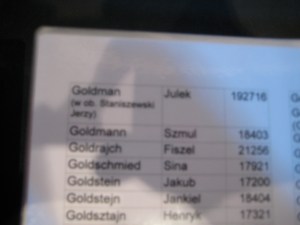
No sign of my grandfather

No sign of my grandfather

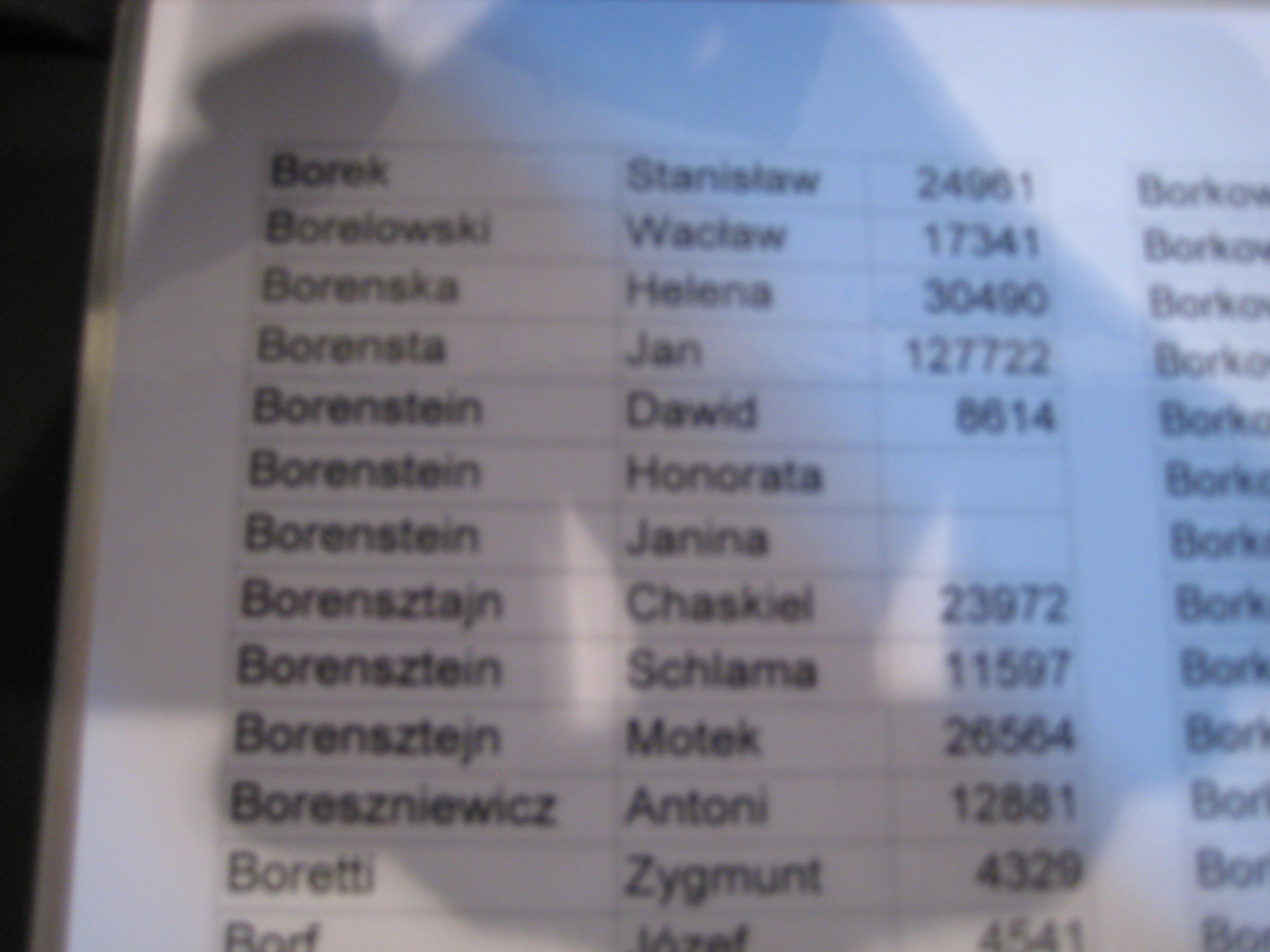
I flip back through the pages until I find the Bs. There are six Borensteins listed, including alternate spellings. There is no Gina, but I do find a Janina. This name, unlike most of those in the book, does not have a corresponding number. The space where the number should be is simply blank. My grandmother had no tattoo. No one knows why she didn’t have one. Nor what she had to do to avoid it.
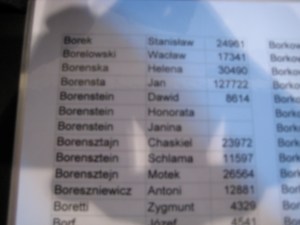
My grandmother's name?

My grandmother’s name?

I stare at the name. It has to be her.

***

Imagine you are a small child. Your father is a graduate student. Your mother works as a nurse, often on the night shift. Both are gone long hours. You spend these hours with your grandmother. A bond is forged between the two of you before you are even conscious, self-aware.  Most of the photos taken of you when you were a baby, the ones that hang on your parents’ wall to this day, are taken in your grandmother’s apartment. Your first memory is walking through a light snow from this apartment to the Bronx Zoo, holding your grandmother’s hand. Her long, slim, fingers wrapped around yours. Holding tight.

Imagine always knowing something terrible happened to this grandmother, who you loved before you knew what love was called. This terrible thing happened long ago, and your grandmother will never talk about it. When you are ten years old, you have to interview an old person, ask her about her life when she was a child, as part of a homework assignment. Of course you choose to interview your grandmother. Your father tells you, don’t ask about the war. Only ask about before.

Imagine your grandmother picks you up from school everyday. She walks the four blocks to meet you and your younger sister in the schoolyard, and walks back listening to you describe each day’s happenings. Only one day she doesn’t show up. You and your sister wait in the schoolyard, at the edge of the chainlink fence. It is hot. You are sweating. You begin to feel panicked. Where is she? You walk the edges of the schoolyard, and when you can’t find her you rush home. You find her in her room, sitting in bed. She is reading a book. When you ask her where she was, she says she’s been there all along.

Imagine your grandmother begins to forget other things. She leaves a pot of water boiling on the stove. She loses money, and when she can’t find it she accuses your sister of stealing from her. Your sister is nine years old, maybe ten.

Imagine your parents put your grandmother in a nursing home. Imagine she starts calling at all hours of the night, every night, calling your father, saying that people are at her door, that they’re coming for her. Your father gets a second phone line, hooks up the phone and turns the ringer’s volume all the way down so it won’t wake up the rest of the family. The answering machine fills up.

Imagine the messages on that machine.

Imagine that you are sixteen years old when your grandmother dies. You do not see her in the last few days of her life. You don’t even know why. You just don’t visit. You always feel guilty about this. You hear later that the last time she saw your father, she did not recognize him.

Imagine you can’t talk about this with people. Not even your father. A decade passes, and the only time it ever comes out of you is on a bad night of drinking. You go to Holocaust museums, you see Schindler’s List, Life is Beautiful. Everything makes you feel worse. When your best friend tries to tell you that rank and file Nazi soldiers shouldn’t be held responsible for their actions, your argument nearly turns into a fistfight. It is the closest the two of you ever come to blows.

Imagine a dozen years pass. You plan a summer trip to Europe. Poland is not on your original itinerary, but halfway through the trip, you realize there’s really only one reason you crossed the ocean.

Imagine you’re on a train from Prague to Krakow. You’re sitting with a couple of nice British kids, a guy and a girl, 22 or 23, fresh out of university. They’re funny in the way that British people tend to be, witty in the way they use their words. They will be in Krakow for two days, and plan to visit Auschwitz. (Every traveler you meet in or on the way to Krakow plans to visit Auschwitz—it’s the main tourist draw.) The guy gets up to use the bathroom in one of the other cars while the train is stopped at a station. While he is up the train splits, half the cars going to Krakow and half going somewhere else. The guy is almost caught on the wrong car in the switch, and the girl, who is sitting next to you and is very pretty, makes a joke about him ending up on the train to Auschwitz. You say that everyone who visits the camp should have to ride there in a boxcar. The three of you make a few more jokes, imagining a Universal Studios Auschwitz Experience. You laugh. It seems funny. You can tell the British kids mean no disrespect. They seem apprehensive about visiting the camp. They wonder if a few abandoned buildings in a field can hold the power of what happened there years before. You wonder the same thing. You are sure they wouldn’t have made the jokes if you had told them about your grandparents. You do not tell anyone you meet on the train or in Poland about your grandparents.

Imagine, after all this, you’re now standing above a binder holding thousands of names and numbers, all that is left of nearly all the people listed therein. You stand above this binder and you stare at your grandmother’s name.

***

I look at the name and all I can think is, wow. That’s it. I don’t cry. I just think, wow. I take a photo of the page and exit the building.

I think about that name as I walk. I can’t decide how I feel about it. In a strange way, I feel … good. Walking around the camp, I hadn’t felt a sense of atonement. It seemed the Polish were taking the easy way out by saying, the Germans did this. Seeing the name doesn’t make me feel like there is atonement going on, but I do feel something else now, something just as important: acknowledgement. Acknowledgement that she was there. That her suffering is remembered. That what happened at Auschwitz and throughout Europe is not just that number, six million, that we always hear. That these were individual people. Nothing will ever make it better. She left part of herself there. She was damaged in a way that most people can’t imagine. There’s no way to recoup that suffering, but at least it is acknowledged. That means something.

This is what I think as I walk three kilometers from the first camp to the second. Auschwitz II (Birkenau) was built about two years after the first camp opened. It was the true death camp, the site of the gas chambers and the crematoria. The place where death went industrial.

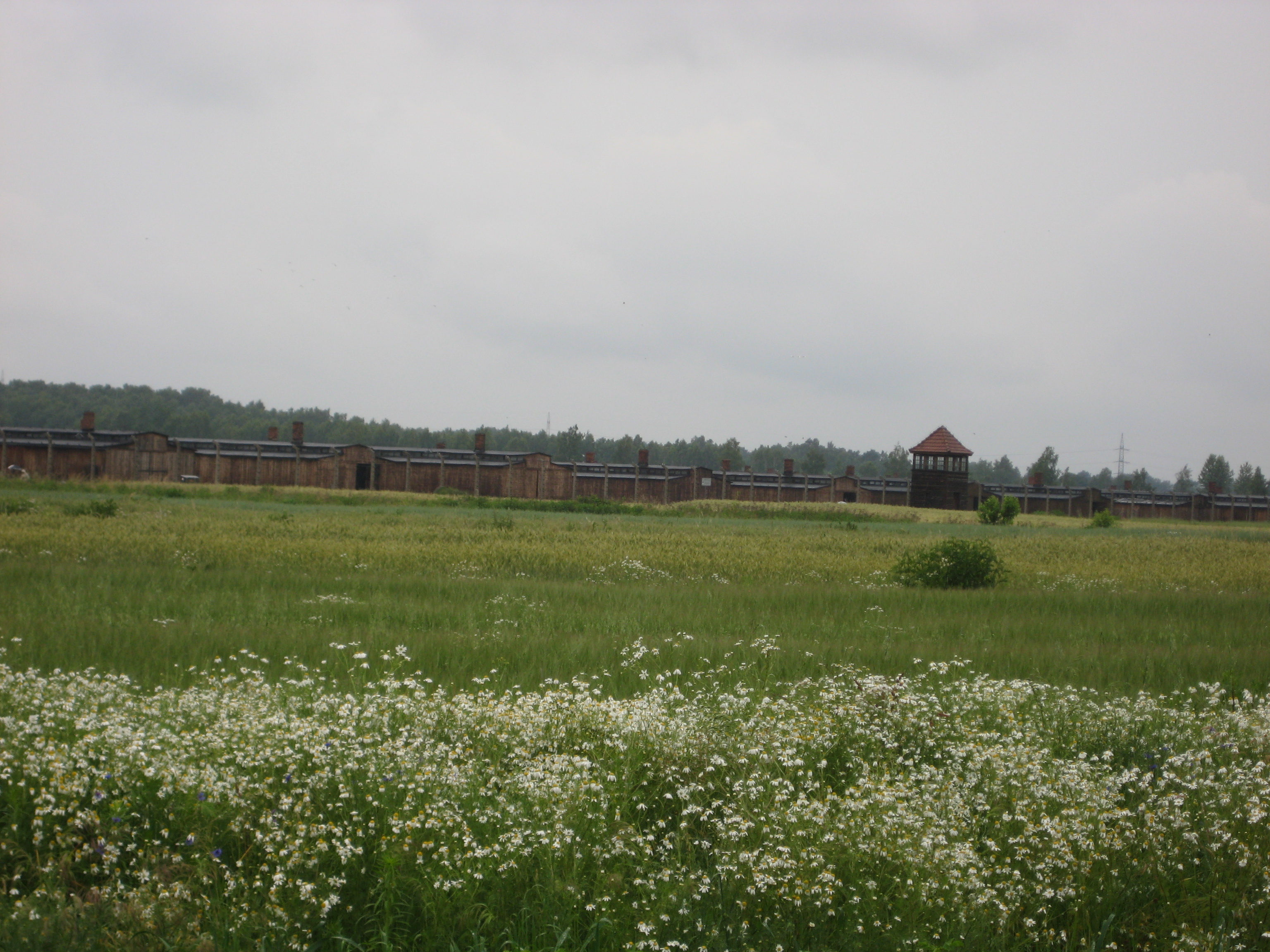
A flowering field, with Birkenau in the background

A flowering field, with Birkenau in the background

I walk for maybe ten minutes along a two-lane paved road. The sidewalk is lined with trees. I see a sign for Birkenau pointing up what looks like a freeway entrance. I walk up the ramp. It doesn’t go to a freeway at all. It just goes up and then descends again to a flat, narrow road with no sidewalk. I follow the road past a few country houses and then I come around a bend and I am looking straight down the railroad track that passes through the Gate of Death, the square brick entrance to Auschwitz-Birkenau.

The Gate of Death

The Gate of Death

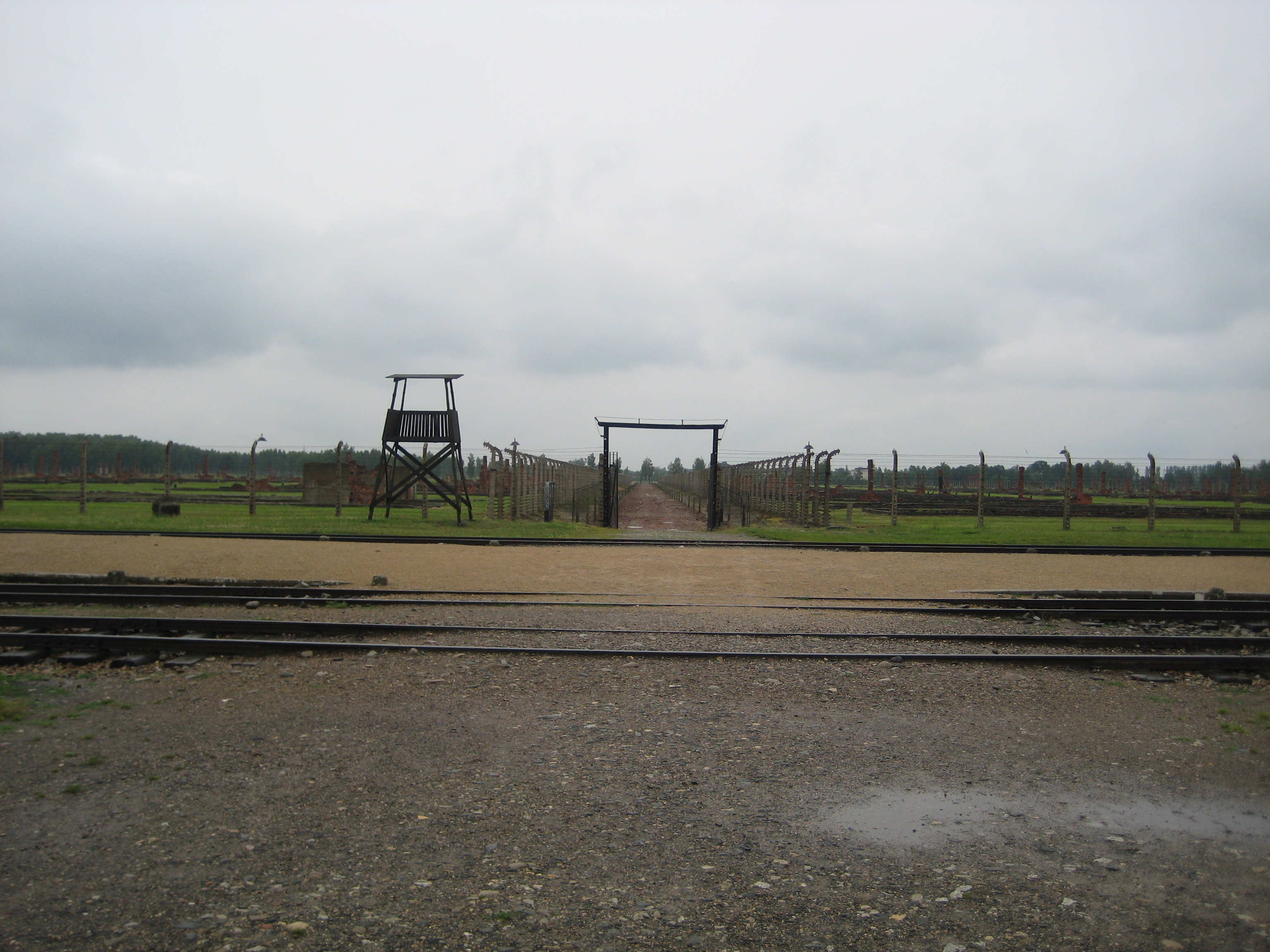
The thing that gets me about the second camp is the size of it. The Nazis destroyed the crematoria and gas chambers when they fled—they’re just piles of brick and concrete now. Many of the barracks are gone as well, with only the brick chimneys remaining. But the grounds of the camp, they stretch on and on. A mile-and-a-half long. A mile wide. More than 400 acres. All that barbed wire.

It's impossible to capture the size and scale of this place in a photo from the ground

It’s impossible to capture the size and scale of this place in a photo from the ground

It is after three o’clock. I haven’t eaten since 8 a.m., but I refuse to buy food at the concession stands. (I refuse in part because of my no-helping-someone-make-a-buck-off-human-suffering rule; in part because of my nervous stomach; and, in part, I suppose, because I feel I should go hungry here). The cloth lining in the heels of my shoes has worn all the way through. I can feel the raw burn of new blisters. My feet beg me to stop, head for the exit, find a seat on the next bus home. But I walk all across that camp. I walk on the tracks, hopping from tie to tie, until I reach the guardhouse where the Nazis drove people off the trains to make their selections, to decide who would die now and who would die later. I stand on this ground and imagine hundreds of people having their bags ripped from their hands, being clubbed if they cried out. The screaming. I walk between two tall barbed wire fences, down the road that women and children who were sent straight to the gas chamber walked. I am reminded of the ramps in a slaughterhouse.
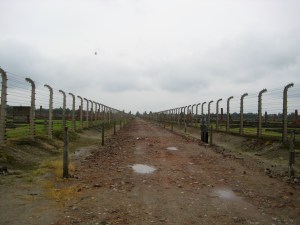
The path taken by people who were sent straight from the trains to the gas chambers

The path taken by people who were sent straight from the trains to the gas chambers

On the far edge of the camp I see a small deer spring between the chimneys. I try to take a picture, but the deer is moving too fast. It is so vibrant, so full of life. But it is trapped inside the barbed wire. It can’t find its way out. The deer bounds out of sight. I never see it again.

I stare after the disappeared deer. I grind my feet in the gravel footpath. My anger is a dull, consuming hardness, as if I were encased in stone. In my three weeks in Europe, I’d crossed paths with many German people. On the whole, I found them to be the kindest, friendliest people I encountered in my travels. I had harbored ill feelings against Germany ever since I was old enough to hold a grudge, but in meeting German travelers and reading about German efforts toward atonement, the monuments in Berlin, the laws against denying the Holocaust, I had begun to wonder if I should let the grudge go. I thought about adding Berlin to my itinerary. But traversing the vastness of Birkenau, I feel that sentiment wane. I cannot forgive the routinization of murder. It’s not the act of murder that I can’t forgive—it’s the way that murder was industrialized, put on the assembly line. This is what I think as I walk between barbed wire fences, on roads small children trudged to their deaths, through stands of trees where people had to wait their turn to die because the gas chambers were full, past ponds and pits where the ashes of the dead were dumped, past the wreckage of the crematoria, piles of brick that look like they’ve collapsed in on themselves, the way I imagine a body without a soul would crumple, from the inside.

The remains of a gas chamber and crematorium. The Nazis razed the buildings when they fled the Russians—an attempt to destroy evidence
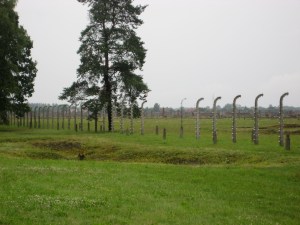
The remains of a gas chamber and crematorium. The Nazis razed the buildings when they fled the Russians—an attempt to destroy evidence

A pit where people's ashes were dumped

A pit where people’s ashes were dumped

I think of my inability to forgive, and I think of the members of my family I will never know who walked these paths, and I think of my grandmother and grandfather, who somehow avoided these paths, who somehow stayed alive until the camp’s evacuation, who somehow escaped during the death march from Poland to Germany. Was that how they met? Under a snow-covered bush, listening to the shuffling feet of the walking dead, the shouts of the S.S., waiting to be noticed, waiting for the bullets that would take them to the end they’d somehow escaped when they eluded the gas? Was this where the elements that ultimately formed me began to bond? I do not know. I won’t ever know, now.

As I leave the camp, passing through the same gate my grandparents did as they were driven west, I find two conflicting impressions stand out. The first is disbelief at the scale of the operation of this genocide. What’s left of the camp now is just old buildings and what’s left of other old buildings. It’s a place where people did terrible things to other people a long time ago. There are many places like this throughout the world, many of them unmarked, unremembered. But the sheer size of this place, the number of people who came through here and who died here, the ruthless efficiency of these murderers, sets it apart. Even walking the grounds where it happened, having read all the books, seen all the movies, knowing and loving people who were here when it happened, it is still almost unimaginable.

And yet, there is that name in the book. In the act of recording my grandmother’s presence, publishing it for all who pass through to see, the keepers of this erstwhile death camp have given me a gift. My grandmother has been acknowledged, and it feels as if I have in some way been acknowledged as well.

Deep down, I had always known I had to come here. I knew that, until I came here and saw it for myself, this place would haunt me. I’ve always felt that the Holocaust was something I could never escape, that what the Nazis did to my family would forever define me. But now, having seen that name, walking through the gate, leaving the camp behind me, I feel different. I can neither forgive nor forget what happened to my family, but perhaps it is possible to honor the memory of my grandparents without defining myself through their suffering. Today I walked the grounds of Auschwitz. I saw that name. And something ended. There are many parts of my grandparents’ stories that I don’t know, that I’ll never know, but there is a little bit less that I need to imagine after today. That is something I can begin with.

*This essay was originally published, in slightly different form, in Dark Sky magazine.

Posted in Grief, Travel, Writing | Tagged , , , , , , | 1 Comment

The Soundtrack of My Life

A couple of weeks ago, my buddy Ethan linked to a story on NPR in which a writer chose six songs that would make for the soundtrack of her life. It’s an idea I’ve thought about often: If someone made a movie about my life, what songs would play in any particular moment. But six? No way. I love music way too much—and am way too self-centered—to whittle it down to six.

A few days later, Ethan came up with his own soundtrack, but he decided to give himself ten songs. I thought I could maybe do that. But when I got to thinking about the arc of my journey through life (I’m a writer—we tend to think of things in terms of narrative arcs), I found that I didn’t want to make this a Top 10 list, like I’ve done with so many posts on this blog.

So, what I ended up putting together isn’t a list of my favorite songs (though if I do someday put together my All Time Top 10 list, a few of these will almost certainly make the cut). Instead, it’s a list of songs—a lucky thirteen of them, to be exact—that I either associate with moments in my life or that represent what I was going through in those moments. Personally, I think this would make for a pretty bitchin’ soundtrack.

Update: A few of my other writer buddies are getting in on this now. Here’s Brian Mihok’s soundtrack. And here’s Juan Alvarado Valdivia’s.

1981 – Speak To Me/Breathe In The Air, Pink Floyd

Because the opening of Dark Side of the Moon—that dark, quietly beating heart being intruded upon by laughter and screaming and then a crescendo burst of haunting, echoing arpeggios and slide guitars—sure seems to me like what being born must feel like.

1986 – King of Carrot Flowers, Part 1, Neutral Milk Hotel

“When you were young you were the King of Carrot Flowers/And how you built a tower tumbling through the trees/And holy rattlesnakes that fell all around your feet.” The almost hallucinatory imagery that Jeff Mangum describes here perfectly evokes what childhood—years I lived nearly entirely in my own cracked imagination— was like for me. And the second verse, when he sings, “Your mom would stick a fork right into daddy’s shoulder/And Dad would throw the garbage all across the floor,” also captures for me what it’s like to be a child who sees things he doesn’t yet have the wherewithal to understand—like the rage and sadness of his parents.

1995 – Ambitionz Az a Ridah, 2Pac

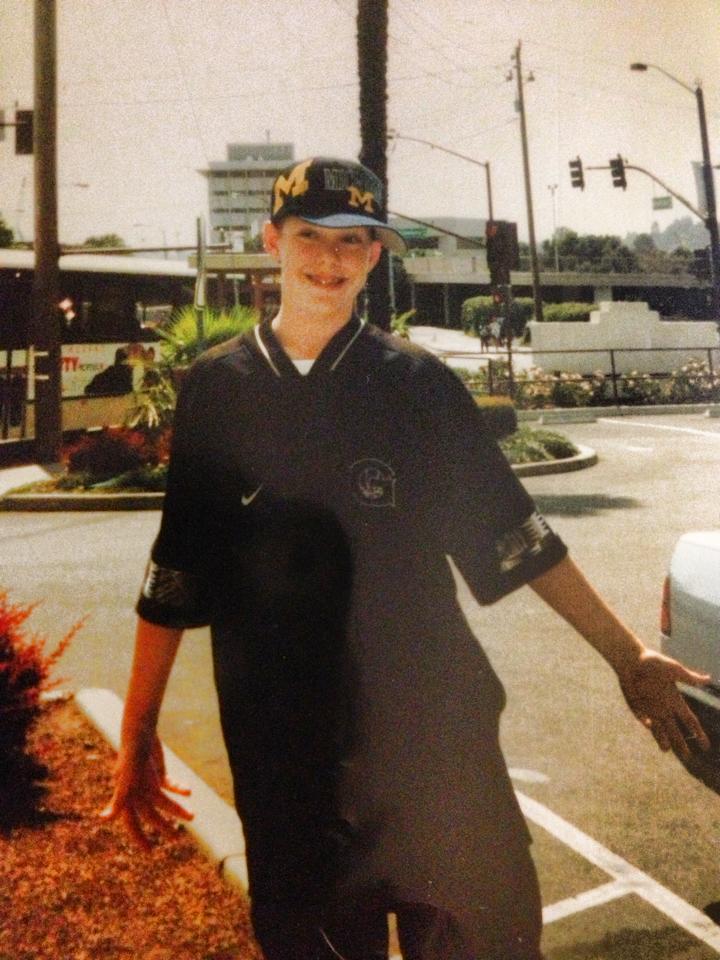
I was a confused, angry kid—like most teenagers. Dragged across the country from New York to California, then from gritty Richmond to affluent Walnut Creek, I really didn’t get who and what I was supposed to be. I tried on a bunch of costumes, during this time, one of which was a pretty dedicated Hip-Hop schtick.

Portrait of the artist as a confused 14-year-old

A portrait of the artist as a confused 14-year-old

Released right after 2Pac got out of prison, and in the midst of my high school Hip-Hop phase, All Eyez On Me is full of anger and hubris and yet dotted with insecurity (I’ll always think of ‘Pac as a truly intelligent artist wearing thug’s clothes to fit in with the people around him). So, it’s a pretty good fit for what these years were like for me.

1997 – Holland, 1945, Neutral Milk Hotel

I spent much of my early childhood with my grandmother, and I often say she raised me. (No slight to my parents; the time with my grandmother was just that formative). She was a Holocaust survivor, giving this song, written by Jeff Mangum about Anne Frank, extra resonance. My grandmother died when I was sixteen and, for me, “The world just screamed and fell apart.”

1999 – St. Ides Heaven, Elliott Smith

In September, 1999, I showed up on the campus of UC Santa Barbara. It may seem funny to choose a dark song set in gray, rainy Portland for my years on a beach paradise, but it’s all in the lyrics. I drank hard at SB, a lot of it under the guise of “partying,” and I look back on those years fondly, but there was a self-destructive sadness beneath it all. St. Ides Heaven is a song about exactly that dynamic. It opens with a carefree, get-fucked-up-and-do-whatever-you-want sentiment: “Everything is exactly right/When I walk around here drunk every night/With an open container from 7-11/In St. Ides Heaven”; but later it gives way to a darker, more isolated feeling: “I think you know what brings me down/I want those things you could never allow/You see me smile and think it’s a frown/Turned upside down.”

2001 – Paperback Writer, the Beatles

It was right around this time, my junior year of college, that I decided I wanted to be a writer. It was an ambition that I spent the next decade pursuing.

2003 – Little Wing, the Jimi Hendrix Experience

I graduated from college and moved back to the Bay, and then I started going out with Lara. And for a long time, I really felt like she could walk on clouds.

IMG_1080

Lolly

2006 – You Really Got a Hold on Me, Smokey Robinson and the Miracles

In June of 2006, less than two weeks after I turned 25, Lara received a double lung transplant. Her recovery was incredibly difficult: she spent several weeks in the ICU at Stanford Hospital, and then about three months living in an apartment next to the campus. She struggled to walk, to eat, to remember things. It was an awful time. But I’ll always remember one day we were sitting in the living room of that apartment, and this song came on the radio, and Lolly made me get up and slow dance to it. It’s one of my favorite memories of her, a moment that encapsulates so many of the things I loved about her: Her persistence, her strength, her ability to take joy in small things. I think of her every time I hear Smokey Robinson.

2009 – In My Life, the Beatles

I broke up with Lara at the end of 2009. 18 months later, she died. As I’ve written about before, we sang this song when we scattered her ashes on Sands Beach in Santa Barbara.

2011 – Oh My Sweet Carolina, Ryan Adams

Lara was dead and I was lying in a basement in New York City, no job, no book deal, heartbroken and flat broke, having failed at anything I ever tried to do that could have mattered and not seeing any way that it’d ever get better and wondering if there was any point in going on with life. And I lay in the basement in the dark, lost, listening to this song, with “the sunset just my lightbulb burning out.”

2012 – Desperados Under the Eaves, Warren Zevon

I found myself back in San Francisco, trying to recover, but finding that I was still lost. I hated my job, I was surrounded by friends and family but still felt completely alone, “still waking up in mornings with shaking hands,” still “trying to find a girl that understands me,” still unable to see how things were ever going to work out for me. It sure seemed like if California slid into the ocean, I’d get stuck holding the bill.

2013 – I and Love and You, The Avett Brothers

So I left San Francisco and went back to New York. “Brooklyn, Brooklyn, take me in/Are you aware the shape I’m in?”

2014 – To Live Is to Fly, Townes Van Zandt

Because I’ve left friends behind. Because I’ve still got holes to fill. Because the choice was mine to make, and I chose life. Because to live truly is to fly, both low and high, so I’ll shake the dust off of my wings and the tears out of my eyes.

Posted in Music | 2 Comments

Niners Conference Championship Awards and Season Post Mortem

I really have no desire to write this. I haven’t read or listened to any game recaps, and I don’t really intend to. But enough people have told me they enjoy reading these things that I thought perhaps some of you would be looking for it, and besides, if you’re going to crow after a victory, you have to be able to face the music after a defeat. Still, I have no intention of wallowing: I’m going to hand out a few quick awards, and then I’ll do a bit of a season post mortem at the end.

The Bryant Young Award (Inspiring Player Who Suffered a Gruesome Injury): NaVorro Bowman

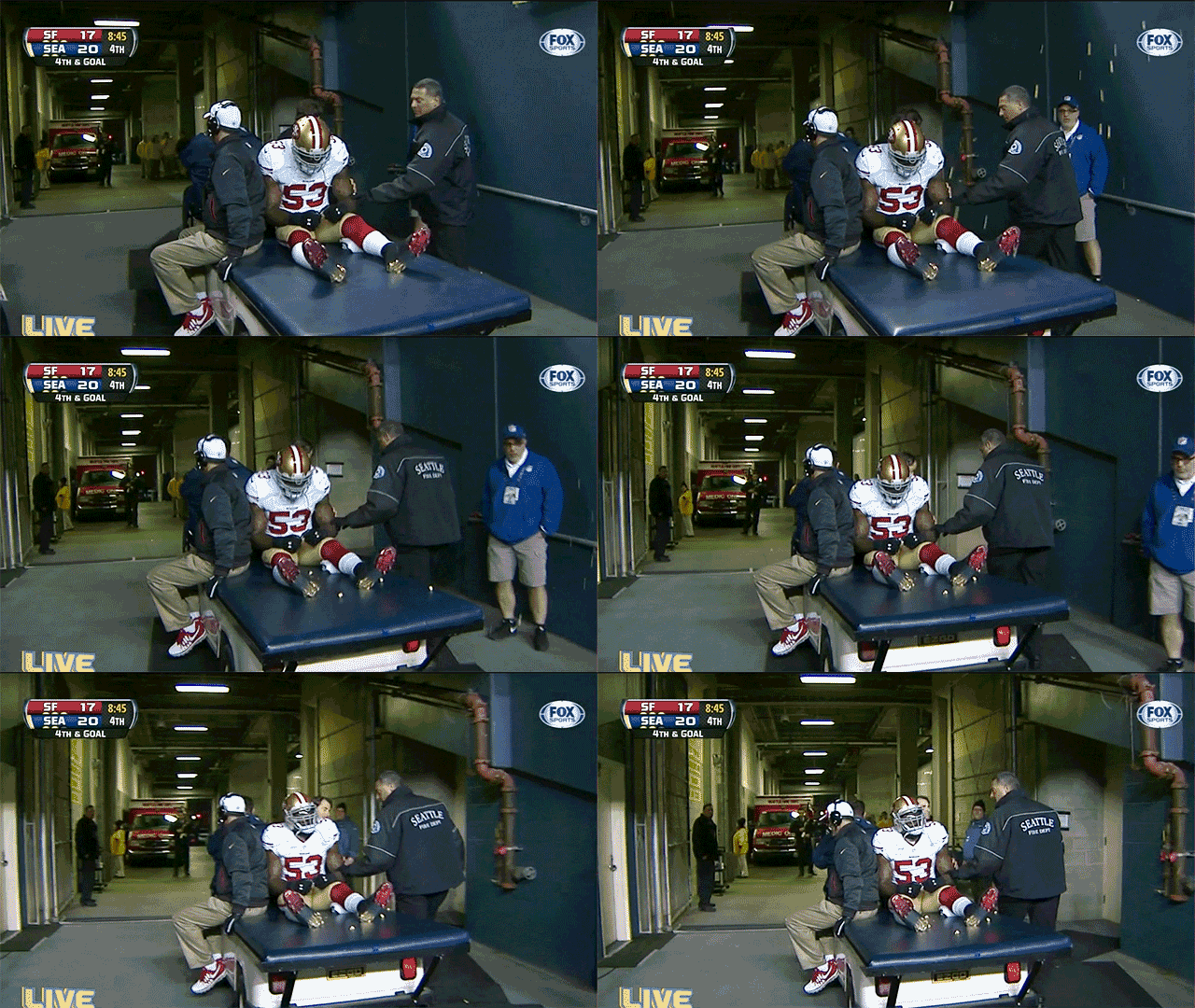
I hate this picture so much

I hate this picture so much

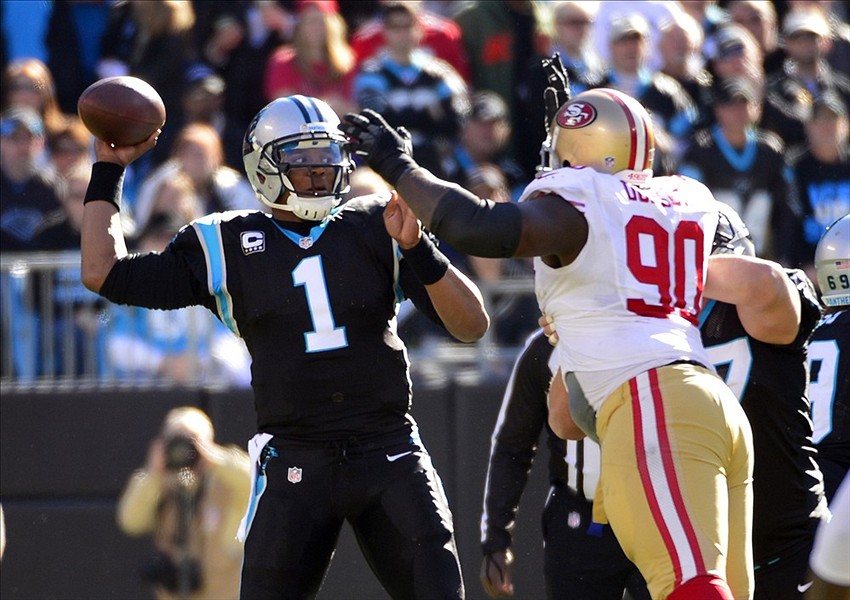
As I’ve said a couple of times in this space, Bowman was the best player on the team this season. From his complete destruction of the Rams in a critical Week Four matchup, to his epic interception return TD in the Candlestick finale, to his week-in, week-out dominance, he was consistently the team’s best playmaker on either side of the ball all season. He made another brilliant play in the fourth quarter of yesterday’s game, tearing the ball out of Jermaine Kearse’s hands on the one-yard line for what should have been a key turnover. Of course, the incompetent officiating crew blew the play dead, meaning there was no turnover (this ended up being moot, as Marshawn Lynch fumbled on the next play). Even worse than the unconscionable call was that, after he stole the ball, a Seabitches player rolled onto Bowman, twisting his knee in gruesome fashion and reportedly tearing his ACL. Even worse, when Bowman was carted off the field, Seattle fans threw popcorn at him from the stands.

ku-xlarge

Now, let me say, I have no bias against Seattle. It’s a city that gave us Jimi Hendrix, Kurt Cobain, and Gary Payton–Sean Kemp alley-oops. The Pike’s Market is cool. The cascades and Puget Sound are lovely. I have good friends who live there, and I have enjoyed my visits. But Seattle football fans? You are the worst kind of degenerate pieces of shit. Please go hang yourselves with your Columbia raingear, you fucking assholes.

The Emmett Smith Award (Most Hated Opponent): Richard Sherman

I haven’t watched his now infamous postgame interview, and I have no intention of doing so. What’s the point? All I really have to say is that I hate that this fucking dickbag was the guy who made the game-deciding play. As my brother Juanito likes to say: Life is pain.

The Box of Chocolates Award (You Never Know What You’re Gonna Get): Colin Kaepernick

628x471

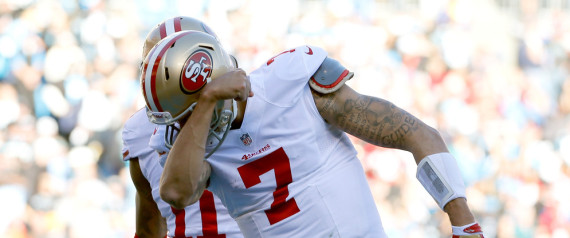
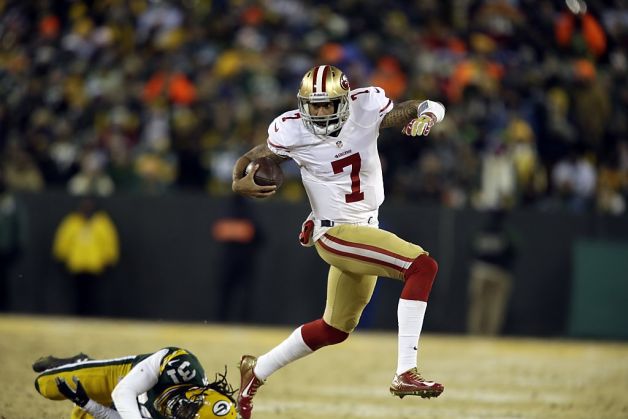
It’s hard to know exactly what to say about Kaep’s performance. He ran for 130 yards, giving him his second career 100-yard playoff rushing performance (the same number as every other quarterback in NFL history combined). And it sure seemed that the Niners’ entire offensive game plan was “Kaepernick will run around and make something happen,” to which I have to say, just because your quarterback is Randall Cunningham 2.0 doesn’t mean you should have the same game plan the 1990 Philadelphia Eagles did. Kaep kept the team in the game, especially given that there was no running game at all. (Hey, let’s just have Frank Gore run straight up the middle for no gain again! More on the offensive coaching below.) On the other hand, he did throw two key fourth quarter picks. I’m not really going to blame Kaep for that final throw—as my attorney said to me this morning, if he throws that ball a foot higher, we’re celebrating the best kind of win—except to say that he threw at least two other interceptions this year on the same sort of play, a back-shoulder pass that he underthrew. And the first interception was a carbon copy of the near pick-six he threw in the Wild Card game at Green Bay; the only difference was Seattle’s linebacker caught the ball, and the Packers’ linebacker didn’t. It was a mixed bag of a performance by Kaepernick, in what was a mixed-bag season. More on this in this in a minute.

Overall Rating For This Game (On a scale of Zero to Twelve Anchors, in honor of San Francisco’s favorite beverage): 0 Anchors

At least I get to have my Sundays back for a few months.

Yesterday’s loss was a bitter one, and it leaves a lot of questions about where the team goes from here. I hesitate to say the Niners are at a crossroads here, but we may be rapidly approaching something like that. Teams have much shorter championship windows in the salary cap era, and San Francisco has been the best team in football, cumulatively, for the last three years. And yet, they haven’t managed to win a Super Bowl, because Kyle Williams couldn’t catch a punt, they couldn’t punch the ball in from the five-yard line against a tired Ravens defense, and Kaepernick underthrew a ball by a foot. Actually, check that last one: Does anyone believe that Seattle, so dependent on it’s home field advantage, could have won games at Green Bay, Carolina, and San Francisco to make it to the Super Bowl? I will go to my grave believing the Niners had the more complete team this year, and if the officials hadn’t made that apocalyptically horrible penalty call on Ahmad Brooks in the New Orleans game, we would have had home field and would have beaten the Seabitches and won the Super Bowl.

Last I checked, they play TACKLE football in the NFL

Last I checked, they play TACKLE football in the NFL

The first question, then, is, how long will this team’s window remain open? The Niners have most of their core players signed to long-term deals already, and they have a little bit of cap space to work with, but Anquan Boldin, Donte Whitner, and Tarell Brown are all key free agents the team has to make decisions on. Moreover, they have benefitted the last two years from having Kaepernick on his rookie deal. Last year is the final year of that contract, though, and Kaep is going to be up for an extension that is going to seriously alter the team’s cap situation.

How much will a new Kaepernick deal go for? That remains to be seen. It won’t be as big as the disastrous Joe Flacco-level contract he would have gotten if they’d won the Super Bowl and he’d been the game’s MVP, but Kaep’s agent will be able to say that he’s taken a team to the Super Bowl (and he would have been that game’s MVP if the Niners had gotten five more fucking yards) and the NFC Championship in less than two full seasons as a starter, and there are all sorts of advanced statistics that indicate Kaep was better this year than his traditional numbers would suggest. On the other hand, the team can argue that Kaep was inconsistent, that he didn’t put up the numbers that his contemporaries, like Andrew Luck, did. For what it’s worth, I think Kaep was better this year than most people gave him credit for, and I maintain that some of the criticism he’s received is at best ageist and at worst racist. (How much less criticism would he get if he didn’t have tattoos?)

At any rate, the team is probably not going to have a ton of wiggle room to make improvements. And what improvements would they need to make? To me, the two key areas are, once again, the secondary and the receivers. Crabtree came back and should be at full strength next season, but can they afford to bring Boldin back? How much does the 33-year-old receiver have left in the tank? His game’s built more on toughness and hands than on speed, so maybe more than some guys his age would (the best-case analog I can come up with is Cris Carter, a similar sort of player who stayed effective until he was 36). But what kind of contract will he be looking for? And even if the Niners manage to hold onto him, they could sure use a speed receiver (the only stretch-the-field guy they’ve had the last few years has been their tight end, Vernon Davis).

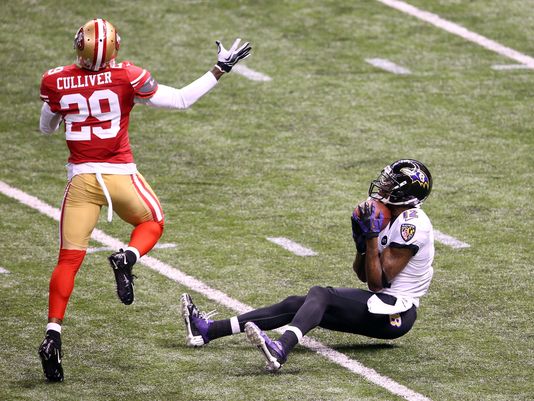
And on the other side, of the ball, can the team improve the secondary, which has been the defense’s weak link the last couple of years? Whitner has been a great run defender and big hitter, but has always been a bit shaky in coverage; what sort of offers will he see as a free agent? Carlos Rogers makes a lot money and by the end of the year was the team’s third-best corner; might he be a candidate to get cut? (With visions of that 40-yard fourth-down touchdown dancing through my head, I’m inclined to say yes.) Can the team re-sign Brown, who put together a solid year? Is Tramaine Brock a legit starter? (I’m inclined to say yes, but how sure are we?) Eric Reid certainly appears to be a foundational piece, but this is the unit the team could most stand to upgrade—and don’t even talk to me about Chris Culliver coming back. When I close my eyes, I still see him staring at the back of Jacoby Jones’ jersey in the Super Bowl.

Yeah, SUPER excited about Culliver

Yeah, SUPER excited about Culliver

There are also questions about the backfield: How many more years can Frank Gore fight off Father Time? I love Gore as much as anybody, but he’s got just one year left on his contract, and NFL running backs tend to lose a step without warning. Can Kendall Hunter handle a bigger role? Will LaMichael James ever be a real contributor? The team probably needs to start planning for life after Gore.

Finally, perhaps the biggest question, is what happens with the coaching staff? Harbaugh has two years left on his deal, and it’s pretty obvious he’s going to be angling for an extension that makes him the highest-paid coach in football? Does he deserve that? Three straight NFC Championship Games is a pretty positive argument, but the team has played questionably in a few big games, and Harbaugh is known for being difficult to deal with. Where will Trent Baalke and Jed York draw the line? What’s more, while it’s hard to imagine a better job than the current Niners situation, Harbaugh is also known for being a restless type. Would he jump ship for a team that gave him more control? I don’t see it happening this offseason—there are no desirable jobs left—but it bears watching moving forward.

And then there’s the Greg Roman question. Many Niners fans have conflicted feelings about the team’s offensive coordinator. I am not one of those fans. I was frankly hoping he would get a head coaching job somewhere, because I am pretty disappointed with the offense. How does a team with the weapons the Niners have struggle so badly in the Red Zone (a problem for three years running)? How many times can they send Gore running straight up the middle when it’s clearly not working (how about trying a sweep, guys)? I’ve heard that the Niners would send Kaepernick to the line of scrimmage with three plays called, a possible explanation for all the clock management problems the team had this year (way to make things easy on your young QB, guys). For a guy that’s supposed to be an offensive mastermind, Roman sure seemed to put together a pretty vanilla offense this year. Where was the creativity? How about trying a fucking screen pass once in a while?

This wasn’t a bad season. This team battled through injuries, adversity, and bad luck, and was a very real championship contender. But they didn’t get it done. They should contend again next year, but how many more chances will they get? Having come up short three seasons in a row, the best analog for this team is the early 2000s Donovan McNabb–Andy Reid Eagles, who never quite got over the hump. That sucks.

Ugh

Ugh

Goddammit.

Posted in football, Sports | Tagged , , | 1 Comment

2014 Conference Championship Picks

Over the last few years, the NFL Playoffs have been rife with surprise teams and upsets, but this year’s tournament has gone pretty much to form (San Francisco was the only road team to win in the Divisional Round, but they went into that game as a one-point favorite). Last week, when I made my picks, I figured there would be at least one upset, and I went with the Chargers over the Broncos, which was actually in play in the fourth quarter, until San Diego blew a coverage on third-and-17 and allowed Peyton Manning to complete a 21-yard game-clinching pass. I was fairly close in my other predictions though, correctly forecasting that the Niners would win a slugfest over Carolina, that the Seadderall PEDhawks would outlast the Saints at home, and that the Patriots would score a bushel of points on the Colts’ sad defense.

The results of the Divisional Round have set us up with an insane slate of football for this Sunday: In the AFC Championship, we have Manning-Brady MMXLCV, and in the NFC Championship we have a matchup between football’s two best teams and most heated rivals, the Niners and Seabitches. The slate is a veritable wet dream for football fans and ratings-hungry network executives alike, and is very much in line with what most analysts expected coming into the season. (For the record, in my season preview, I called for a final four of Denver vs. New England and San Francisco vs. Green Bay, which could have been in play were it not for Aaron Rodgers’ collarbone injury.) Maybe the playoffs have gone chalk so far, but it’s given us the Championship Sunday we wanted. Will the favorites continue their dominance? Here’s what I think.

New England at Denver

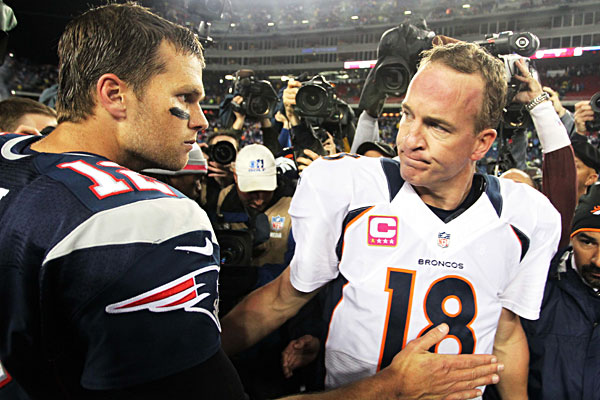
As noted above, and by every football writer in the known universe, this is the 15th time Manning and Brady have faced off. Bady’s Patriots have won 10 of the previous 14, and two of their three playoff matchups. Does this have anything to do with how this game will go? The numbers-oriented analysts will tell you no, of course not. After all, it’s not like Manning and Brady are covering each other’s receivers.

We've seen this once or twice ... or fourteen times

We’ve seen this once or twice … or fourteen times

And yet…

Hold on, not yet. A little more on the matchup. The two teams have very different offenses right now, with Manning leading yet another record-setting airshow and Brady managing a punishing ground game (sounds a bit like those early 2000s Pats-Colts matchups, no?) in the wake of losing his dynamic tight end duo to injury (Rob Gronkowski) and a spree of murders so crazy you wouldn’t believe it if it was in a movie (Aaron Hernandez). They both will be going up against questionable, injury-riddled defenses, and I’m guessing there will probably be a lot of points in this game—especially with the early weather forecast calling for clear skies and temperatures in the 50s in Denver next weekend. Pleasant weather and a shootout would seem to favor Denver.

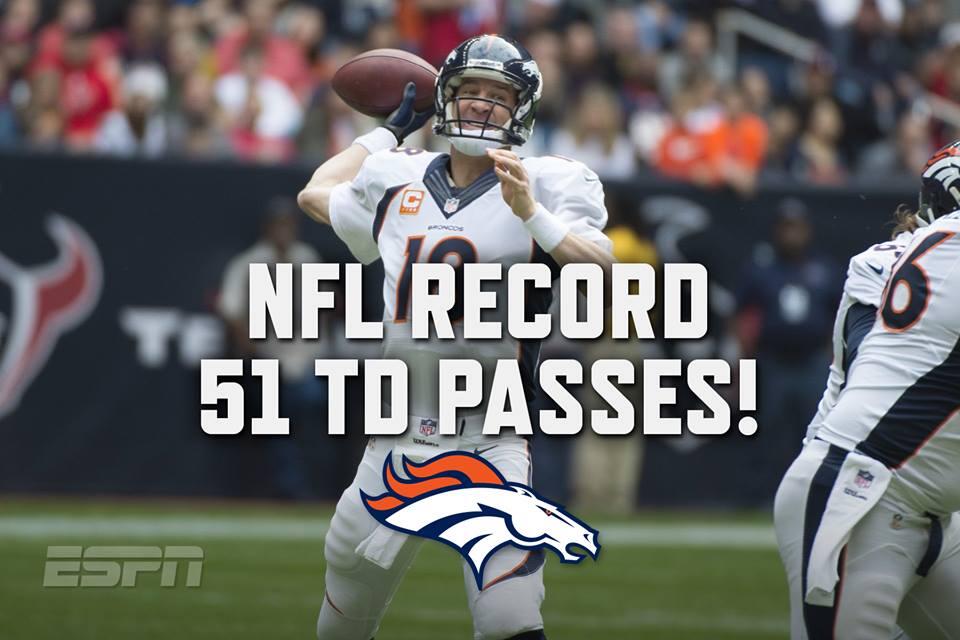
He finished with 55. And also broke the yardage record.

He finished with 55. And also broke the yardage record. And his team broke the scoring record.

And yet…

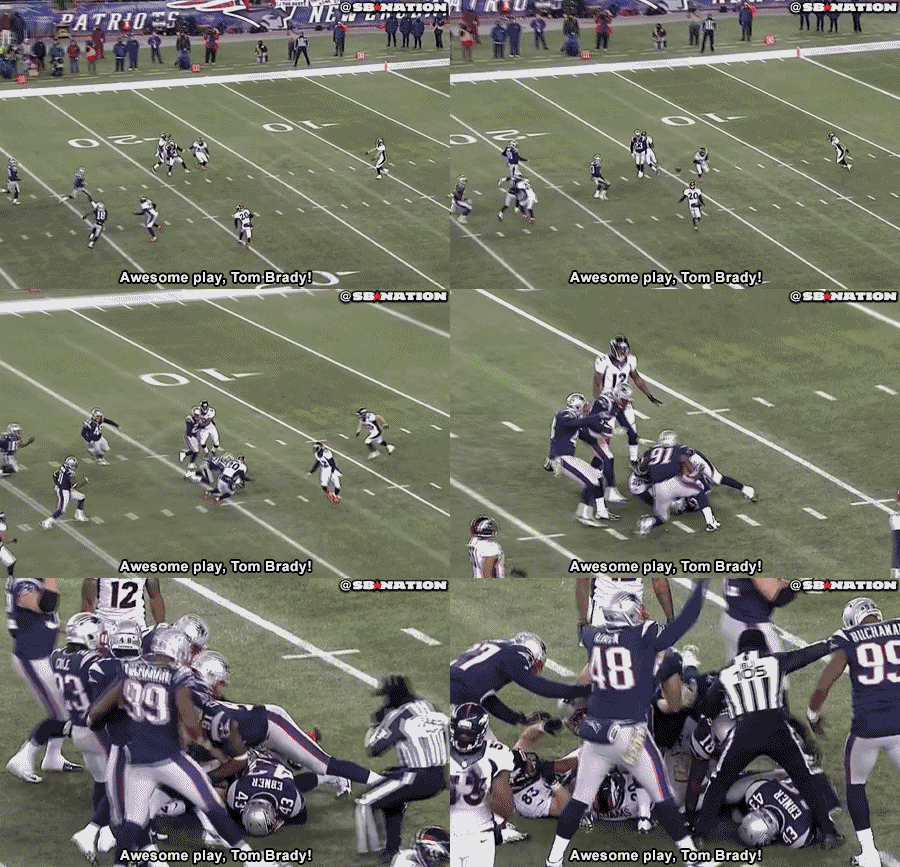
Nope, not yet. I know those other 14 games these two quarterbacks have played don’t really have a lot of bearing on this one. I know that not even the most recent one, New England’s 34-31 comeback overtime victory in Week 12, should affect my prediction. After all, that game was played in frigid conditions in Boston, when the Pats still had Gronkowski and the Broncos still had Von Miller, and the key play in overtime was a punt that bounced into a Broncos coverage team gunner and was recovered by the Pats, leading to the game-winning field goal.

broncoschoke_medium

And yet…

Look, I write these picks columns and pretend to know shit about football, but I really don’t know a damn thing. I didn’t even try out for my high school football team because I am slow and small and oh so white. The only knowledge I have comes from years and years of sitting on couches and in bars every Sunday watching this stupid, violent game that epitomizes most of the worst aspects of American society. All I can do is compare what I see now to what I’ve seen in the past. And goddammit, if there’s one thing that I know about the generation of players that I’ve been watching for the last decade, it’s that Tom Brady is the closest thing in today’s game to Joe Montana (the ultimate clutch QB), and Peyton Manning is the reanimation of Dan Marino (the guy who sets the records but chokes in big games). When I wrote about the possibility of this game back at the beginning of the season, I said Denver would win 27-24. But if someone put a gun to your head, would you pick Dan Marino over Joe Montana?

Everyone remembers how this turned out, right?

Everyone remembers how this turned out, right?

Me neither. Patriots 37, Broncos 35.

San Francisco at Seattle

I know I just wrote like 700 words about the AFC Championship Game, but I honestly don’t even give the tiniest shit about what happens in Manning-Brady MMXLCV. (Is that a real number? I’m too lazy to check). All this week, every fiber of my being has been and will be wrapped up in this game, my beloved Niners traveling to Seattle, a place where they’ve been torched twice in a row by the perpetually shit-talking Seabitches. Seeing as how this is turning into the same sort of rivalry that Niners-Cowboys (the iron upon which my undying hatred of all things Dallas was forged) was 20 years ago, it’s impossible for me to be rational about this game. But I’m going to try to handle it Socratically (well, kinda) by asking a few questions about the matchup.

Does Seattle’s homefield advantage matter?

Well, duh. The Seabitches are 16-1 at home since Russell Wilson became their starting quarterback. The damn thing was engineered to produce as much noise as possible, and the crowd gets so loud that seismologists have found that it literally creates an earthquake.

It's not Loma Prieta ... but still pretty impressive

It’s not Loma Prieta … but still pretty impressive

In two trips to Seattle since Colin Kaepernick became the Niners’ starting QB, San Francisco has lost by a combined score of 71-16—and they looked every bit that bad in those games, with their offense crumbling in the face of the din and the swarming Seabitches defense.

Does Seattle’s homefield advantage matter as much as people think it does?

Maybe, maybe not. Seattle’s homefield mystique has lost a bit of its luster in the last month: Arizona went in there and won 17-10 despite their quarterback throwing four interceptions, and the Saints, a piss-poor road team all year, had a shot to tie their Divisional Round game in the fourth quarter. Golden child Russell Wilson threw for 211 yards in those two games COMBINED. And can we please take a moment to dispel the myth being propagated about Seattle fans by football analysts and Kaepernick’s Beats by Dre commercial …

Seriously, have you ever been to Seattle? The people in that commercial pretty clearly haven’t. As someone who has been there recently, I can tell you that, while maybe it was once a city of loggers and fisherman, now it’s a hive of scrawny, latte-slurping, indie-rock-fan emo hipsters. The stadium gets loud, sure. But scary? Nah. Not Seattle.

Which team was better during the regular season?

Pretty clearly the Seabitches. Football Outsiders’ statistical metric DVOA had them rated the best team in the NFL by a pretty wide margin. They had the second-best point differential in the NFL, behind only Denver, a team that was running up scores in an effort to set offensive records. And Seattle, led by their Legion of Boom defensive backfield, had arguably the best pass defense of the last decade.

These dudes are pretty damn good. And I hate them

These dudes are pretty damn good. And I hate them

Which team is playing better right now?

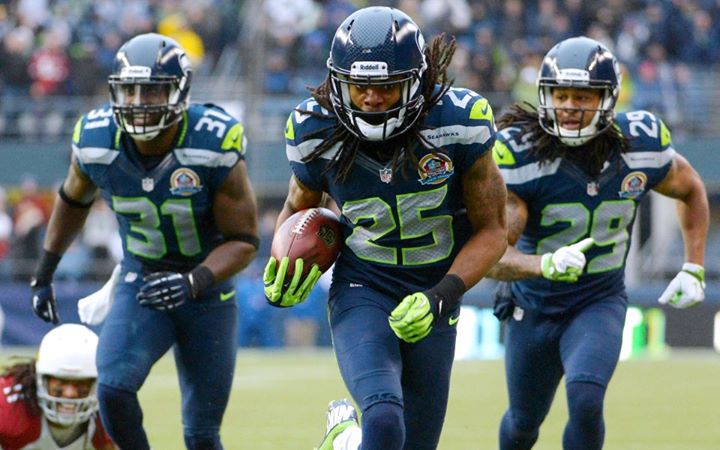
Pretty clearly the Niners. Seattle’s passing offense has fallen apart as they’ve lost weapons to injury, leaving Wilson very few options to make plays downfield and the Seabitches’ offense looking like … well, like the Niners’ offense did earlier this year. Meanwhile, the return of Michael Crabtree has helped to open up the Niners’ passing game, and Vernon Davis, Anquan Boldin, and of course Kaepernick have all benefitted.

Moreover, I’d like to point out that if it weren’t for a string of lucky breaks, this game would be happening at Candlestick, not CenturyLink. Seattle won at least four games this year that it probably should have lost (over the Panthers when DeAngelo Williams fumbled inside the 20-yard line when Carolina was driving to possibly take the lead, over the Texans when Matt Schaub threw one of the worst pick-sixes in NFL history to let Seattle back in the game, over the Rams when St. Louis stupidly threw instead of running when they were at the goal line at the end of the game, and over then-winless Tampa when the Bucs blew leads of 21-0 and 24-7 in Seattle). Meanwhile, the Niners were victims of maybe the worst call made in the NFL this year, the obscene roughing the passer penalty on Ahmad Brooks that cost them the game against the Saints. Hell, take away that one flag, and this weekend’s game would be in San Francisco.

Meanwhile, for all the hype that Seattle’s defensive backs get—and don’t get me wrong, it’s much deserved, as Earl Thomas might be the best safety in the NFL, and Richard Sherman put together a Deion Sanders-esque season in which he led the league in interceptions while being the least-targeted cornerback in the NFL—the Niners have a pretty damn good defensive unit of their own. Consider that three of the Niners’ four starting linebackers (Brooks, NaVorro Bowman, and “Kill that Motherfucker,” Patrick Willis) made the Pro Bowl, and the guy who didn’t, Aldon Smith, had 19 sacks last year.

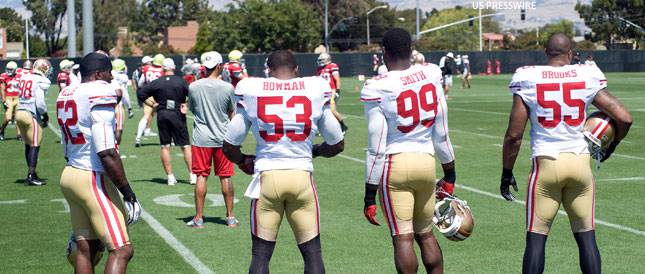
I could not love these four men any more than I already do

I could not love these four men any more than I already do

That’s the best linebacking corps in the NFL by about a hundred miles, which matters a great deal, considering that Seattle depends on Marshawn Lynch and their running game to move the ball.

Did I predict the Niners would win both their playoff games so far by scores of 23-20?

You’re goddamn right I did. I got the score exactly right in the Packers game (I may have mentioned this once or twice) and then the Niners’ defense shaved 10 points away to beat Carolina 23-10. The trend indicates that the Niners should beat Seattle 23-0, right?

Yeah, probably not. But San Francisco comes into this game with 1) a defense that is playing punishing, physically dominant football and also matches up very well with Seattle’s run-oriented offense, and 2) a balanced offense playing its best ball of the season, led by a quarterback who is 3-0 in road playoff games, including a win at frozen Lambeau Field over Aaron Rodgers and a comeback win at another very loud stadium, the Georgia Dome in Atlanta.

In case you forgot, this guy has been pretty damn good in the playoffs

In case you forgot, this guy has been pretty damn good in the playoffs

Am I going to pick the Niners to win 23-20, because I’m a superstitious asshole of a sports fan, because the Niners are the better team overall and are peaking at the right time, and because the only way for this season to end in justice is for those shit-talking, PED-swallowing Seabitches to choke at their precious piece of shit echo chamber of a stadium?

YOU’RE GODDAMN RIGHT, MOTHERFUCKERS!!! NINERS 23-20, FOR THE MOTHERFUCKING WIN!!!

Posted in football, Sports, Uncategorized | Tagged , | 1 Comment

Niners Divisional Round Awards

All week, I felt confident about the Niners’ chances against Carolina. They were the hottest team in the NFL, having won their final six regular season games and their Wild Card round igloo-building contest with the Packers, and they were playing a Carolina team that, while it has a great defense, also had a quarterback and coach involved in their first playoff game. What’s more, while Carolina beat San Francisco 10-9 in early November, the Niners were missing both Vernon Davis and Michael Crabtree for most of that game.

Of course, everyone else took note of these same facts, and the Niners went into Carolina as one-point favorites, with nearly every analyst picking them to win. By the time the game kicked off, all those jinxes had left me a complete nervous wreck. Fortunately, the Niners pulled out a 23-10 victory. Here’s how they did it.

The Chris Berman Award (Keys to the Game): Carolina’s Turnovers and Penalties

Named for the magnificently toupéed longtime host of ESPN highlight and analysis show NFL Primetime, this award goes not to a player, but to the few key plays that defined this game: Carolina’s costly turnovers and penalties. The thing that will probably get forgotten when people look at the final margin is that the Panthers completely outplayed the Niners on both sides of the ball for most of the first half. But, flash back to my picks column from last week, when I said, “this game could be decided by anything—a missed field goal, a bad penalty, an ill-timed turnover.” This turned out to be very much the case, as the Panthers made several key mistakes that kept San Francisco in the game. There are so many of them, I think we need bullet points:

  • On the Niners’ opening drive, Colin Kaepernick threw incomplete on a third-and-six near midfield, but Panthers safety Mike Mitchell hit Davis late, drawing a fifteen yard penalty that brought the Niners into field goal range.
  • On the Panthers’ opening drive, Cam Newton threw an interception to Patrick Willis that let the Niners start with the ball in Panthers territory.
  • On the ensuing drive, cornerback Captain Munnerlyn (who, really, should be a character in a Horatio Hornblower novel) headbutted Crabtree, drawing a 15-yard penalty that again helped the Niners get into field goal range (it should be noted that Anquan Boldin did the same thing later in the game, and he was not flagged).
  • The Panthers then proceeded to drive down the field all the way to the one-yard line, only to have the Niners mount a goal-line stand, culminating in Ahmad Brooks stuffing Cam Newton on fourth down on the first play of the second quarter.
  • This one’s not a turnover, but later in the second quarter, the Panthers drove down to the one yard line again, and the Niners mounted a goal-line stand AGAIN, this time dropping Mike Tolbert for a two-yard loss on third down and forcing the Panthers to settle for a field goal.
  • Then, on the Niners’ final possession of the first half, on third-and-goal from the nine, Carolina’s Drayton Florence took an obvious pass interference penalty on a pass that Boldin had basically no chance of catching. The Niners took the lead with a touchdown two plays later.

Newton also threw a game-sealing interception late in the fourth quarter (following an obscenely ridiculous helmet-to-helmet 15-yard penalty on linebacker Dan Skuta, who was flagged even though Newton spun right into him—seriously, while it wasn’t nearly as damaging, this penalty was even stupider than the roughing the passer penalty called on Brooks during the Saints game.) But those plays in the first half were the real key to the Niners’ victory. It seemed like the Panthers came out trying to make a statement that they were the more physical team and that they would manhandle the Niners. But, while Carolina WAS physically dominant early in the game, they overdid it, with the result being those big early penalties that led to points for the Niners. And then Carolina’s turnovers and failed conversions kept points off their side of the board. The Panthers easily could have been up something like 21-3 halfway through the second quarter. Instead they led just 10-6, and the Niners went into the half up 13-10 thanks to a play we’ll get to shortly.

The Gary Plummer Award (For the Play that Shifted the Momentum): Ahmad Brooks

Brooks’ hit to keep Newton out of the end zone on fourth down would be enough to get this award, but he absolutely HAD to get the Gary Plummer trophy for what he did on the second goal-line stand. On third-and-goal from the one, Brooks tried to anticipate the snap count—and guessed wrong. He ended up leaping over the offensive line and giving Newton a love tap on the back, a play that left me facedown on the bar, convulsing with laughter. For the love of all that is holy, please click on this GIF.

Offsides

Aside from the fact that you have to mention Gary Plummer any time a linebacker jumps over the line on a goal-line play, I just wanted to salute Brooks (who had yet another fantastic game, with 2.5 sacks) for what is actually a really smart play. In that position, it’s absolutely worth it to try to guess at the snap count: If you guess right, you blow up a play in the backfield for a huge loss; if you guess wrong, the resulting offsides penalty only costs you a foot or two of field position. Really, I don’t understand why more guys don’t try this. With plays like that, Ahmad Brooks has turned himself into one of my favorite Niners.

The Dwight Clark Award (Clutch, Athletic Touchdown Catch on a Ball Thrown by a Rolling QB to the Back Corner of the End Zone During a Playoff Game): Vernon Davis

Drag that back foot, big fella

Drag that back foot, big fella

This is a pretty specific award, but I already gave Gary Plummer honors to Brooks, and I had to come up with something else for this gigantic play. On the final drive of the first half, the Niners had gotten the ball down to the Carolina one-yard line, and due to some questionable clock management—they were trying to score while leaving Carolina no time to retaliate, but in the process left themselves with no margin for error—there were just five seconds left on the clock when a rolling Kaepernick threw a ball to Davis in the back corner of the end zone that was ruled incomplete. Jim Harbaugh then stupidly came charging out on the field, drawing a 15-yard penalty that was going to force the Niners to settle for yet another field goal. (Harbaugh later said that he was not disputing the ruling, but pointing out that the clock had kept running at the end of the play, costing the Niners about three seconds. He was right, but running out on the field the way he did was still stupid.) The whole thing was a complete fucking disaster, except that the official in the replay booth reviewed it, and the slo-mo replay—not to mention the divots in the corner of the end zone—showed that Davis had gotten both feet down. Touchdown. The Niners went into halftime with a lead they would never relinquish.

The Colin Kaepernick Award (Best Touchdown Celebration): Colin Kaepernick

Yes, that's Michelle Obama Kaepernicking

Yes, that’s Michelle Obama Kaepernicking

I would have loved to name the touchdown celebration award after Terrell Owens, who had a few well-publicized doozies during his career, but I already named an award after T.O. earlier this year, so Kaepernick, who of course has a famous touchdown celebration of his own, gets his own award. The Niners’ defense shut Carolina down on the opening possession of the third quarter, and then the offense took the ball right down the field, thanks largely to a couple of big catches from Boldin, who had yet another monster game, with 8 receptions for 136 yards. On first-and-goal, Kaepernick and Gore fumbled their handoff exchange, a play that nearly gave me a heart attack, but on second-and-goal from the four, Kaepernick ran left, eluding a couple of Carolina defenders and striding into the end zone to give the Niners a 20-10 lead. After scoring, he stood in the end zone and made a motion like Superman pulling off his Clark Kent clothes—mocking Newton’s trademark touchdown celebration—before Kapernicking.

Kaep jumped out of the phone booth just in time to score

Kaep jumped out of the phone booth just in time to score

Have I mentioned that I love Colin Kaepernick? Not sure if I have. Probably at some point.

The Emmett Smith Award (Most Hated Opponent): Cam Newton

Newton had me terrified for most of the first half

Newton had me terrified for most of the first half

I actually don’t hate Newton at all. He seems like a pretty likable player, and I think, much like Kaepernick, he’s been the target of some pretty unfair—and more than a little racist—criticism early in his career. I’m using this space to give Newton his props, because he terrified me during this game. His 31-yard touchdown throw to Steve Smith was, objectively, a thing of beauty, and he made several other laser throws during this game. He also ran for 54 yards on 10 carries, and he’s so big that at times he seemed to overwhelm the Niners’ vaunted linebackers. The recaps of this game will say that Kaepernick outdueled Newton, but it’s not really true: Newton looked A LOT better than Kaepernick for most of the first half. The interceptions hurt, the second one in particular, but don’t forget that Kaepernick very nearly threw a pick six himself, and he has a lot more weapons to work with on offense than Newton does. Kaepernick deserves credit for putting together the drives that won the game for the Niners, starting late in the second quarter and continuing throughout the second half, but we should all remember that Cam Newton is a beast.

Overall Rating For This Game (On a scale of Zero to Twelve Anchors, in honor of San Francisco’s favorite beverage): 8 Anchors

For the second time this year, San Francisco goes a six-pack of Anchor over the St. Louis Macro-Brews

As playoff wins go, this one feels pretty ho-hum, mostly because Carolina just couldn’t move the ball at all during the second half, making the final seem like a foregone conclusion. Still, it’s worth noting that the Niners have now won three road playoff games in the last two years; Colin Kaepernick already has more career road playoff wins than Peyton Manning (and more than Steve Young and Joe Montana COMBINED—though it’s hard to win road playoff games when you have homefield advantage every year). It’s also worth noting that after this game ended I went home and laid flat on my back in a state of utter, narcotized contentment that led into a two-hour nap. Sounds like an 8 Anchor win to me.

And so it comes down to Niners-Seahawks, in Seattle, the rubber match for the season series, to decide who comes to New York (well, New Jersey) for Super Bowl XLVIII. That’s just the way it had to be, and everybody knows it.

Posted in football, Sports | Tagged , , , , , | 1 Comment

2014 Divisional Round Playoff Picks

Before I get to my Divisional Round picks, let’s go back and look at my Wild Card picks, to give you some idea of if you should even bother reading this column.

On Saturday, I had the Colts 21-10. Right result, although by no means did I anticipate the insanity that was begotten in that game. In the night game, I had the Eagles, anticipating that the weather would be worse than it was in Philly, and not anticipating that the Saints would stuff the ball down the Eagles’ throats, led by Mark Ingram, a first-round draft bust up to this point who happened to put together the best game of his career in Pierre Thomas’ absence.

In the Sunday games, I forecast the Bengals would outlast the Chargers, as I figured that, for at least one round, they would be able to overcome having a ginger for a quarterback. I was wrong. You suck, Andy Dalton. BUT, in the late afternoon game, I not only correctly predicted that the Niners would escape from Lambeau victorious, but I got the final score of 23-20 EXACTLY RIGHT. If you’re wondering when I’m going to stop talking about that, the answer is NEVER IN A MILLION FUCKING YEARS!!! BOW DOWN BEFORE ME, ALL WHO WISH TO KNOW THE RESULTS OF THIS WEEKEND’S GAMES!!!

Ahem. I think I blacked out for a second there. Not sure what happened. I assume you’re still with me, so let’s make some picks.

San Diego at Denver

Behold! The Peyton Manning Choking in the Playoffs Face!

Behold: the Peyton Manning choking in the playoffs face!

I don’t know much about football, but I know this: People who think Peyton Manning is the greatest quarterback of all time, who dare to even mention his name in the same breath as Joe Montana’s, are goddamn idiots. Manning is a longtime playoff choker. Need I point out his numerous shitty performances in wintertime Foxboro? How about the Super Bowl-clinching pick-six he threw to Tracy Porter to give the Saints a championship in 2010? Or his awful overtime interception against the Ravens last year? Manning is a great regular season player, but once the calendar turns to January, his specialty becomes throwing back-breaking interceptions. Even in the one Super Bowl he won, the MVP should have been the abominable Rex Grossman, who singlehandedly destroyed the Bears’ hopes of a victory. Now look at the QB going up against Manning this weekend.

Philip Rivers, you are a golden god

Philip Rivers, you are a golden god

Look at that ridiculous gold and mother-of-pearl bolo tie. Philip Rivers looks like an oil tycoon. He looks like an unrepentant asshole. He looks like he doesn’t give a shit what you think about him. In other words, he looks like the kind of quarterback who can go into a hostile environment and wrangle a victory. He looks like the guy who’s taking his turn sending Manning home early this year. You heard it here first: Chargers 31, Broncos, 28.

Indianapolis at New England

The Colts authored a miraculous comeback against the Chiefs last week, but can they repeat the performance? Against the Chiefs they were at home and going up against the quarterback/coach combo of Alex Smith (who, to be fair, was phenomenal in that game) and Andy Reid (who was considerably less so). On top of all that, they benefited from nearly every key Chiefs defensive player, plus their star running back, getting hurt during the game. Andrew Luck is a badass, and deserves full credit for his performance, but this week they’re on the road, going up against Tom Brady and Bill Belichick. You’re telling me Belichick won’t have something up his sleeve for the young quarterback? And after Alex Smith led a Jamaal Charles-less Chiefs team to 44 points, what is Brady going to do against a Colts defense that, other than stud defensive end Robert Mathis, is awful? With this game being played on Saturday night, giving that crowd of New England Massholes all day to get shitfaced.

Remember after the Marathon bombing, when we had to pretend that we liked people from Boston. That sentence is up. I hate these fucking people so much

Remember after the Marathon bombing, when we had to pretend that we liked people from Boston. That sentence is over. I hate these fucking people so much

I’m picturing a rowdy environment and a game that gets out of hand quickly. Patriots 41, Colts 24. And I’d be predicting more points for the Pats if this game weren’t being played outdoors in Boston.

New Orleans at Seattle

These teams played a few weeks back on Monday night, with the Seadderall PEDhawks laying waste to the Saints at their echo chamber of a stadium by a score of 34-7. Did New Orleans learn enough from that first matchup to take down the top-seeded Seabitches? They ran the ball exceedingly well at Philadelphia last weekend, and they’ll need to do it again if they want to keep Seattle’s pass rushers at bay and prevent their ball-hawking DBs from picking off Drew Brees, who, for all his virtues, has a tendency to get careless with the ball.

Can Brees get revenge against Wilson this week?

Can Brees get revenge against Wilson this week?

On the Seattle side, can they rediscover their offensive mojo, which seemed to go AWOL in the last few weeks of the season—especially the passing game, as Russell Wilson has a paucity of wide receivers similar to what Colin Kaepernick was dealing with earlier this year. And has Seattle’s long-cultivated air of invincibility at home been damaged by their Week 16 home loss to Arizona?

My take: This won’t be the blowout that their previous Monday Night game was, but Seattle will be able to move the ball on an overrated Saints defense, the home crowd will make an impact, and Brees will commit a couple of turnovers, including a late pick-six that will seal the game. Seabitches 29, Saints 17.

I know that, as a San Francisco Giants fan, I am perhaps being a tad hypocritical with the PED jokes. To this I say, "Suck it, Seabitches"

I know that, as a San Francisco Giants fan, I am perhaps being a tad hypocritical with the PED jokes. To this I say, “Suck it, Seabitches.”

San Francisco at Carolina

First a little musical interlude that has nothing to do with this game.

Man, I love that song. If you happen to also like it, you should read my post, written way back in the salad days of this blog, about the fantastic album on which it appears.

Anyway, enough with the shameless self-promotion and back to the game, which is gonna be a really good one. Coming off their dramatic win over the Packers, the red-hot Niners, winners of seven in a row, come in to Carolina looking to avenge a Week 10 loss that was a 10-9 rock fight. These teams are mirror images of each other. Both feature young, athletic quarterbacks, physical offensive lines, coaching staffs that like to establish the running game, and dominant defenses headlined by All-Pro middle linebackers (Luke Kuechly on the Carolina side, Patrick Willis and NaVorro Bowman on the Niners side).

Yeah, Motherfuckers

Yeah, Motherfuckers

Will Carolina be rested and ready for a Niners team that played a tough game in brutal conditions in Green Bay last week? Or will the Panthers be rusty coming off the bye week? Will the early East Coast start time (the kickoff is effectively at 10 a.m. for the Niners) have an impact? (This is a common pitfall for West Coast teams that the Niners have avoided during Jim Harbaugh’s tenure.)

In short, this game could be decided by anything—a missed field goal, a bad penalty, an ill-timed turnover. Hell, look at the Panthers’ victory back in early November: If Vance McDonald catches a third-quarter Kaepernick pass on a deep seam route, the Niners probably end up winning. And that’s the biggest reason I’m feeling confident about this week’s game: In that loss, the Niners didn’t have Vernon Davis (who left in the first quarter with a concussion) or Michael Crabtree (who hadn’t yet returned from his torn Achilles). Now, San Francisco’s offense, which back in Week 10 was so dysfunctional it had the entire Bay Area freaking out, has all its downfield weapons healthy, and the Niners are moving the ball the best they have all season. This game will be close, but I believe that having VD and Crabs at the same time (ewww) will make the difference. The score? Well, as a sports fan I’m nothing if not superstitious, and since I hit the nail on the head last week, I’m going right back to the well: Niners 23, Panthers 20. The NFC Championship Game has to come down to Niners-Seabitches. It just has to.

Posted in football, Sports | Tagged , | 2 Comments

Niners Wild Card Round Awards

The Niners went to Green Bay for Wild Card weekend for the latest installment of their bi-annual Holy War against the Green Bay Packers. The game was a seesaw affair, played in Arctic conditions, that San Francisco barely survived, winning on a last-second, tie-breaking, 33-yard field goal by Phil Dawson. But it wasn’t stressful. Nope. Not at all. Whhyy arrrre my hhhhands shakinnnng? I’d better get to the awards.

The Joe Montana Award (Coolest Player on the Field): Colin Kaepernick

Once again, Kaep ran all over the Packers

Once again, Kaep ran all over the Packers

For the second week in a row, The Niners’ young quarterback led two clutch fourth quarter drives to guide his team to victory. The first came after the Packers took a 17-13 lead with just over 12 minutes left in the fourth quarter, thanks largely to a deflating fourth-down conversion the Packers should have lost had the referees flagged an obvious holding penalty. But Kaepernick responded by marching the Niners right back down the field, first by taking off on a 24-yard run into Packers territory, then by throwing a 28-yard dart to Vernon Davis for a touchdown that briefly gave the Niners the lead. Then, after Aaron Rodgers brought the Packers back to tie the game, Kaepernick responded with another key drive that included the play of the game: On third-and-eight, with 1:13 on the clock and the ball on the Green Bay 38-yard line, Kaepernick stood in the pocket, pump-faked, then pulled the ball down and scrambled around left tackle. He was in a race to the sticks with a Green Bay linebacker, but Kaepernick beat him to the edge—because he’s Colin Kaepernick and the Green Bay linebacker is a Green Bay linebacker—for an 11-yard gain and a critical first down.

iznMTqqN2YzjQ

A few moments later, Dawson hit the game-winning kick. In a vacuum, Kaepernick’s numbers may not seem overly impressive—16-for-30, 227 yards, one TD, one INT, and 7 rushes for 98 yards (that last part is actually pretty impressive, though it pales next to the 181 he got against the Pack in last year’s playoffs)—but make no mistake, the Niners’ young QB was the single biggest reason they won the game yesterday. Also, dude played yesterday’s game with no sleeves. I have tattoos, so let me assure you—tattoos do not keep you warm. What a badass.

The Michael Crabtree Award (Chemistry with Colin Kaepernick): Michael Crabtree

Crabs had a clutch of clutch catches. See what I did there?

Crabs had a clutch of clutch catches. See what I did there?

All year, we wondered how Crabtree’s return from a torn Achilles tendon would impact the Niners offense. It surely seemed like the offense improved since his return, with Davis and Anquan Boldin finding more room to work down the field, but his numbers have been fairly pedestrian. That changed this week, with Crabtree posting 8 catches for 125 yards. He had 70 yards on the Niners’ first drive alone, and made several key fourth quarter catches to aid San Francisco’s rally. Watching the game, you could see shades of the Kaepernick-Crabtree connection that was so potent in last year’s playoffs, and if that continues, the rest of the league had better watch out.

The Emmett Smith Award (Most Hated Opponent): Aaron Rodgers

I don’t really hate Aaron Rodgers. As someone who grew up in and around Berkeley, I have a soft spot for anyone who played at Cal. And as much as I love Colin Kapernick and almost everything that has happened with this San Francisco team in the last few years, I am still so, so bitter that the Niners passed on Rodgers to take Alex Smith with the first pick in the 2005 draft. Rodgers grew up a Niners fan, he went to Cal, he was clearly the best QB in the draft … and the Niners took Smith instead. It’s like it was TOO perfect. I’ll never understand it. And Rodgers almost made the Niners pay, tearing San Francisco’s vaunted defense apart from the beginning of the second quarter on, including an almost unbelievable Houdini act (aided by an obvious holding penalty by Packers center Evan Dietrich-Smith that the referees didn’t flag) he pulled to escape a sack and complete a fourth-down throw to Randall Cobb on the drive that briefly gave the Packers the lead.

2014-01-0516_07_23

His numbers (17-for-26, 177 yards, one TD), may look pedestrian, but make no mistake: Rodgers was a freaking mensch in this game.

Nostradamus Award: Justin Goldman

That’s right, motherfuckers, me!!! Just read this sentence from my Friday picks column: “I think the Niners hold too many advantages, I think the poor conditions will end up accentuating those advantages, and I think the Niners will win 23-20.” It looked to me like the conditions did bother the Packers more than the Niners, and I hit the nail on the head with the score.

Also, don’t read the rest of that column. My powers of prescience are apparently limited to Niners-Packers games.

Overall Rating For This Game (On a scale of Zero to Twelve Anchors, in honor of San Francisco’s favorite beverage): 9 Anchors

For the second time this year, San Francisco goes a six-pack of Anchor over the St. Louis Macro-Brews

That was quite a barn-burner wasn’t it? (The players and fans in the stadium probably wished they could burn a barn for warmth, anyway.) The Niners dominated the first quarter, but settled for field goals on their first two drives, and then watched the Packers bounce back after Kaepernick threw a bad interception on a drive that was looking like it would stake San Francisco to a two-possession lead. From the time Green Bay got on the board in the second quarter, it was clear this game was going down to the wire—especially since the refs seemed determined to avoid throwing flags at all costs. (For the record, as much as I have bitched about the non-holding-call, I much prefer the let-the-players-play approach to the throw-a-bullshit-flag-on-a-clearly-legal-hit-and-potentially-ruin-a-team’s-season shit we’ve seen from the referees at times this season.) It was historically cold, which adds a certain theatricality to the game—it’s just cool watching the mist come from the players’ mouths on the field. There was some slapstick comedy, with John Kuhn’s failed Lambeau leap, and even the chip-shot winning field goal was nerve-wracking, as it went between the arms of a diving Green Bay player.

The reason he got so close to blocking the kick is that he was offsides. Broadcast team Joe Buck and Troy Aikman failed to notice this, because they are morons

The reason he got so close to blocking the kick is that he was offsides. Broadcast team Joe Buck and Troy Aikman failed to notice this, because they are morons

The bottom line is, we got to watch two longtime rivals duke it out in a classic, win-or-go-home playoff game—which, praise the football gods, the right team won. That gets 9 Anchors—the most I’ve awarded a game this season. Now, the Niners will be rewarded for their efforts with a trip to Carolina to play a Panthers team that may be their NFL doppelganger. I’ll cover that in my picks column later this week. For now, I need another beer. And a nap.

Posted in football, Sports | Tagged , , , , , , | 2 Comments