An Indie Press Worth Your Time: Sunnyoutside

As I wrote recently, there’s a whole boatload of small, independent presses out there putting out great literature. These presses have become the backbone of the literary community and the home of most of the really interesting work being written today. One of my favorites is Sunnyoutside.

Sunnyoutside is the brainchild of David McNamara, who runs the press from the publishing hotbed of Buffalo, New York. (I’m actually not being facetious about that–Buffalo is home to one of the best small press book fairs in the country.) I discovered the press because an old friend of mine, Brian Mihok, became an editor there a couple of years ago, and when I went to AWP in Boston in March, Brian and David let me crash on the floor of their hotel room. So–I guess this is a roundabout sort of disclosure–I consider both of those guys to be friends. However, my admiration for their press is entirely (well, at least mostly) independent of my personal affection for them.

Sunnyoutside produces a range of poetry, fiction, and nonfiction books and chapbooks. David does the design work, and he does a fantastic job–in particular, the letterpress, hand-sewn chapbooks are labor-intensive works of art, and would be even if they didn’t contain any words at all. Brian and David choose the titles for publication together, and there is some really interesting work in there. My favorites: Micah Ling’s Sweetgrass, a collection of lovely poems that wonderfully evoke their setting, the mountains and plains of Montana; and Anhvu Buchanan’s just released debut, The Disordered, a collection of poems written in the voices of people with a broad range of metal illnesses. That last one also offers a bit of symmetry for me: I don’t know Anhvu well, but I’d met him a couple of times at different reading series in the Bay Area, and when I was hanging out with Brian and David (as well as Dan Shapiro, whose book How the Potato Chip Was Invented is forthcoming from Sunnyoutside) at AWP, I found out they were publishing his book. Good people find other good people, I guess. We all ended up going out for beers and the other guys got to watch me strike out with a cocktail waitress. Because of course I did.

Anhvu's book

Anhvu’s book. The design on the cover is  awesome if you look closely.

Micah's book Sweetgrass, which I knew I would buy the second I saw the cover

Micah’s book Sweetgrass, which I knew I would buy the second I saw the cover.

Anyway, Anhvu, Dan, and Micah all serve as examples that there are a lot of really cool writers out there that the general public–and I’m talking about the small portion of the general public that actually reads books–hasn’t heard of. And they are able to publish their work thanks to great small presses like Sunnyoutside. Don’t believe me? Go over to the website and order a book–you won’t be disappointed.

Posted in Books, Writing | Tagged , , , , | Leave a comment

The Top 25 American Novels

Hemingway and Faulkner both considered Huck Finn to be the essential American novel

Hemingway and Faulkner both considered Huck Finn the essential American novel

If you’ve read this blog at all, you know that, like most people, I love lists. They’re silly and arbitrary, sure, but they give us a great excuse to debate with our friends about the things we love.

One such debate I’m always having, as a confirmed book nerd, is: what are the greatest books, greatest novels, greatest American novels, etc. Lots of cultural organizations have made such lists, from the Modern Library to the New York Times (even Entertainment Weekly). Do I have the cachet that these publications have? Of course not! (Well, maybe EW.) Did that deter me from making a list of my own? Of course not!

I got together with my good friend Luke Chamberlin, the person with whom I have most of my book debates, and we started batting around our personal opinions of the 25 best American novels (expanding the term “novel” to include collections of linked short stories). We may not work for Modern Library, but we’re both pretty dedicated lit nerds; We both have BAs in English, I have an MFA in Fiction, and he won a Fulbright Fellowship to study William Faulkner. Also, we both tend to think–misguidedly, of course–that we’re smarter than everyone else.

After several sessions of drinking beer and geeking out, we came up with something vaguely resembling a consensus, attempting to balance what we considered to be historical importance with our own personal tastes, and Luke built a website with our picks: Check it out, and let me know what you think.

Posted in Books, Writing | Tagged , , | 4 Comments

The Meaning of a No-Hitter

There is nothing else in sports that makes you drop what you’re doing and sprint for a TV like the words “no-hitter.” This is true no matter who is pitching, but if the guy throwing the no-no happens to play on your team, there’s nothing that’ll stop you from catching that final out.

TIMMMAYYY!!!!

TIMMMAYYY!!!!

On Saturday night, I was at a friend’s house in Salt Lake City, where the day before I’d gone to his wedding reception. I was scheduled to take a red eye flight back to New York at midnight, and we were killing time by watching the Oakland A’s play the Boston Red Sox, which happened to be the nationally broadcast game on the MLB Network. My friend’s baseball loyalties are similar to my own–we like both the A’s and the Giants, and tend to watch whoever is playing at the moment (admittedly, I have swung more toward the Giants in the last few years), and even if we’d had a choice, we probably would have watched the A’s game, pitting the teams with the two best records in the American League, over Giants-Padres, a battle to stay out of the NL West cellar.

A’s-Red Sox was close and well-played, and I noticed that the Giants went up big early, so I stopped thinking about that game. Then, just as we were leaving my buddy’s house to head to the airport, I saw the MLB Network ticker flash something along the lines of “Lincecum No-Hitter through 6 IP.” This piqued my interest, of course, but I wasn’t ready to drop everything to follow it; as a general rule, I don’t get really excited about a no-hitter until a guy gets through 7, and given how inconsistent (which, really, is being kind) Lincecum has been over the past season-and-a-half, I wasn’t about to hold my breath–even against the woeful Padres.

A few minutes later, as we drove to the airport, I checked my phone. Lincecum was through 7. Uh oh.

A friend in California texted me, saying that it would probably need to be a combined no-hitter if it was going to happen, as the undersized Lincecum had already thrown 114 pitches to get through the 7th. Bullshit, I thought. If Timmy was a rookie, a prized young arm, maybe; but he’s in his seventh season in the Big Leagues, is clearly past his prime, is in the final year of his contract before free agency, and had a chance to do something historic for himself and the Giants. Bruce Bochy was going to let him pitch until he gave up a hit or his arm came flying off his body. And, for the reasons I just outlined (plus the fact that the All Star break is this week, meaning a bunch of extra days off in between starts), I was 100% fine with that.

I told my buddy to keep texting me updates. I was sliding my bag through the TSA X-ray machine as Lincecum threw his 131st pitch, which Padres outfielder Alexi Amarista flared to right. Hunter Pence came in on the ball and made a diving catch, the sort of sparkling defensive play that seems to happen at least once in every no-hitter, to end the 8th. Once I was through security, I ran to the first seat I could find, broke out my laptop and fired up the internet. Fortunately, the Salt Lake City airport has free, easily accessible WiFi, and I have MLB.TV. I’ve barely used the service this year, but I will never complain about spending $130 for it, because I got it open in time to see Yonder Alonso step to the plate with two down in the ninth, the last man between Lincecum and his history. I happened to load the Padres broadcast, and their announcers didn’t say a word the entire at-bat, letting the crowd noise do the work. The Giants fans at Petco Park (and it sounded like there were a lot of them) chanted “Timmy, Timmy” as he got two quick strikes, Alonso flailing at a couple of filthy off-speed pitches. Alonso took a high fastball and then a ball in the dirt to even the count 2-2, fouled a pitch off, and then, on Lincecum’s career-high 148th pitch of the night, lifted a lazy flyball to left, which settled easily into the glove of Giants leftfielder Gregor Blanco for the final out. Lincecum’s reaction was classic Timmy: Most pitchers go nuts when they throw a no-hitter, but Lincecum just gave a casual fist pump, until Buster Posey came running up from behind and crashed into him, at which point Timmy burst into an almost sheepish grin.

Watch the grown men turn into little boys

Watch the grown men turn into little boys

No-hitters come from out of the blue, and the joy that comes with them is so sudden that it wipes away everything bad that came before it. It’s been a miserable season for the Giants, as their World Series title defense has unraveled amid a slew of injuries, poor play (the team has the worst record in the Majors since June 1) and disappointing pitching. That last part is especially true of Lincecum, who has gone from a Cy Young-level dominator to a wildly inconsistent enigma over the last couple of years.

But none of that matters now. No matter how badly the Giants play the rest of the year, 2013 will be the year Timmy threw a no-hitter. And if he leaves the team as a free agent after this season, and we never again see the team’s most iconic player from the post Bonds era, this game will be the final crown jewel in his Giants career, right up there with the Cy Young Awards and the 2010 World Series-clinching masterpiece. No matter what else happens, Timmy gave us a moment of joy, a moment that will define this season for Giants fans. That’s the meaning of a no-hitter.

Posted in Baseball, Sports | Tagged , , , , | 2 Comments

Desert Island Album #9: Warren Zevon

zzzz10

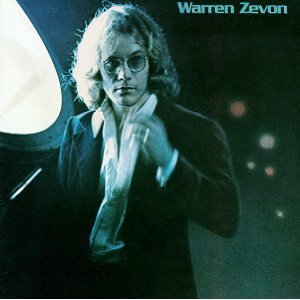
The album cover:

A photo of the 29-year old Warren Zevon in black suit and unbuttoned white shirt, a dim, noirish image with only an offset stage light providing illumination.The image indicates a bit of Zevon’s past (he was a band leader for the Everly Brothers before starting his solo career) and future (he was friends with David Letterman and often filled in as band leader for Paul Shaffer on Letterman’s show).

Warren Zevon, recorded in 1975 and released in 1976, was Zevon’s major label debut. He had spent much of the early ’70s trying to get a record deal, without success, and had actually moved to Spain for a period, where he had a regular gig in a bar owned by a former mercenary (the inspiration for the song Roland the Headless Thompson Gunner). Jackson Browne talked him into returning to Los Angeles to record this album, which Browne produced. Zevon was a true songwriter’s songwriter, with both the good and bad implications of that title: He never achieved the commercial success his talent seemingly deserved (at least in part because of his self-destructive alcoholism and drug habits), but he was universally respected by other musicians. Just look at the list of contributors on this album: Jackson Browne, Lindsey Buckingham, Stevie Nicks, Don Henley, Glenn Frey … it’s like a ’70s Southern California Hall of Fame.

The first sound you hear:

The opening solo piano riff of Frank and Jesse James. Zevon grew up mostly in Fresno, California; he’s been quoted as saying, “I’m the smartest guy to ever come out of Fresno,” but he did spend time as a youth in Fresno taking lessons from Igor Stravinsky, and his classical training shows in the intricate piano work throughout the album.

The last sound you hear:

The long fade out of a beautiful string arrangement in the coda of Desperados Under the Eaves. Much more on this song below.

Track by Track:

The album opens with Frank and Jesse James, a narrative song that tells the story of the famed outlaws in a sympathetic voice (“No one knows just where they came to be misunderstood/But the poor Missouri farmers know that Frank and Jesse do the best they could.”) Zevon was one of the smartest songwriters ever, and his work tended toward stories, showing the influence of both folk music and the westerns and detective novels he loved. His lyrics evoke the landscape of the West: “Keep on riding riding riding/Cross the rivers and the range/Keep on riding riding riding/Frank and Jesse James.” The jumping, syncopated piano work evokes those mountain ranges as well.

A chunky electric guitar leads us into Mama Couldn’t Be Persuaded. Zevon wrote many of the songs on this album while living in Spain and looking back over his life and seemingly failed career. As such, many of the songs are autobiographical: The chorus of this song is straight from Zevon’s parents (his father was a professional gambler): “My mama couldn’t be persuaded when her daddy said/Daughter don’t marry that gambling man.” He explicitly reveals it’s his family’s story in the verse when he sings “They all went to pieces when the bad luck hit/Stuck in the middle, I was the kid.”

Next is the upbeat acoustic Backs Turned Looking Down the Path, which features Lindsey Buckingham playing lead guitar and Jackson Browne on slide. The song shows folk and country influences, and the best part is the chorus: “People always ask me why?/What’s the matter with me?/Nothing matters when I’m with my ba-aby/With my back turned/Looking down the path.”

The fourth track is Hasten Down the Wind, a mournful breakup song with this lovely chorus: “She’s so many women/He can’t find the one who was his friend/So he’s hanging on to half a heart/He can’t have the restless part/So he tells her to hasten down the wind.” Linda Ronstadt covered this and used it as the title track for her Grammy Award-winning album.

The next track is titled Poor Poor Pitiful Me, but it’s anything but mournful. Zevon had a great sense of humor, and it’s never more on display than in this tongue-in-cheek appraisal of the L.A. hookup scene. The chorus goes “Poor, poor, pitiful me/These young girls won’t let me be/Lord have mercy on me/Woe is me.” He tells stories about a couple of encounters, the first of which goes: “I met a girl in West Hollywood/I ain’t naming names/She really worked me over good/She was just like Jesse James/She really worked me over good/She was a credit to her gender/She put me through some changes, Lord/Sort of like a Waring blender”; the second features one of the funniest moments ever recorded in song: Zevon sings “I met a girl at the Rainbow bar/She asked me if I’d beat her/She took me back to the Hyatt House…” and then he stops for a moment before muttering, “I don’t want to talk about it.” Set to an upbeat barroom piano riff and stellar electric guitar licks, it’s an oxymoronic song that’s a Zevon classic.

The French Inhaler is, on the surface, a song about a failed-actress turned prostitute and an alcoholic in a Hollywood bar who falls for her. It’s actually another autobiographical song, a “fuck you” to Zevon’s first wife, which ends with an audible blown kiss.

The next track is the gorgeous Mohammed’s Radio, which layers piano, electric guitar, and saxophone, along with harmony lyrics from Lindsey Buckingham and Stevie Nicks. It’s a song about weighing the struggles of the day-to-day with spiritual crisis: “Everybody’s working/Trying to make ends meet/Still can’t pay the price of gasoline” in the verse, while the chorus soars: “Don’t it make you want to rock and roll/All night long/Mohammed’s Radio/I heard somebody singing sweet and soulful/On the radio/Mohammed’s Radio.”

Zevon switches to a heavy thumping bass track on the next song, the anthemic I’ll Sleep When I’m Dead. The title says it all. Zevon wrote about death so often, and in such a brash, fearless manner, that he nicknamed himself a “travel agent for death.” Sadly, this became a self-fulfilling prophecy, as Zevon died of cancer in 2003 at the edge of 56 (though his death was actually less attributable to his drinking and smoking habits than to years of being exposed to asbestos while sleeping in an attic as a kid). Even shortly before his death, Zevon’s final words of advice to David Letterman were pragmatic: “Enjoy every sandwich.”

We go back to the light acoustic milieu for the classic Carmelita. The song starts, “I hear mariachi static on the radio,” and the guitars (rhythm played by Glenn Frey and lead by David Lindley) show a distinct mariachi influence. It’s a song about being down and out in East L.A., with a chorus that goes: “Carmelita, hold me tighter/I think I’m sinking down/And I’m all strung out on heroin/On the outskirts of town.” My favorite part, though, is the final verse, about a writer selling his typewriter so he can head down to a notoriously seedy LA. street to score: “I pawned my Smith Corona/And I went to meet my man/He hangs out down on Alvarado Street/By the Pioneer Chicken stand.” Is it weird that I think this is the most romantic song ever?

Join Me in L.A. carries every bit of the darkness of a Raymond Chandler novel, as he urges listeners to join him on the dark and seedy streets of Los Angeles. The backup vocals are provided by Bonnie Raitt and Stevie Nicks.

The album closes with one of my favorite songs of all time, Desperados Under the Eaves. It’s another down-and-out in L.A. song that begins: “I was sitting in the Hollywood Hawaiian Hotel/I was staring in my empty coffee cup/I was thinking that the gypsy wasn’t lying/All the salty margaritas in Los Angeles/I’m gonna drink them up/And if California slides into the ocean/Like the mystics and statistics say it will/I predict this motel will be standing/Until I pay my bill.” The song contains all of Zevon’s trademarks: the piano work, the darkness, the sense of humor–and then it takes it up a notch. The final verse goes, “I was sitting in the Hollywood Hawaiian Hotel/I was listening to the air conditioner hum/It went…” at which point Zevon begins to hum the song’s melody. He is soon joined by backup singers and then a string arrangement, all of it coming together in a beautiful harmony, and then Zevon takes a lead vocal, singing over that harmony, “Look away, down Gower Avenue/Look away.” It’s a lament, a broken man looking for some way out and unable to find it, but it’s a lament so powerful that it sends the soul soaring, a coda to not just the song, but the album as a whole. If those two minutes of music doesn’t move you, then I’m sorry, you just don’t like music.

The signature track:

It’s so hard to choose. Do you go with I’ll Sleep When I’m Dead, a song that’s tragically so definitive for Zevon? Or the beloved Carmelita? Neither of those would be bad choices, but for me, the album closer, Desperados Under the Eaves, for the reasons outlined above, will always be the song that defines this record.

The signature lyric:

“I’ll Sleep When I’m Dead” would be a worthy choice. But, again, I have to go with that lyric from Desperados Under the Eaves: “And if California slides into the ocean/Like the mystics and statistics say it will/I predict this motel will be standing/Until I pay my bill.”

The essence of the album:

As I said earlier, Warren Zevon is the least famous artist on my Desert Island Albums list. However, he may be the most important. My love of music starts with Zevon. My father is a huge Zevon fan, and one of my earliest memories is riding in a car with him to my uncle’s cabin in the Catskills, with Roland the Headless Thompson Gunner (from the 1978 album Excitable Boy) playing on the stereo. The first album I ever owned (On cassette! I’m old!) was Zevon’s Greatest Hits. My uncle and I often sing Carmelita together at our Friday night jam. Zevon’s music is like a Goldman family heirloom.

My uncle (on the right) and I (in the middle) at our Friday night jam

My uncle (on the right) and I (in the middle) at our Friday night jam

To go even further, I identify quite a bit with Zevon: I feel like I’m a pretty talented person who hasn’t had as much career success as I’d like, and while that’s definitely not all my fault, I have to admit that at least a little bit of it is because of my sometimes self-destructive behavior. When Zevon sings about everything around him being destroyed by a natural disaster, and yet somehow his motel surviving long enough to insist that he pay his bill, I know exactly how he feels.

One last note: Zevon was diagnosed with terminal cancer about a year before his death, and he recorded a final album, My Ride’s Here, as his health deteriorated. Keep Me In Your Heart For A While is the closing track on that album, and I defy you to keep your eyes dry while you listen to it.

Find all my Desert Island Albums here.

Posted in Desert Island Albums, Music | Tagged , , , , , , | 1 Comment

My Final Meal on Death Row

I have a few favorite questions I love to ask people I’m getting to know, or to argue about with friends. I like to call these my “stock questions.” My favorite, of course, is: Which ten albums would you take if you were going to be stranded on a desert island? This is, in my opinion, a life-defining question.

My second-favorite stock question is also life-defining, or at least it is the way I frame it: You know how prisoners on death row are given one last meal of their choice before execution? Well, I love to ask people, If you were on death row, what would your final meal be?

My answer might surprise some people. I’m a little bit of a casual gourmet, and I love eating at fancy restaurants and drinking really good booze. I’ve done a fifteen-brewery tour of Oregon. I’ve eaten a huge side of beef at Brooklyn’s Peter Luger Steakhouse. I’ve gone wine-tasting at Silver Oak and Stag’s Leap in Napa. I’ve had the omakase at Sebo, maybe the best sushi restaurant in San Francisco (just ask Anthony Bourdain). While moving cross-country, I took a detour so I could go bourbon tasting in Kentucky. Because of my connoisseur inclinations, one of my roommates once called me “the Anthony Bourdain of San Francisco.”

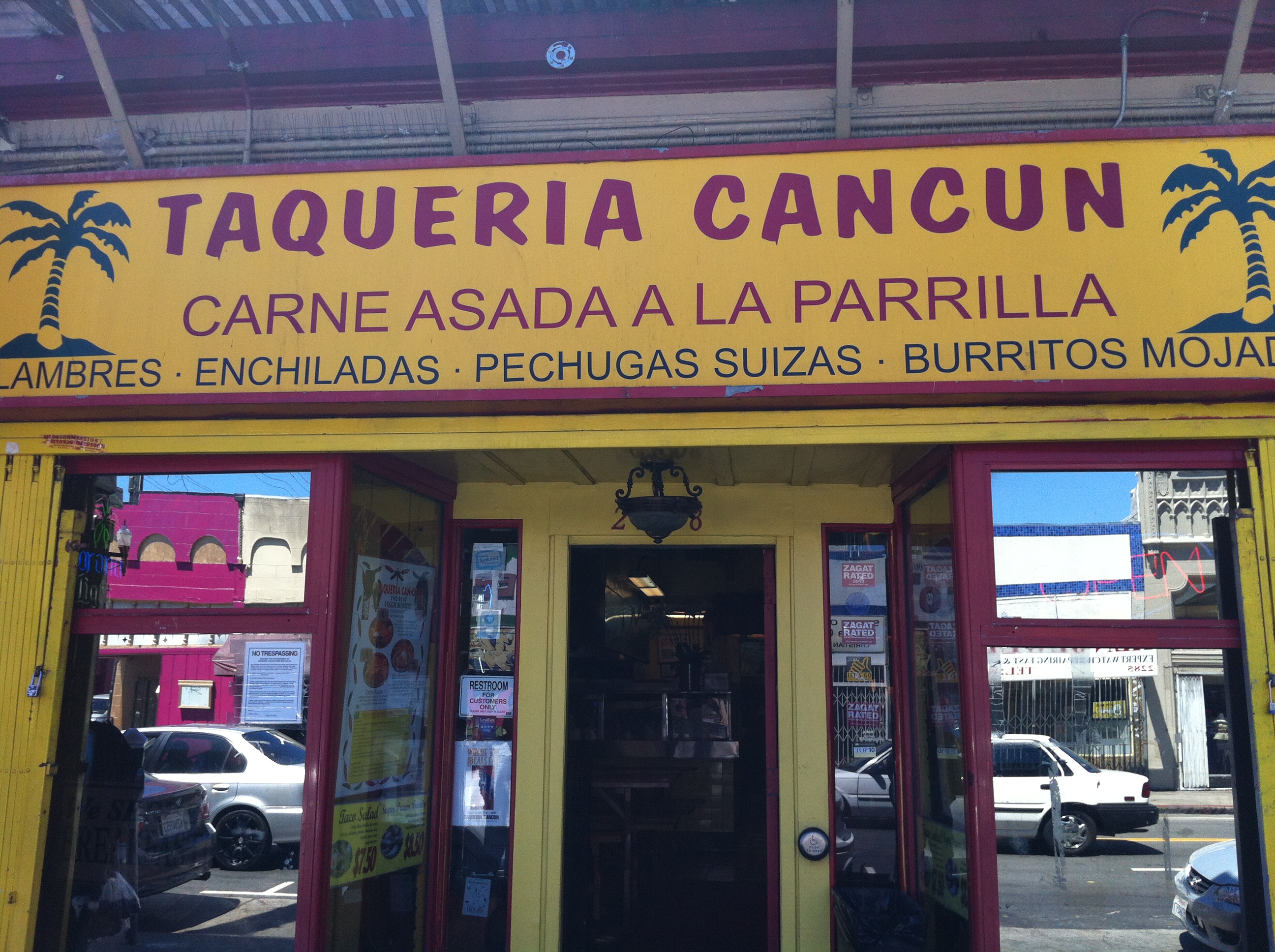
If you couldn’t tell by the multiple mentions in that last paragraph, Bourdain is something of a personal hero of mine. And I think he’d be proud of my last meal on earth, because it doesn’t involve any of that gourmet shit. In fact, it’s a meal you can get for ten bucks at a dive of a taqueria in San Francisco’s Mission District. That’s right: My final meal would be the Burrito Mojado al pastor from Taqueria Cancun, washed down with an ice cold Pacifico.

First, the scene: Taqueria Cancun is on a grimy (though not so much as before the cruel wave of gentrification struck the Mission) block of Mission Street between 18th and 19th streets. It’s an unassuming, almost rickety yellow storefront, set just back enough from the stores on either side that you could walk right past it if you weren’t paying attention.

The Gates of Shangri-La

The Gates of Shangri-La

The floor is a simple red ceramic tile, which evokes terra cotta, and the seating on either side is communal picnic tables (if you seat for any length of time, you’re pretty much assured of being solicited for money by either a mariachi band or a homeless person). The jukebox is almost always blaring ranchero music, though I recall a magical night once when the moment I walked in I was greeted with the opening notes of Samba Pa Ti, one of my favorite guitar instrumentals, by San Francisco’s own Carlos Santana.

Shangri-La's dining hall

Shangri-La’s dining hall

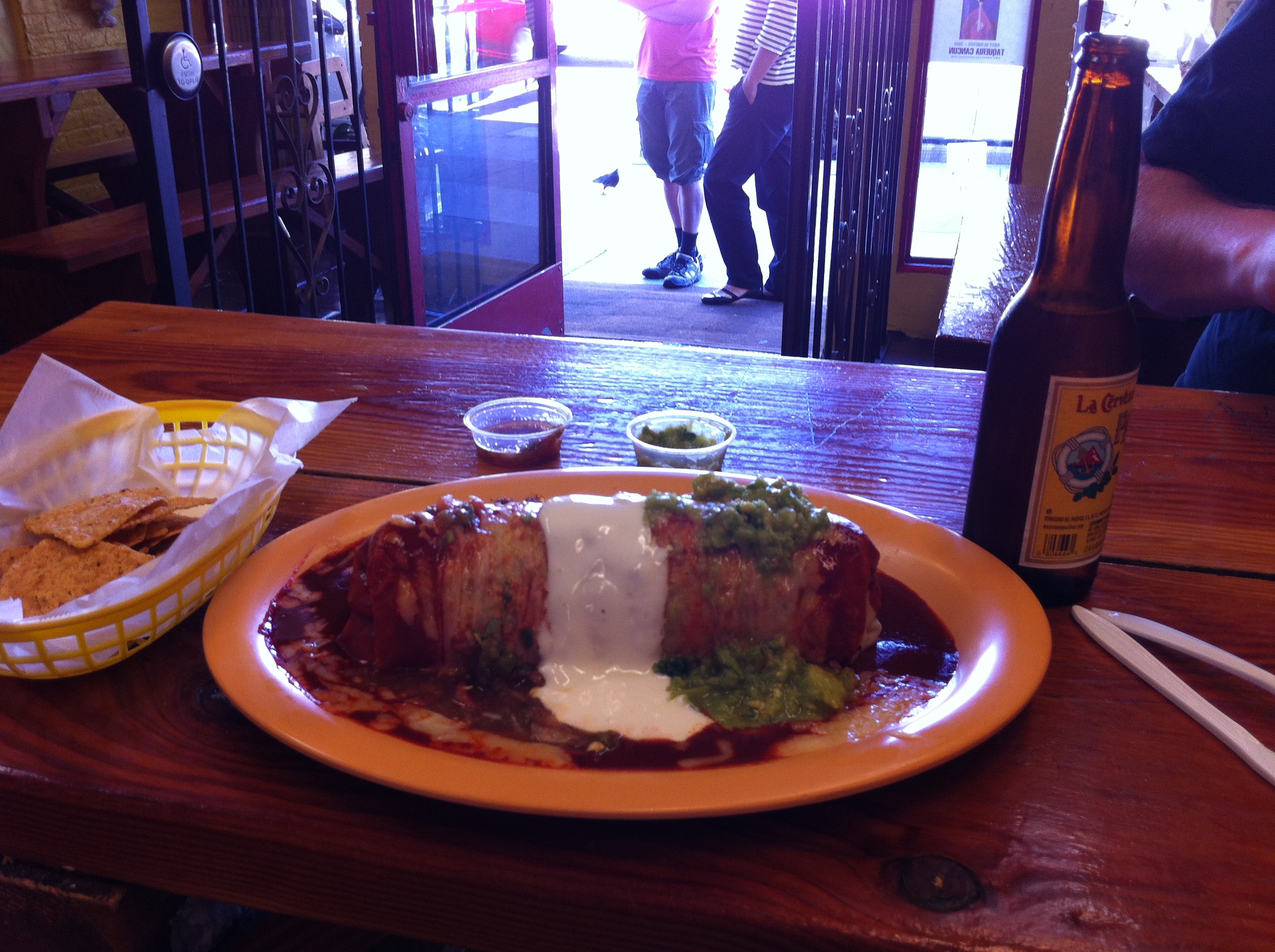
The line files past the tables and the open kitchen with its large flat grills on the left, and loops back around past jugs of agua fresca and huge sacks of onions, to the register, where you order. The cashier takes your $10, hands you a ticket, your beer, and a basket of corn chips with one ramekin each of pico de gallo (the Cancun version is finely chopped and laced with jalapenos) and aguacate (a mix of avocado and jalapenos which is basically creamed fire) salsas. You take a seat, and when your number is called, you return to the counter to retrieve this:

Abandon all hope of finishing this thing

Abandon all hope of finishing this thing

Now that you’ve seen it, let me break this bad boy down for you. Cancun starts out with an enormous tortilla (the menu touts this burrito as “a BIG one”), and fills it with Spanish rice, pinto beans, and the meat of your choice. My meat is al pastor, which is pork marinated for hours in chili peppers and pineapple, rendering it slightly sweet, extremely spicy, and incredibly tender. Al pastor is the reason I could never be a vegetarian.

Even with just those ingredients, this burrito, which is roughly equivalent to a junior size football in length and girth, would be a tasty treat. But it’s what happens next that makes this my favorite dish. The geniuses at Cancun plate the burrito and drench it with a smoky red enchilada sauce. Then they melt cheese (jack, I think) over the top of it. Then for, the coup de grace, the slather on equal parts pico de gallo and aguacate salsas and sour cream. Note the topping colors: red, green, and white, the tricolors of the Mexican flag. It’s the most patriotic meal ever (If I weren’t so pale white, I’d swear that there was a mix-up at the hospital where I was born, and my real parents are Mexican).

Once I’m back at the table, I set out to eat this burrito strategically. I cut across it with a knife and fork (plastic, of course), allowing the guts to spill out, spooning the salsas, enchilada sauce, and crema over the top. I scoop up the burrito’s innards with corn tortilla chips until these edible utensils are gone, and then I retrieve my fork and eat whatever’s left inside the tortilla, which is now sodden with cheese and delicious red sauce.

To wash this monster of jalapeno heat and roasted smoke and hearty arroz y frijol down, there’s no choice but Pacifico. It’s a light beer, perfect for the task because it quenches the heat, cleanses the palate, and doesn’t add too much volume to my already severely tested digestive system. I’m also sentimental when it comes to Pacifico–in four years of college, my roommates and I probably drank enough of the stuff to keep the brewery solvent by ourselves.

Afterward I stumble out, so full I can barely move. It’s a perfect meal for the kind of person who needs to get by on one meal a day (as I often have in my life), and it is the ultimate weapon to combat a hangover, either proactively (at 3 a.m., after the bars have closed) or reactively (after you wake up at noon the next day). Either way, you want to be close to home if you’re going to take down a burrito mojado, because you’re going to need to lie down for at least an hour (and probably more) after you’ve cleaned that plate.

So there you have it: My death row final meal. What’s yours?

Posted in Drinks, Food | Tagged , , , , | 3 Comments

Desert Island Album #8: Electric Ladyland

tumblr_midhb9qE2F1qzhvwjo1_1280

The album cover:

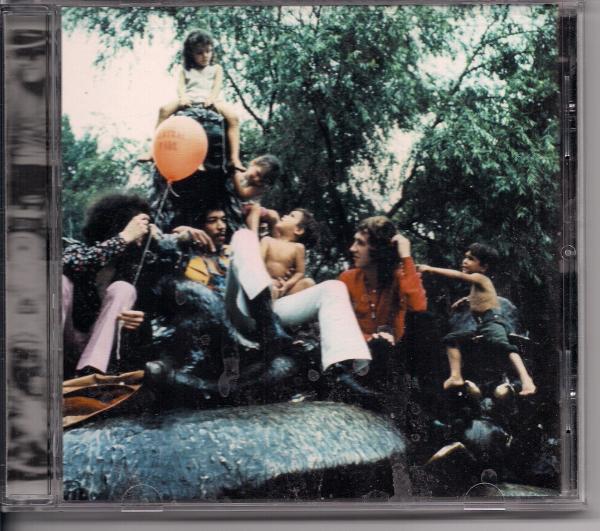
This is a fun one. The above was the cover that Reprise Records chose, a blurry red and yellow headshot of Hendrix. What Jimi wanted to use was the photo below: himself and Experience bandmates Noel Redding and Mitch Mitchell sitting with some kids on an Alice in Wonderland sculpture in Central Park. Fun fact: the photo was taken by Linda Eastman (the future Mrs. Paul McCartney).

Hendrix's choice for the cover ... in a CD jewel case! Remember CDs?

Hendrix’s preferred choice for the cover … in a CD jewel case! Remember CDs?

And this isn’t even the most famous alternate cover. Track Records, which had the rights to Hendrix’s work in England, ran a double-sided cover featuring nineteen naked women.

I imagine this is what the dressing room liked like at Hendrix concerts

I imagine this is what the dressing room backstage looked like at Hendrix concerts

Hendrix disavowed this cover. I suppose the fight just goes to show that everything was complicated for Jimi in 1968, when Electric Ladyland, his third studio album, was released.

The first sound you hear:

A heavy drum and staticky background noise, followed by a deep, unintelligible, alien voice on the intro track …And the Gods made Love. Hendrix was nothing if not a sonic pioneer and experimenter. If you think of Electric Ladyland as more than just a massive 16-track double LP, but also as a world unto itself, the sonic landscape of Hendrix’s mind, then this track plays the role of a Big Bang-style moment of creation.

The last sound you hear:

The fading out of the supernatural outro guitar solo of Voodoo Child (Slight Return) a sound that no other guitar player, no matter how awesome, has ever been able to perfectly replicate.

Track by Track:

The aforementioned intro track leads seamlessly into Have You Ever Been (To Electric Ladyland), a dreamy song with a high, almost falsetto vocal and a guitar that sounds underwater, a sound no other guitarist creates quite so effectively. Hendrix sometimes spoke of his music and fans as being part of an “electric church,” and this song, with its evocation of angels and “electric love” feels, in that context, like a gospel tune.

The next track is the breezy, witty Crosstown Traffic, a lyrical metaphor Hendrix uses to describe an affair, backing it up with a guitar riff that sounds almost like a series of gridlocked horns honking.

Things take a turn for the epic with Voodoo Chile. It’s not as famous as the album’s final track, Voodoo Child (Slight Return), but it may be the definitive Hendrix song–a blues from outer space. It’s also maybe the craziest studio song in Hendrix’s catalog, a fifteen-minute epic in which he trades insane blues guitar licks with organ solos from the great Steve Winwood (then a member of Traffic). Voodoo Chile was born out of an all-night jam session, and you can feel the exhaustion at the end of the song. I would give pretty much anything to have been in the studio when this was recorded.

Side 2 of the record opens with Little Miss Strange, a Brit-pop song written by bassist Noel Redding, who plays rhythm guitar on the track. It’s not a terrible song, but it feels a little derivative of its genre, and doesn’t stand the test of time the way Jimi’s songs do.

Next is Long Hot Summer Night, which features a rapid fire main riff that has long haunted me, a riff that feels like it’s going to melt the walls, like the heat of an August New York City night. The lyrics tell of a girl who’s gone away, but has changed her mind and is coming back to Jimi. The closer she gets, the hotter it feels.

Hendrix goes back to the blues on Come On (Part I), a cover of a 1960 Earl King song. It’s an uptempo jam, with instrumental sections reminiscent of the Experience’s recordings of Driving South.

Next is the uptempo but melancholy Gypsy Eyes, a song Hendrix wrote about his mother, who cheated on Jimi’s father and abandoned her son. (“I remember the first time I saw you/The tears in your eyes look like they’re tryin’ to say/Oh little boy you know I could love you/But first I must make my get away/Two strange men fightin’ to the death over me today.”)

The final track on Side 2 is Burning of the Midnight Lamp, which Hendrix wrote on a long late-night flight. The song is most notable as the first one on which Jimi used a wah wah pedal, an idea his friend and rival Eric Clapton had pioneered shortly before on Cream’s Tales of Brave Ulysses. (Jimi also plays harpsichord on the song. Harpsichord!)

Side 3 opens with the groovy Rainy Day, Dream Away, on which Hendrix trades jazzy licks with a sax played by Freddie Smith. The song also features Buddy Miles sitting in for Mitch Mitchell on drums, as well as a Mike Finnigan organ solo. It’s one of my favorite rainy day songs, for the way Hendrix sings, “Rainy day, dream away/Let the sun take a holiday/Flowers bathe and I see the children play/Lay back and groove on a rainy day.”

Rainy Day, Dream Away transitions seamlessly into 1983 … (A Merman I Should Turn to Be), a 13:39 second jam on which Hendrix makes his guitar sound like it’s both under water and in outer space, and which features flute work from Chris Wood of Traffic. 1983 transitions into Moon, Turn the Tides … Gently, Gently Away, a sprinkling of staticky sound moving from one channel to the next. That’s the end of Side 3, but Side 4 opens with Still Raining, Still Dreaming, which was recorded in the same session as Rainy Day, Dream Away. I think that now, living in times where we don’t have to flip over vinyl discs to keep our albums playing, it’s best to understand these four songs together as a single psychedelic dream.

The next track is House Burning Down, Hendrix’s reaction to the race riots of the summer of 1968, a period that saw several major American cities, including Detroit and Newark, engulfed in flames. (Fun fact: These riots are also the subject of the Beatles’ Blackbird.)

The final two songs are the most recognizable on this, and just about any, album: First is All Along the Watchtower, Jimi’s incendiary Bob Dylan cover. Actually, recognizable doesn’t do this song justice: Everything about it is legendary. The distinctive rhythm played on 12-string guitar by Traffic’s Dave Mason, the searing tone of Hendrix’s strat, the wail of the slide guitar (which Hendrix played with a zippo), and the apocalyptic lyrics, which Jimi sings with aplomb and accentuates with the lightning outro solo. It’s the greatest cover ever (the only possible argument is Aretha Franklin’s Respect), one that’s so great that Dylan began arranging the song a la Hendrix after he heard Jimi’s version.

If it’s possible for a song to be more distinctive than Watchtower, it’s the album-closer, Voodoo Child (Slight Return). Put simply, if aliens came to earth and we had to win a guitar battle to save the human race, I would want our champion to be Hendrix the moment he starts pumping the wah wah pedal and picking that famous opening riff. That probably wasn’t the simplest way to put that.

The signature track:

When I was a freshman in college, a bunch of my good friends made Top 25 lists of what we thought were the greatest rock songs of all time. Watchtower was Number One on my list. If I made that list again today, more than a dozen years later, it would look pretty different–but Watchtower would still be in the top spot. It’s pretty hard to top the greatest guitar player ever performing a song written by the greatest lyricist ever, no?

The signature lyric:

The most famous line on the album is probably the opener of Watchtower: “There must be some kind of way out of here, said the joker to the thief.” But I kind of want the signature lyric to be one written by Jimi himself. So how about the opener to Voodoo Child (Slight Return): “I stand up next to a mountain/And I chop it down with the edge of my hand”? Or the line from the second verse, “If I don’t meet you no more in this world/I’ll see you in the next one, and don’t be late,” which takes on an unexpected poignance due to Hendrix’s tragic death.

The essence of the album:

I kind of can’t believe I got all the way to my eighth Desert Island Album before doing a Hendrix record. I started playing guitar because of Jimi. He’s the guy that other guitar gods unanimously point to when they’re asked who’s the best; he’s on a different planet from anyone else. Electric Ladyland is the apotheosis of Hendrix’s sonic exploration. His other albums are great: Are You Experienced features so many amazing songs–the dreamy May This Be Love, the wistful The Wind Cries Mary, the sexy Foxy Lady, the acid-fueled Purple Haze; and Axis: Bold as Love has several of my personal favorites–the introspective Castles Made of Sand, the screaming Bold as Love, and especially the mind-blowingly beautiful Little Wing. Hendrix was always searching for a way to express the sounds in his head through the guitar, and the expansive Electric Ladyland is the album on which he came the closest to giving full form to that goal. It’s a cruel shame that he didn’t have more opportunity to do so.

Find all my Desert Island Albums here.

Posted in Desert Island Albums, Music | Tagged , , , , | 2 Comments

Ghosts of New York: Max’s Kansas City and the Fillmore East

I’ve long described New York as being like the girl you’re desperately in love with who doesn’t even know your name. It’s not personal; New York doesn’t stop for anyone, doesn’t care what anyone’s name is. It’s a place that always shifts, always moves forward, whether you’re coming for the ride or not.

I recently read a novel that got me thinking about this idea again. Colum McCann’s Let the Great World Spin, which won the National Book Award in 2009 and is, truly, one of the best books I’ve read in years, is set in New York in 1974. It imagines a number of characters’ lives swirling around the day that French acrobat Philippe Petit successfully walked a tightrope between the Twin Towers.

The ballsiest circus trick ever, right?

The ballsiest circus trick ever, right?

In part because it’s set in the past, the book features a number of locations that no longer exist–the most poignant of which are, of course, the Towers themselves. McCann specifically addresses the notion of the city’s impermanence at one point, when one of his characters muses that New York is “a city uninterested in history. Strange things occurred precisely because there was no regard for the past. The city lived in a sort of everyday present … As if it were the only place that ever existed and the only one that ever would.”

This carries special significance after 9/11, but when I first read that passage, I was struck by the more general truth of the city’s protean nature. In another section of the book, one of the characters describes partying night after night at Max’s Kansas City, the famous nightclub where seemingly everyone famous in the art world–Mapplethorpe, Warhol, Rauschenberg, you name it–hung out in the late ’60s and early ’70s. She describes stumbling out of the bar: “Sometimes it was three days later on when I finally got out. The light hit my eyes when I opened the door onto Park Avenue South and Seventeenth Street.”

Max's

213 Park Avenue South in the ’70s

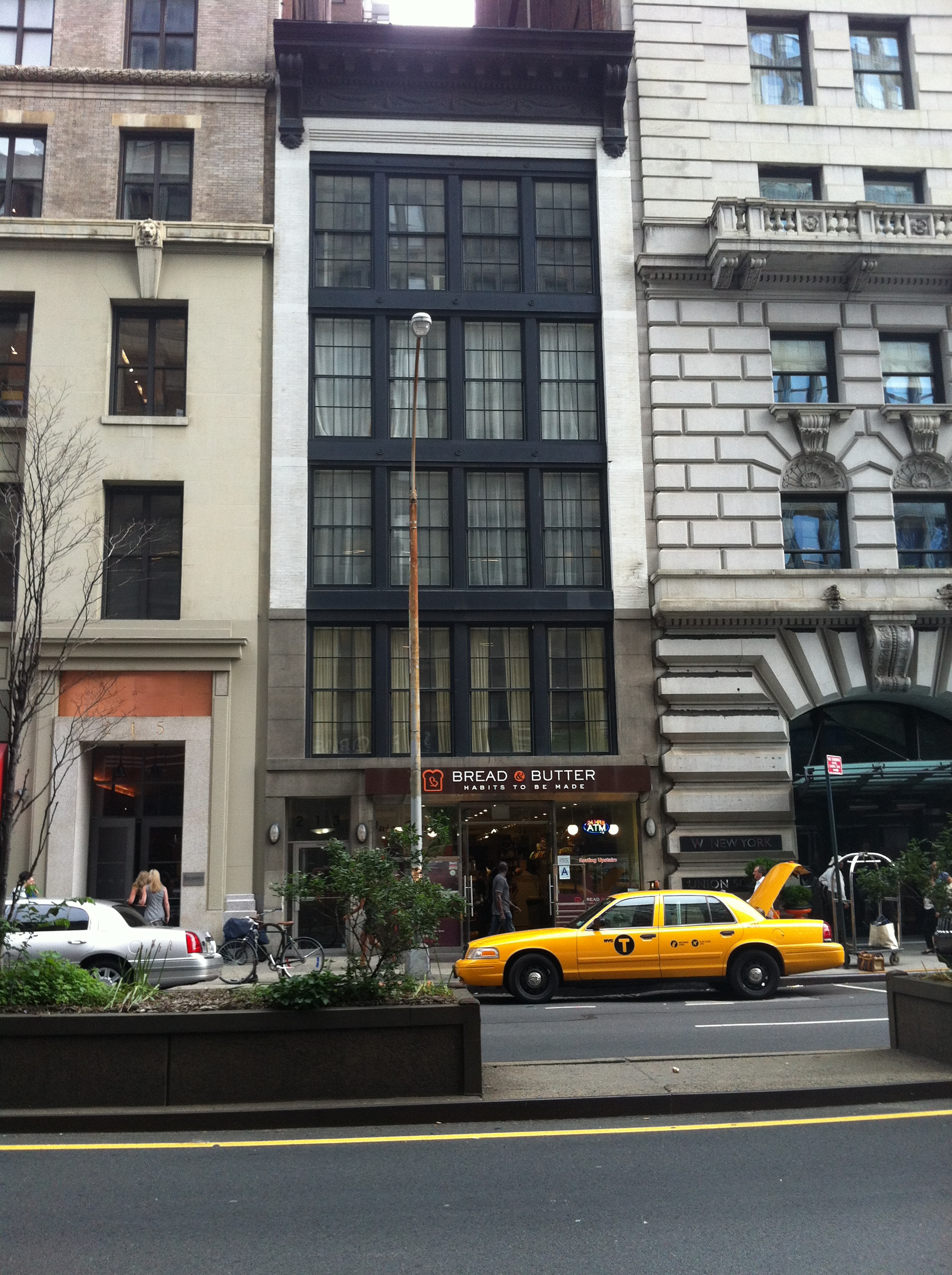
I stopped. Wait, what? You see, that’s the exact block where the office I currently work is located. And, when I looked it up, it turns out that not only is it the same block, but Max’s Kansas City was in the building next door, between my office and the W Hotel. I walk by it every day. Of course, it’s not a nightclub anymore. Max’s went in and out of business several times, and now the storefront at 213 Park Avenue South is a cruddy sandwich and salad place.

Moving on doesn't necessarily mean becoming something better.

And today: “Moving on” doesn’t necessarily mean becoming something better.

New York is full of these, once famous buildings that are now nondescript, with nothing to commemorate their importance. You want another example? How about the Fillmore East?

The Fillmore East was known as "The Church of Rock and Roll."

The Fillmore East was known as “The Church of Rock and Roll.”

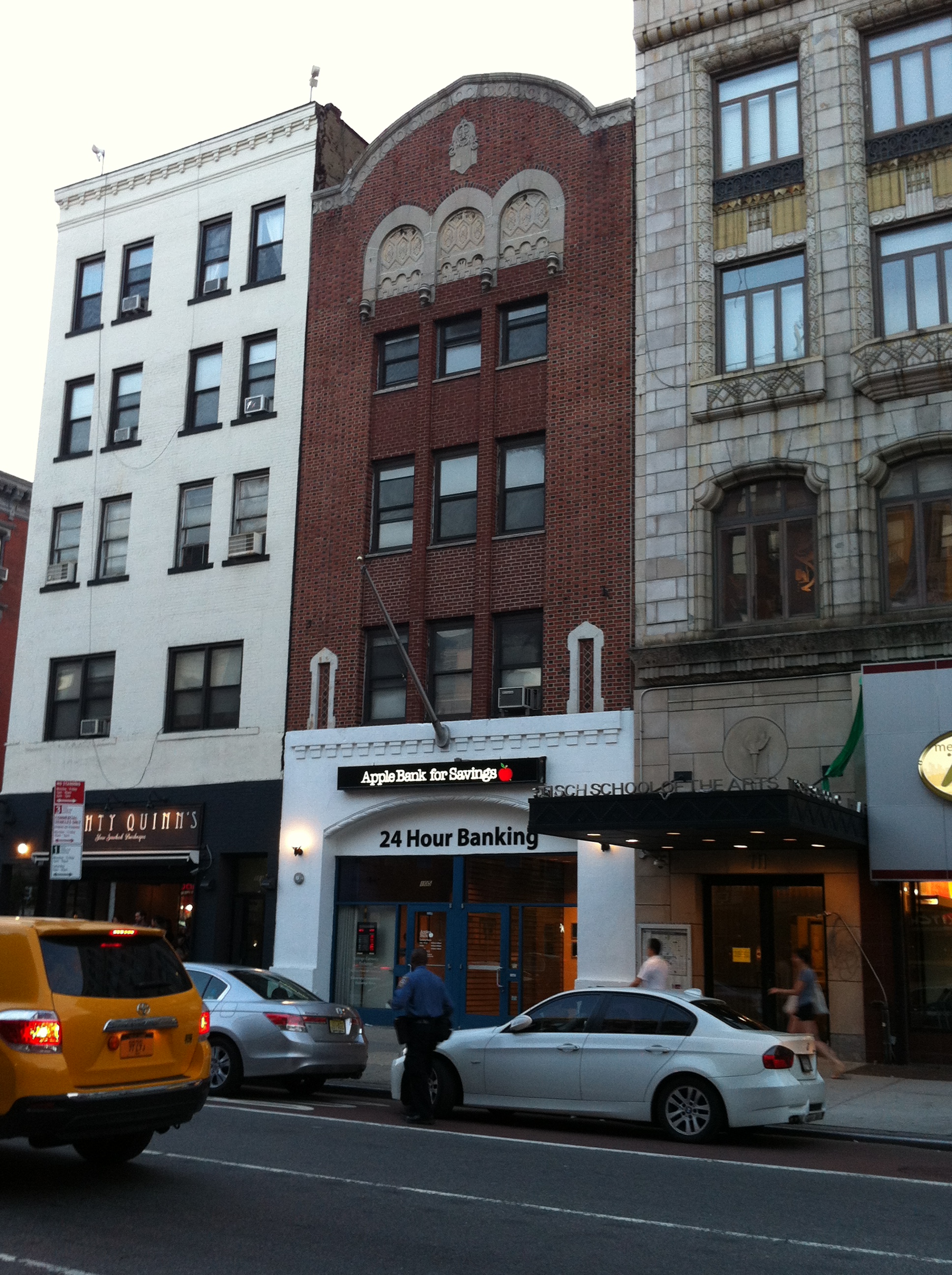
Opened by famed concert promoter Bill Graham, between 1968 and 1971 the Fillmore East, at 2nd Avenue and East 6th Street in the East Village, hosted nearly every major rock ‘n’ roll act you can think of. It’s also where a couple of the most famous live albums ever were recorded: Jimi Hendrix’s Band of Gypsys and the Allman Brothers Band’s At Fillmore East. Now? It’s a bank, no indication whatsoever of its former glory.

Jimi Hendrix and Led Zeppelin both played in this building

Led Zeppelin and the Grateful Dead both played in this building

I don’t mean to be overly nostalgic. As this city moves forward I’ll go on loving her, even if she never learns my name. But there’s a funny thing about that girl you love so much: She’ll never be more beautiful than in your memories.

Note: This post was partially inspired by fellow blogsmith Juan Alvarado Valdivia’s series, Fantasmas de San Francisco. Check it out.

Posted in Books, Travel | Tagged , , , , , , , , , | Leave a comment

Desert Island Album #7: Led Zeppelin IV

Led_Zeppelin_-_

The album cover:

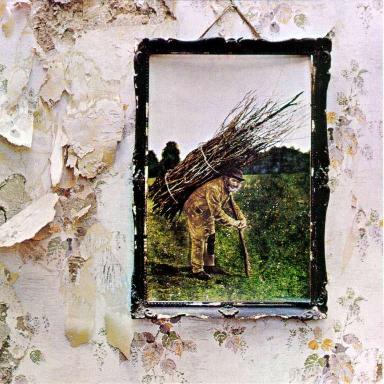
The image of the old man bent beneath the weight of the load of wood on his back is from a 19th Century oil painting Zeppelin singer Robert Plant bought at an antique shop. The painting was hung on the disheveled walls of a suburban house that was slated for demolition, and then the photo that became the cover was taken. The album cover is most notable for displaying neither an album title nor the band’s name, which was unique for its time, 1971, and which the band did in part as a response to the poor reviews for Led Zeppelin III. Officially the album has no title, although it’s most commonly referred to as either IV or ZoSo, after the four symbols the bandmates chose to represent themselves with on the back sleeve.

The back sleeve

The back sleeve

One other important note on the album: The band recorded it at Headley Grange, an English country mansion, which ended up influencing the songs in ways Page talked about in the documentary It Might Get Loud.

The first sound you hear:

A quiet guitar lick that sounds like a tape rewinding, followed by Plant howling out “Hey hey mama, said the way you move/Gon’ make you sweat, gon’ make you groove,” the famous opening line of Black Dog.

The last sound you hear:

A crunching, echoing, note sliding off a guitar and fading out, the end to the epic, powerful blues of When the Levee Breaks.

Track by Track:

Black Dog, one of Zeppelin’s signature songs and a staple of their live performances, opens the album. It’s a thunderous song, drums pounding, lyrics blatantly sexual an electric guitar riff that Jimmy Page triple-tracked to give it more weight.

The second track of Side A is another uptempo rocker, Rock and Roll. Everything about this song is frenetic, from John Bonham’s unparalleled drumming to Page’s famous 12-bar blues guitar riff to Plant’s almost screamingly insistent vocal, “Open your arms, opens your arms, Open your arms/Baby, let my love come running in.”

The uptempo rockers give way to the band’s inclination toward mythology and Tolkien-inspired lyrics on The Battle of Evermore. Even within Led Zep’s multi-faceted catalog, it’s a truly unique song, it’s signature sound a ringing, instantly recognizable mandolin riff (which Page came up with while plucking bassist and multi-instrumentalist John Paul Jones’s mandolin) and a multi-tracked vocal that’s one of Plant’s best on wax, the duet with English folk-singer Sandy Denny bringing out the best in him. And of course there are the lyrics, about ringwraiths, dragons, magic runes, the usual Zeppelin gobbledygook. It’s awesome.

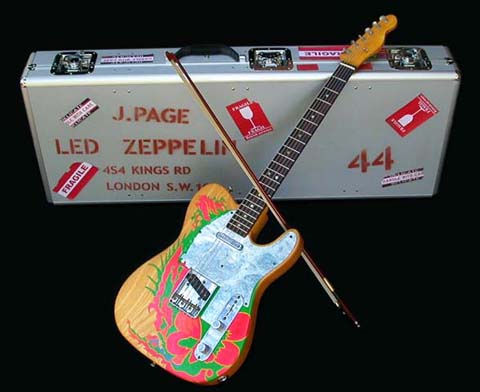
Side A ends with the band’s most famous song and arguably the greatest rock song ever, Stairway to Heaven. There’s so much mythology surrounding this song that I’m not going to rehash it all. Page come up with the riff on an acoustic guitar (Some people claim that they stole it from the Spirit song Taurus, but I think the similarities are only superficial. Not to say Led Zeppelin never stole anything–as just one example, Whole Lotta Love is a direct rip-off of a Willie Dixon song), Plant wrote most of the lyrics in a single quick session, and the band cut the song, with Page playing the solo on his old custom-painted Fender Telecaster.

Behold, a god's instrument

Behold, the hammer of the gods

It’s the band’s signature song in part because, at exactly eight minutes long, it’s an emblematic Led Zeppelin song. It starts out acoustic, with weird instruments (pan flute), it has weird lyrics that at least make me think of Lord of the Rings, and it builds to a crescendo of electric guitar with powerful drums, an epic guitar solo, and that famous hard rock outro with Page walloping his guitar strings, Bonham trying to break his drum kit, and Plant screaming “As we wind on down the road…” It’s a song that, if you’ve been listening to rock music as long as I have, you never need to put on, because you’ve heard it a million times. But when it does come on, you sit there and listen to it and find yourself shaking your head and saying, This is fucking awesome. Also, check out this deleted scene from Almost Famous, which is just too ridiculous for words.

Side B opens with Misty Mountain Hop, a heavy electric guitar-driven song about escaping the hassles of the city (I’ll be honest, this is the one track on the album I can live without). The following track, Four Sticks, features an even heavier electric guitar riff, which seems almost to be racing against Bonham’s rapid fire drums. It’s impossible to stay still in your seat while this song is playing.

The following song is the lovely, acoustic, folk-influenced Going to California, which Page and Plant wrote about the singer Joni Mitchell. It’s a spot of softness, almost the eye of the storm in this album, and serves as a lovely respite. (Aside: I’ve always wanted to learn to play this song, but the guitar, aside from being heavily interspersed with mandolin, is in double drop-D tuning, which is annoying. Also, I suck at finger picking. But I still love listening to the tune.)

The album closes with When the Levee Breaks. Everything about this song is thunderous: the drums, which got that sound because the band recorded Bonham playing them in the wide open front hall of Headley Grange; the slide guitar, which comes in waves like a flooding river spilling over its shores; and Plant’s echoing blues harp and wailing vocal about “Going down to Chicago.” The song was originally written about the Great Mississippi Flood of 1927 and recorded by Memphis Minnie in 1929. I had a hard time listening to this song for a while after Hurricane Katrina, when a shattered levee caused the flooding of one of my favorite cities in the world. But as New Orleans has recovered, When the Levee Breaks has returned to being what it’s long been for me: A song that gets me so fired up, every time I hear it I want to tear the walls off whatever room I’m in.

The signature track:

Stairway. Duh.

The signature lyric:

There are so many famous songs and lyrics on this album. I think the signature lyric would have to come from Stairway, and I’d say there are actually two: the diametrically opposed first and last verses, the first of which is softly sang over acoustic guitar and pan flute (“There’s a lady whose sure/All that glitters is gold/And she’s buying a stairway to heaven”), and the last, which is screamed over heavy drums and electric guitar (“As we wind on down the road/Our shadows taller than our soul/There walks a lady we all know/Who shines white light and wants to show/How everything still turns to gold/And if you listen very hard/The tune will come to you at last/How all are one and one is all/To be a Rock and Not to Roll … And she’s buying a stairway to heaven”).

The essence of the album:

Led Zeppelin is a great, great rock ‘n’ roll band, one I’ve spent thousands of hours listening to, and one that I absolutely would need to have to help me headbang away my loneliness. And it is seriously hard to choose one Zeppelin album. My favorite Zep tune, Your Time is Gonna Come, is on I. Many fans believe that II, with Whole Lotta Love, Heartbreaker, and Ramble On, among others, is the band’s best, and if I could take a second Led Zep album, it’d probably be that one. But what about III, which features The Immigrant Song, which my sister and I used to scream at each other while snowboarding, and Tangerine, which I sang while drunkenly stumbling arm-in-arm through the streets of Tijuana with one of my best friends? Or Houses of the Holy, with the amazing Rain Song and Over the Hills and Far Away? Or the double album Physical Graffiti, with all its classic longform songs, In My Time of Dying, Ten Years Gone, Kashmir?

Basically, you can’t go wrong with a Zeppelin album. I chose IV because I think it’s the most solid across the board, with the greatest number of iconic tracks. What would your Led Zeppelin album be?

Find all my Desert Island Albums here.

Posted in Desert Island Albums, Music | Tagged , , , , , , , | 3 Comments

My Five Favorite Moments from Mad Men Season 6

SPOILER ALERT: If you don’t want any surprises ruined, don’t read this until you’ve finished Season 6.

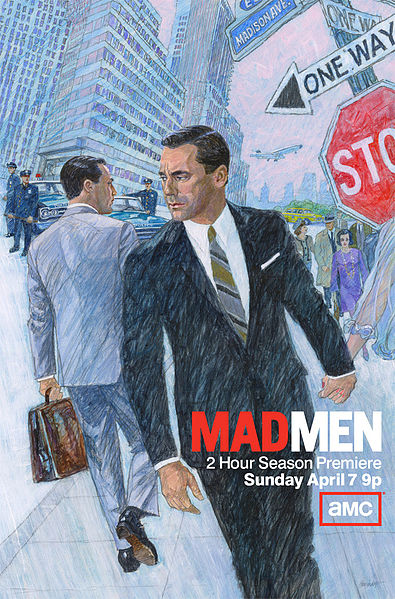
The Season 6 promo poster. The double image was not an accident

The Season 6 promo poster. The double image was not an accident

The sixth season of AMC’s Mad Men ended on Sunday night. It’s a show I’ve always had mixed feelings about. It’s fun to look at, the people in it are beautiful, and I think I would have fit in great in that bygone everyone-gets-drunk-and-chain-smokes-cigarettes-all-day-at-work environment. But I’ve often felt the dramatic tension a bit lacking. I personally don’t give a shit what accounts the mythical Sterling Cooper advertising firm wins or loses, and to take it a bit further, I basically think Don Draper and Roger Sterling and all those Madison Avenue types are what’s wrong with America. In the early seasons, the only plots that I thought were really compelling were the ones about Peggy trying to break through the incredibly low glass ceiling of the early 1960s.

But the show was always just good enough to keep me watching. And I felt like it broke through in Season 5, when they really hit what we think of as THE SIXTIES, in which characters from the old school are forced to confront what their society is becoming. In particular, the scene in which Megan (who I originally thought was a boring–albeit ridiculously hot–addition, but proved to be a nice youthful foil to Draper) handed Don a copy of Revolver, and he snapped it off after a minute of Tomorrow Never Knows, not understanding the point, was masterful. And the episode in which they win the Jaguar account, in which we see Joan and Peggy take polar opposite paths (Joan securing her financial future at the cost of prostituting herself for the firm, while Peggy quits for a better deal elsewhere and steps into the elevator to the brash chords of the Kinks), was one of the best hours of dramatic TV ever, right up there with some of the best work on Breaking Bad or The Wire.

Season 6 didn’t quite live up to the lofty standards of Season 5. Some of this, I felt, was because the show seemed like it just wanted to go back and cover old ground (I am not the first one to point this out): I thought when Peggy walked into that elevator she was gone, but she gets dragged right back into the office so Draper can fuck with her life some more; and the plotline of Draper screwing the downstairs neighbor led to some memorable scenes (none more than when his daughter catches him in flagrante), but it still felt kind of tired. This season did capture a few landmark moments (my favorite episode from this season is the one that swirls around the MLK assassination), but it was most obsessed with Draper’s disintegration, and with the presence of his two doubles, Bob Benson (who the show really wants me to care about, but I just don’t), and Ted Chaough (who we’ll get to shortly). At this point it feels incomplete; show-runner Matthew Weiner has said he plans to do one more season, which would take the characters through to the end of the ’60s, and the end of this season feels like it’s mostly just open-ended questions to make us think about that: Will Megan leave Don? Will he get his job back? Follow her to California? What about his relationship with his daughter? And I haven’t even addressed any of the other characters who are up in the air.

I don’t have answers to these questions. Without going into too much of a belabored analysis, here, in no particular order, are my five favorite moments from last season.

1. When Trudy finds out Pete slept with the neighbor: I was laughing watching Pete lie awake in bed, waiting for his wife to come home, knowing that the neighbor girl he screwed was going to spill the beans, and the scene got even better when Trudy walked in and, boring holes in the back of Pete’s head with her eyes, clicked the lights off. That bit of righteous rage would have been enough for me, but the morning-after scene topped it, when she tells him, “All I wanted was for you to be discrete,” and then kicks him out with the coup de grace: “I’m going to draw a 50-mile radius around this house, and if you so much as open your fly to urinate, I will destroy you.” God, I love Alison Brie.

God, I love Alison Brie

Let me say it again: God, I love Alison Brie

2. Pete telling off Harry in the MLK episode: Pete Campbell is a funny character; he’s such a slimy, weasel-faced piece of shit, and 99% of the time you just want to punch him. But his character does display rare moments of decency. I thought the scene in Season 5 where he visited his mistress after her electro-shock therapy was strangely touching. And in this scene, when he excoriates Harry for thinking about the money that will be lost on ads due to the assassination of MLK: “Let me put this in terms you’ll understand: That man had a wife and four children.” It’s so unexpected–this character is the very definition of pampered upper crust, and the only black people he ever talks to are cab drivers and elevator operators–and it actually makes you like him for a moment. As Amy Hempel said in a writing workshop I once took: “People aren’t one thing or another; they’re one thing and another.”

3. “Frank Gleason’s last idea”: Ted Chaough is a mirror for Draper; they hold the same position in the company and they’re equally competitive, but Ted’s a nice guy who can’t hold his liquor and stays true to his wife (at least for a while), and Draper is none of these things. Draper wants to destroy Chaough, especially because it kills him to see that Peggy loves Chaough. It’s not that Draper wants Peggy; he doesn’t. But he doesn’t want anyone else to have her either. So he holds them both over the fire in the client meeting, letting them see that he could out them (and crush them), only to then give them an out that they have to agree to–giving the credit for Peggy’s idea to the recently deceased Frank Gleason. When Peggy calls him a monster, she’s not kidding.

4. Chaough asks to go to California: This is a couple of scenes together. First there’s Chaough sleeping with Peggy, a scene in which he shows his similarity to Draper when he tells Peggy he doesn’t want anyone else to have her. Then he decides the answer to his problems is to run away to California–the same decision Draper made. Draper lets him go, and the characters split–Chaough presumably returning to the light and staying with his family, Draper possibly losing Megan over the decision. And then, of course, there’s the scene where Chaough breaks the news to Peggy, telling her, “One day you’ll be glad I made this decision.” Her acid, jilted reply is as good as screenwriting gets: “Well, aren’t you lucky. To have decisions.”

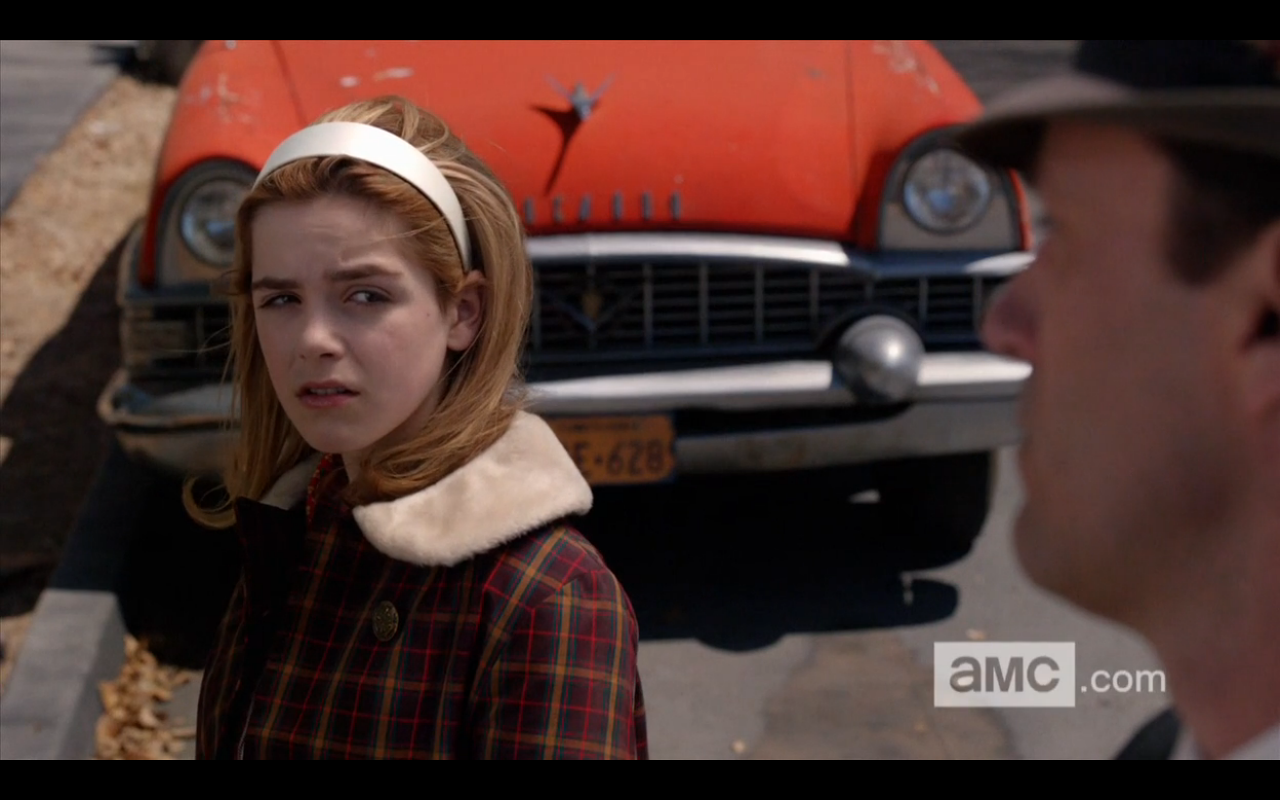
5. The Whorehouse: I’m referring to two scenes from the season’s final episode. The first is Draper’s confession in the Hershey’s meeting, in which follows his fake childhood Hershey bar story with the real one, about how a hooker would give him a Hershey bar if he robbed her trick. Aside from it being a superbly written anecdote, it’s the first time in the history of the show that Draper is truly genuine. He follows this up in the final scene of the season, when he takes his kids to see the house he grew up in, now a dilapidated building in a crumbling neighborhood. His sons are a bit too young to understand, but Sally does. It’s a stark contrast to earlier in the season, when she caught her dad shtupping the neighbor and he tried to feed her some tripe about “comforting her.” The ripple of comprehension that comes across young actress Kiernan Shipka’s face in this scene is brilliant.

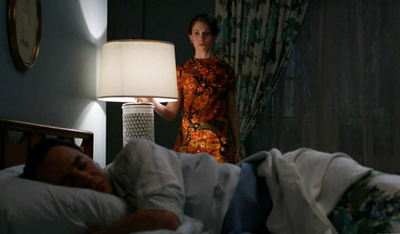
Oh ... this is why you're a whoremonger

Oh … this is why you’re a whoremonger

So, while this season wasn’t as good as the last one, it ended on a high note, giving us some hope for the finale. Until then, how will we entertain ourselves? What’s that you say, AMC? The final season of Breaking Bad starts in August? Oh yes. That’ll do nicely.

Posted in TV | Tagged , | 3 Comments

On the Supreme Court and Self-Contradiction

I’ve always felt that the easiest way to explain the difference between liberals and conservatives in America, at least when it comes to social issues, is that if you think the 1960s (the Civil Rights Movement, protests against the Vietnam War, Free Love, etc.) were good, you’re a liberal; if you don’t, you’re a conservative. It’s reductive, and has nothing to do with economics (you have to go back at least to the New Deal for those arguments), but as a rule of thumb, I think it’s pretty solid. Take me, for example: My mom was a bra-burning anti-war protestor, and my dad went to Woodstock, so it follows that I became a liberal.

I bring this up because the Supreme Court made two decisions this week, one awesome, one asinine, that I think we can understand in part through the prism of the ’60s.

First, there’s the unconscionable decision to overturn section 4 of the Voting Rights Act. I’m no lawyer, and there are lots of places you can go on the internet to get a full analysis, but in short, section 4 put the burden on counties in a few states in the deep south with histories of voter suppression to prove that their current laws weren’t discriminatory. The Justices, in a 5-4 decision that, shockingly, went along party lines, overturned this section, saying that it was punitive for past wrongs these states had committed and that it did not reflect current reality. Saying, in essence, that racism is no longer a problem in America.

This is, of course, an unfathomable pile of horseshit. Calera, Alabama, a city in the very county that was the plaintiff in this case, was guilty just a few years ago of redrawing its districts to remove the only black member of its city council. Immediately after the Court’s ruling yesterday, Texas moved forward with a harsh Voter ID law that would never have survived the scrutiny of the old Voting Rights Act. Voter ID laws are designed to suppress turnout of poor and minority groups–groups that vote for Democrats.

As someone who believes that the ’60s were a good thing, this pisses me off. The Voting Rights Act is arguably the most important piece of legislation of Lyndon Johnson’s Great Society. And, as John Lewis, the longtime Georgia congressman and Civil Rights leader, said, the Court “put a dagger in the heart of the voting rights act.” The people who were beaten and intimidated and who fought so hard against literacy tests and poll taxes just had their biggest victory stripped away. It’s a sudden rollback of 50 years of progress.

If anything, the Supreme Court was right about one thing: It’s not fair that southern states need to bear the burden of the Voting Rights Act. EVERY STATE should have to do it. In the last couple of elections, the governments of major swing states Ohio and Pennsylvania have engaged in Jim Crow-esque behavior to suppress voter turnout among minorities. But our current, impossibly incompetent Congress will never pass a new, more comprehensive law, meaning the Voting Rights Act is effectively dead. This same Congress, by the way, renewed the Voting Rights Act by landslide margins, not that it mattered to the unelected members of the Supreme Court. Next time someone talks about “activist judges,” please point to this decision as yet another piece in a long trail of evidence that Conservative judges are just as “activist,” if not moreso, than liberals. If there are any typos in that last paragraph, it’s because my hands are shaking with rage.

Of course, yesterday the Court turned around and struck down the Defense of Marriage Act, while also electing to not take up the challenge to Proposition 8, thereby upholding a lower court ruling that same-sex marriages could not be banned in California. It’s a victory for marriage equality, and it also meant they got to have a hell of a party in San Francisco yesterday.

I wish I'd been there

I wish I’d been there

The DOMA ruling is much more in the spirit of, well, good, than the VRA ruling. But it’s not a complete victory. As I understand it (and please correct me if I’m wrong), other states can still pass anti-gay marriage laws, and those will have to go through the appeals courts as Prop 8 did. Prop 8 was struck down by San Francisco’s famously liberal 9th Circuit Court. Do you think the conservative 5th Circuit in New Orleans would rule the same way? And remember, the laws that court will be looking at will likely have an extreme conservative bent, as they will have been passed by legislatures from states that can go back to suppressing minority voters because they don’t have the protection of the Voting Rights Act anymore.

In the case of DOMA, the Court saw the way history was going, and rolled with it; in the case of the VRA, the Court attempted to turn back history. So why did the Supreme Court make these two dissonant decisions? Fuck if I know. And I’m not reading the opinions to figure it out, because, seriously, have you ever tried reading a court opinion?

My point is that we can all go ahead and celebrate the societal step forward that the DOMA ruling represents, but the VRA ruling is a reminder that no gain is permanent, and a step backward can come at any time.

Posted in Current Events | Tagged , , , | 4 Comments